Star Trek: Every Starship Enterprise Ranked From WORST To BEST
Welcome to the Sophie's Choice of starship rankings, where we finally settle the age old debate

The USS Enterprise, regardless of what comes after, is one of, if not the, most recognisable names in Sci-Fi. All respect to the Millennium Falcon and the TARDIS, but those opening sequences announcing the ongoing mission of the Enterprise helped solidify its place in pop culture history.
The destruction of the Enterprise in Star Trek III: The Search For Spock couldn't erase the need for another Enterprise to zoom off, leading to the christening of the Enterprise-A. Thus began a lineage of ships, all introduced out of order, expanding on the history of the name.
To rank these ships, we're doing our best to put our own personal preferences aside. Some would have the aircraft carrier as the number one slot, what with its colourful place in Star Trek's history, but this list is confined to starships only. When we're comparing warp cores here, it's only fair!
There will also be an honourable mention, which will hopefully make sense when seen.
Enterprises have arrived, departed, returned, made cameos, and popped up in unusual places through the years. Only one has been constant to every timeline in Trek, though, does that make it a saucer section and nacelles above the rest?
Place your bets now on which of these classic ships will come out on top. Until then, engage warp engines and get ready for the fighting words in the comments.
Make it so!
14. Honourable Mention: XCV-330
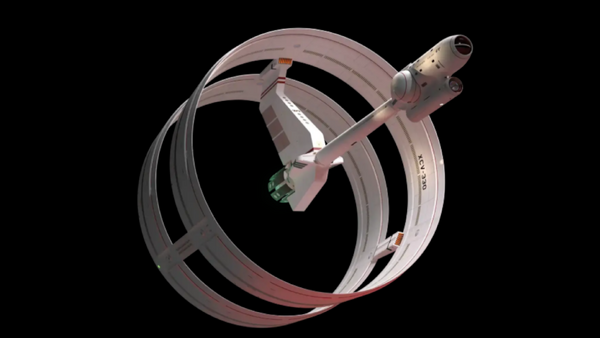
We begin with the XCV-330, affording it an honourable mention because it has yet to be seen on screen. To date, it has appeared in drawings, paintings, and even in the form of a model on a desk, but this ring ship hasn't taken flight in the Star Trek universe.
OTOY have depicted in their short films, though that version was downed on a planet's surface, and the overall ring design served as the inspiration for the USS Beagle in Star Trek: Lower Decks. The ship was based on one of Matt Jefferies' original concepts for the USS Enterprise, but was discarded when the designer felt a studio model wouldn't hold up to the rigours of television.
It returned in The Motion Picture as a backlit transparency on the rec deck, then again in Star Trek: Enterprise. Its portrait hung in the 602 Club on Earth, suggesting it was launched before 2143. In the Kevlin timeline, there is a model of this ship on Admiral Marcus's desk. If the ships are arranged in order of their launch date, then in that universe at least, it departed Earth before the launch of the Phoenix.
The design inspired Doug Drexler when it came to the Vulcan ships on Enterprise, so its legacy lives on through variations and that famous name.
13. NCC-1701-G
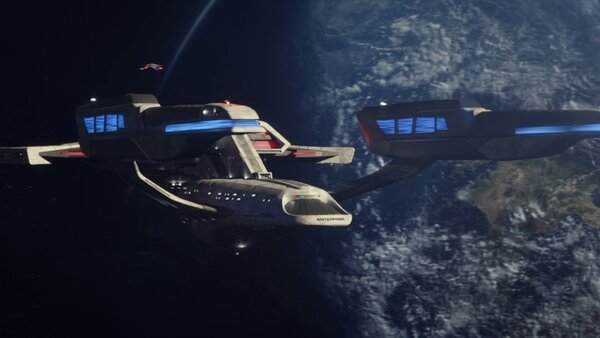
The hastily re-christened Enterprise-G shares a similarity (at least in rumour) to another ship on this list. Like one of its predecessors, it was an active starship before being honoured with the greatest name in the fleet.
The Constitution-III class ship was originally the USS Titan-A. Under the command of Captain Liam Shaw, it was a well-oiled machine, benefiting from an engineer's style. It rarely saw combat or ventured outside of its comfort zone. Perhaps that is why it was in pristine condition when Admiral Picard (retired) and Captain Riker boarded in 2401.
The Enterprise-G, when it was given that new name in honour of the crew of an earlier iteration, was commanded by Captain Seven Of Nine. Though she had served aboard the ship for more than a year by the time of her promotion, it hadn't been an easy service. Shaw, damaged and traumatised from his experiences during the Battle of Wolf 359, kept her at arm's length and refused to address her by her Borg designation.
The legacy of the Enterprise-G, so far, is one of rebirth and renewal. Shaw, like the Titan name itself, was a symbol of a previous time. The physical ship itself may hail from that time, but with Seven in the captain's seat, its future is largely unknown. This may be a quiet period in Star Trek's history in which we now find ourselves, but there remains a ship and a crew with a blank canvas, ready to earn their place in history.
At that point, it will almost definitely see itself higher on this list.
12. NCC-1701-A (Kelvin)
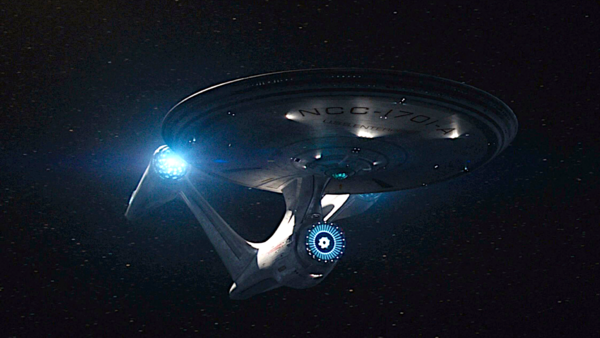
This Enterprise has one of the shortest on-screen depictions of any, though it still has more screen time than the XCV-330 or the Enterprise-J. Sean Hargreaves brought this new vessel to life for the closing scene and end credits of Star Trek Beyond, serving as the final ship (to date) seen in the Kelvin Universe.
Despite its brief appearance, Hargreaves poured many hours of work into the design of this ship. He was given a brief to 'beef up' the perceived weaknesses of Ryan Church's earlier designs, with the neck and nacelle struts taking priority. Having been thinner and slightly tapered in the previous Enterprise, the Enterprise-A featured a more vertical take on both, with a thicker structure for added strength.
Hargreaves took inspiration from Matt Jefferies' original design for the saucer section. He angled the edges to an almost 45-degree angle, avoiding the straight lines present on the previous ship. With some other visual additions to the model, the Enterprise-A was launched from Starbase Yorktown in 2263, under the command of Captain James T. Kirk.
As of writing, the Kelvin timeline seems set to remain a three-film adventure, meaning this version of the Enterprise may be relegated to this short amount of screen time forever. It has appeared in expanded media, including the comic book series, where it may continue to embark on further adventures. For now, while brief, this version of the Enterprise-A's journey was a lovingly crafted, painstakingly realised adaptation of the Constitution-class of that universe.
11. NCC-1701-J
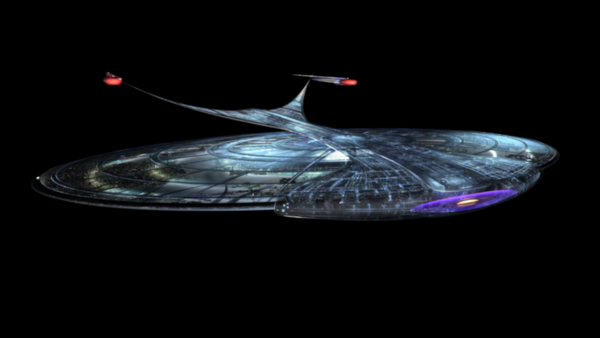
The USS Enterprise NCC-1701-J is one of the outliers on this list. The ship has yet to be seen in full relief on screen, though action has taken place on board the vessel. Azati Prime sees Jonathan Archer transported into the future by Daniels. The captain from the 22nd century is suddenly standing aboard this ship from the 26th.
The Universe-class ship, designed by Doug Drexler, was rendered in high definition by OTOY for The Roddenberry Archive. While it was depicted on a schematic in the episode and featured in the Ships Of The Line calendar series, this version provided the audience with the clearest look yet at this immense starship.
With translucent (possibly transparent) aluminium hulls, the interior of the ship displayed wide-open fields and forests, effectively becoming a moveable colony. The short film 765874: Unification is heavily suggested to take place aboard the Enterprise-J, which would mean sunny skies and peaceful parks aplenty.
This is perhaps the most ambitious project yet, when one considers the fundamental mission of the USS Enterprise. If the ship is designed to seek out new life and new civilisations, and also strange new worlds, then the Enterprise-J is the first in that line of ships to actually bring colonies directly to those new worlds.
Other Enterprises were instrumental in first contact missions, but the Enterprise-J was the one that brought entire civilisations to worlds, helping the Federation expand out into the galaxy.
10. NCC-1701-F

The Odyssey-class Enterprise-F debuted in Star Trek Online long before it made its bright and shining appearance in Võx, the penultimate episode of Star Trek: Picard. Though it arrived just so that it could be decommissioned, it was a beast of a vessel, exiting Spacedock in a grand arc while fireworks exploded in the background. Seemingly minutes later, it was overrun by assimilated crewmembers.
The Enterprise-F first appeared in 2012, defending Deep Space Nine from an attack by the Jem'hadar. From there, it became a playable ship in the game, under the command of Captain Va'Kel Shon. Though they did not make a screen appearance, the Enterprise-F was commanded by Fleet Admiral Elizabeth Shelby during that decommissioning ceremony.
This may be the most overt example of a ship crossing over from a game to the screen. Designed originally by Adam Ihle, then adapted for the show by Thomas Marrone, this version of the Enterprise emphasised the size of the ship. It was longer and beefier than the Sovereign-class that preceded it, though even that didn't leave it free from Changeling interference.
While the sudden and brutal fridging of Shelby taints the screen time of the Enterprise-F, the overall design of the ship was a bold yet clear development in the namesake's lineage. Its true home may be in the games, where it has already been refit and upgraded into the Yorktown-class.
9. NCC-1701 (Kelvin)

The ship that was introduced in Star Trek took care to honour the overall design that originated with Matt Jefferies' idea, yet Ryan Church updated the ship for the 21st century. The nacelles were given a wider, beefier look, while the size of the Constitution-class vessel was vastly increased.
In universe, this was due to the destruction of the USS Kelvin by the Narada, Nero's advanced mining ship from the future. Like its Prime universe counterpart, this Enterprise was the flagship of Starfleet, though it was captained first by Christopher Pike, not Robert April.
The increased size (roughly that of a Galaxy-class starship) caused some frustration among long-term fans of the franchise. While William Shatner praised the decision to retain the general shape of the original ship, others decried the decision to enlarge everything for the big screen.
Star Trek and Star Trek Into Darkness share the same version of this ship with minimal changes, while Star Trek Beyond saw a refit. Designer Sean Hargreaves reduced the nacelles in size and slimmed the ship down. Arguably, this led to its easy destruction by Krall and his forces, but that's hardly Sean's fault now, is it?
This Enterprise may have survived longer than expected underwater, though it was its bright and shiny interior that may be the most recognisable aspect. When comparing the ship to an Apple store, it's easy to forget the beautifully detailed screens and consoles, as well as the sleek and functional designs put in place.
It's the Enterprise, Jim, but not as we know it.
8. NCC-1701 (SNW)

The reimagined Enterprise that made its debut in Will You Take My Hand? was a team effort. Outgoing production designer Todd Cherniawsky tasked John Eaves, Scott Schneider and William Budge with bringing an earlier version of Kirk's ship to the screen. When Cherniawsky departed the show, Tamara Deverell took over.
This version of the ship aligns more closely with Doug Drexler's ideas for the NX-01, featuring a more metallic exterior. The nacelles, while perpendicular on Jefferies' design, are swept back here, more closely resembling the ship first seen in Star Trek: The Motion Picture.
John Eaves imagined a ship that was several refits away from the ship that was made famous by The Original Series, while remaining visually recognisable as the same ship. As it first appeared in Star Trek: Discovery, it had to resemble contemporary ships (such as the Crossfield and Walker classes) without veering too far from familiar territory.
The result successfully blended the old and new aesthetic of the shows. The ship underwent minor revisions when Strange New Worlds was picked up for a series, and, as of the writing of this article, it remains to be seen if this Enterprise will undergo further refits before that show comes to an end.
A detail that was added to the lore in Those Old Scientists directly links this ship with the NX-01, in that the first piece of the new Enterprise contains a piece of the last. While perhaps not as directly connected as the USS Titan-A and the Enterprise-G, this subtle addition to continuity further cements the NX class in Star Trek's history, now updated with this version of the Constitution class.
7. NCC-1701-C

The Enterprise-C was designed by Rick Sternbach and built by Gregory Jein for the episode Yesterday's Enterprise. The original concept, depicted in gold on the wall of the Enterprise-D's observation lounge, was designed by Andrew Probert. The ship was seen as a natural evolution between the Excelsior and Galaxy-class models.
The original drive section was more angular, with smoother lines, closer to the Excelsior-class drive section. However, the time frame on Yesterday's Enterprise wouldn't permit the creation of that ship, so Sternbach settled on the design eventually seen on screen.
While the studio model appeared in Data's Day (redesigned slightly and renamed the USS Zhukov) and Emissary (as the USS Yamaguchi), stock footage of the Enterprise-C served as the USS Excalibur in Redemption Part 2.
The ship was created to be destroyed, though it broke several barriers before it met its final fate. Yesterday's Enterprise managed to combine different eras of Star Trek, depict the first female captain of an Enterprise (in the form of Tricia O'Neil's Rachel Garrett), and fix a wrong in the death of Tasha Yar. While her Prime counterpart's death in Skin Of Evil was quick, brutal, and meaningless, Yar's death here manages to save millions of lives - even if it does create a slight hiccup in the form of the Romulan Sela.
6. NX-01

The NX class was introduced in the pilot episode of Enterprise, Broken Bow. Roughly resembling Alex Jaeger's Akira-class design, it was a much smaller Enterprise than seen previously, with a metallic, azteced hull pattern. Most of the familiar design was present, including a saucer section and two warp nacelles. Lacking a secondary hull, the deflector dish sat at the front of the saucer.
Had Star Trek: Enterprise been granted a fifth season, designer Doug Drexler planned to add a secondary hull as part of an overall refit of the ship. While this version of Enterprise never appeared on that show, a model of the updated version, produced by Eaglemoss, was included in Star Trek: Picard's second season. Then, in 2401, the refit version finally appeared on screen, docked at the Fleet Museum at Athan Prime.
The NX-class has the distinction of being present in both the Prime timeline and the Kelvin timeline, making it, along with the XCV-330, an anchor point in the history of the Enterprise. Its pared-back design, resembling the interior of a submarine rather than the cruise ships that would follow, perfectly depicted the earliest years of Starfleet's exploration program. Launched in the 2150s, it travelled beyond the Sol System barely a century after the Vulcans made first contact with humanity.
While the ship took a beating during its lifetime, the launch of the NX-02 Columbia proved that the design was solid. It also happens to look delightful in the middle of a snowglobe as well.
5. NCC-1701-B

The Enterprise-B appears in the opening scenes of Star Trek: Generations, depicting an upgraded version of the USS Excelsior, designed for Star Trek III: The Search For Spock by Bill George. Rick Berman requested an update of the original model after it had appeared in four consecutive films, as well as The Next Generation. Coupled with the plan to damage the ship during its escape from the Nexus, the design began to take shape.
John Eaves and Herman Zimmermann added additional impulse engines to the saucer section, as well as struts to the warp nacelles. The biggest change, other than the colour palette, was the fins that were added to the drive section. Though these were added to protect the filming model underneath, the glue used did, in fact, damage that original model, so they were left in place when filming was completed.
The Enterprise-B, on screen, was a combination of the filming model and a CGI render for some of its scenes in the Nexus. Though this ship only appeared once, the model was repainted and later became the USS Lakota in the Deep Space Nine episode Paradise Lost.
4. NCC-1701 (Matt Jefferies)
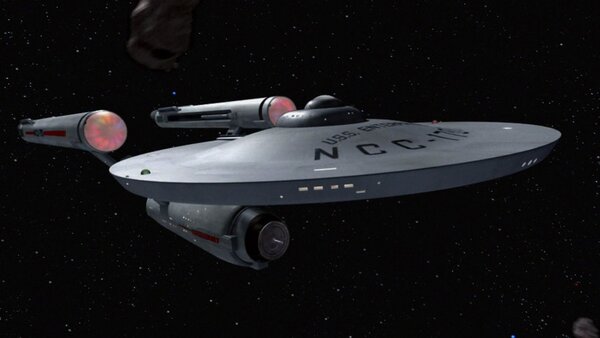
When Gene Roddenberry created Star Trek, he originally pitched a ship named the SS Yorktown. This ship would contain a crew as diverse as the planet on which Gene lived. It would, in essence, be Starship Earth. That ship morphed from Yorktown to Enterprise and, with a design from Matt Jefferies, the flight into the final frontier began to take shape.
Though there have been several variations on the theme, the design that Jefferies delivered in 1964 for The Cage has remained the blueprint for almost everything that has followed. The saucer section, those warp nacelles, and that cylindrical secondary hull are as much a part of pop culture now as any other design one cares to mention.
Stories arose of the ship being presented upside down, of spherical hulls, and of ringed propulsion systems (all of which have both merit and would later appear in various forms), but the winning design has remained one of the enduring configurations in Star Trek. When the ship was refit for the films, it was largely unchanged, though more surface details were added.
The filming model for the Enterprise now resides in the Smithsonian's National Air and Space Museum in Washington, D.C., and is a beautiful sight to behold.
3. NCC-1701-E

The Enterprise-E, designed by John Eaves for Star Trek: First Contact, was a departure from the Galaxy-class before it. While her predecessor was designed and built for diplomacy, this was a ship that was far more militaristic. The arrival of the Borg may have justified its design, yet Starfleet was clearly going in a new direction.
The Battle of Sector 001 was an explosive way to highlight the stakes of the film, with the size of this Enterprise in full relief as it zoomed past the USS Defiant. Surrounded by an array of other Starfleet vessels, including several designed by Alex Jaeger specifically for this film, the Enterprise-E quickly became a firm fan favourite.
It was remodelled slightly between films, appearing again in Star Trek: Insurrection and Star Trek: Nemesis. Though it spent years confined to the films, it finally made an appearance (in full) in Star Trek: Prodigy. Now, we must also say that it depends on the angle. The saucer section of the USS Sovereign seemed to have 'borrowed' the nacelles from the Enterprise-E in Supernova, Part 2!
It also appeared, in slightly better condition, in The New Next Generation, taking up a position alongside the USS Cerritos at Starbase 80. While those examples cover the exterior of the ship, the interior appeared in one episode of Star Trek: Voyager, popping up on a phone call from Troi to Barclay.
This ship sits high on many 'Best Of' lists - and for good reason. It may be a bit of a departure from the utopian hope for Roddenberry's future, but it was undeniably cool. We can only hope that, by 2401, it was safely ensconsed in a big glass case, possibly as a museum, regardless of whether or not it was Worf's fault.
2. NCC-1701/A
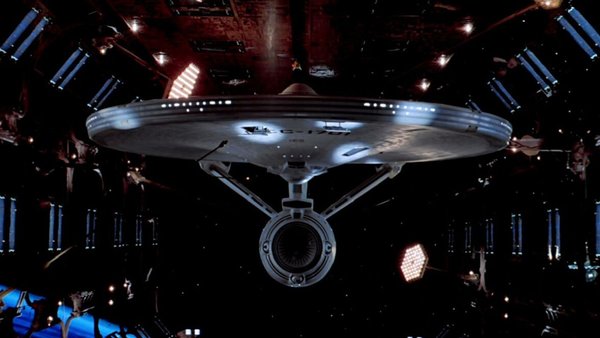
When Star Trek moved from the small screen to theatres, the original Enterprise underwent a number of conceptual refits. First, the ship was given more surface detail. While television screens of the 1960s were better suited to smooth ships, as evidenced in the Enterprise, the Romulan Bird of Prey, and the Klingon D-7 Battlecruiser.
For The Motion Picture, while the Enterprise would receive an overhaul, the Klingon K'T'inga class was a highly detailed upgrade of the D-7. The theatrical age had reached Star Trek's filming models. A proposed Phase II series resulted in Jefferies doing a slight redesign to the original idea. The nacelles were changed from cylindrical to rectangular, now swept back rather than arching straight out from the hull. The saucer section was largely unchanged.
When Phase II became a film (thank you Close Encounters Of The Third Kind and Star Wars), a team that included Joe Jennings, Richard Taylor, Mike Minor, Jim Dow, Don Loos, Douglas Trumbull, Harold Michelson, and Andrew Probert were all involved in bringing together the result that is seen in drydock and beyond.
This version of the Enterprise is this writer's clear favourite of the bunch, a truly beautiful upgrade to what came before, and one so enduring that the filming model was reused as the subsequent Enterprise as well. Both the NCC-1701 and 1701-A are symbols of that era of Star Trek where the final frontier was a little wilder, a little more lawless, and delivered a lot of beauty shots that we still enjoy today.
We may not know what God needs with a starship, but we can certainly understand why they'd pick this one.
1. NCC-1701-D

The Galaxy-class USS Enterprise NCC-1701-D was designed by Andrew Probert for Encounter At Farpoint, descending from the top of the screen to display its sheer size. This was a new beast for a new era of Star Trek, and it quickly established itself as one of the most recognisable ships in the entire franchise.
The Enterprise-D was effectively a floating town, equipped with hundreds of cabins for travelling dignitaries, powerful armaments to protect the Federation, and a saucer section that separated to provide an escape for most of the crew during battle. Though it was far from invulnerable, it was nothing if not enduring, so much so that it was the first Enterprise to die and come back to life without the aid of time travel.
The drive section of the ship was destroyed by the Duras Sisters in Star Trek: Generations, resulting in an explosion that saw the saucer section crashland on Veridian III. It was recovered and brought to the Starfleet Fleet Museum at Athan Prime, where over the course of two decades, Commodore Geordi LaForge lovingly restored it to something of its former glory.
After hundreds of missions, the Enterprise-D took one last flight to Jupiter, did battle with a Borg Cube, rescued her former crew, and flew alongside the USS Titan-A into the sunset, before finally taking pride of place at the museum, alongside two former Enterprises.
Simply put, there is a reason that this was the Enterprise brought back for Star Trek: Picard's final season. Its continuing mission was to explore strange new worlds, and to seek out new life and new civilisations. Having more than achieved its mission, it is forever placed in the collective memory as one of, if not the, greatest ships in Star Trek and Science Fiction in general.