WandaVision MCU Explained: Who Is Agatha Harkness Really?
WandaVision's supposed antagonist wasn't always the villain in the comics.
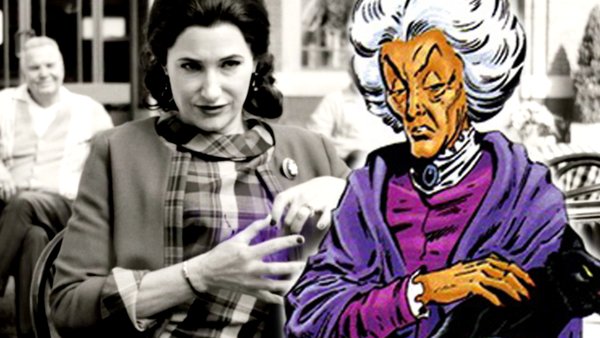
Although it would be a huge disservice to label WandaVision as a great mystery and nothing else (it's also a superb examination of trauma, loss and guilt, after all), it's difficult to ignore just how well the series has kept audiences guessing and in turn how it's cultivated online fan discussion in a way only something from the MCU could.
The series is now approaching its endgame however. Episode seven (or "Breaking the Fourth Wall"), finally unveiled the big mystery surrounding Kathryn Hahn's Agnes, who is really the witch Agatha Harkness, and in doing so recontextualised Wanda's experiences in Westview thus far.
Not fully of course - it's clear Wanda has created the Hex and that she's been powerful enough to bend reality to her will - but for those who had suspicions that someone was benefitting from her trauma and that Wanda was still being manipulated in one way or another by a party or parties unknown (i.e., me), there will have undoubtedly been a small sense of vindication that accompanied the reveal.

It's not as if fans didn't have their doubts as to Agnes' true identity from the off either. Many had Hahn nailed on to be revealed as Agatha at some point, but there are still plenty more who may not be familiar with the character, her importance to Scarlet Witch in the comics, or why her history as a mentor to Wanda may yet lend doubt to the idea that it really was Agatha all along.
If WandaVision should've taught viewers anything, it's that jumping the gun and grasping at conclusions straight away is never a good idea. There are still two episodes left, and there's still plenty of mystery left to be revealed, so let's see what diving into Agatha Harkness' comics history may yet reveal about WandaVision's fast approaching finale...
Agatha Harkness In The Comics - Sorceress, Mentor, And Ally
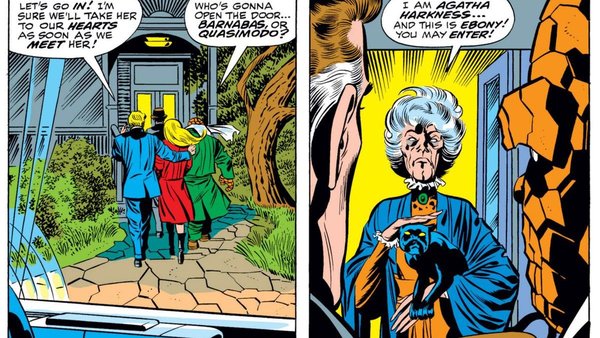
The Marvel Cinematic Universe has never been one to shirk playing fast and loose with the source material.
While undoubtedly faithful to the spirit and ethos of most of the characters (unless you're name's Peter Parker, in which case we'll just rip off Miles Morales and pretend like we didn't), the MCU has often put its own spin on pre-established Marvel characters and groups, most notably changing the Skrulls from a tyrannical alien race of shapeshifters into a group of space refugees in Captain Marvel. So there's precedent for them to do something similarly drastic with Agatha in WandaVision too.
Regardless of however Marvel chooses to diverge from the comics when it comes to Agatha's depiction in WandaVision, they still form the character's foundation and you can expect to see different elements from them incorporated over the course of the coming episodes.
In the comics, Agatha Harkness was a witch whose history dates back to the fall of Atlantis (which needless to say was a long time ago). She later settled in Salem during the burgeoning days of America's colonisation, and was, yes, involved in the infamous witch trials that took place there. Agatha eventually left the area and founded a new community of magic users in a town called New Salem (later Colorado), and even had a son called Nicholas Scratch. (It's still unclear whether or not Agatha turned her son into Scratchy the rabbit in WandaVision, or whether it's just the show paying homage to the comics, but the more you know, you know?)
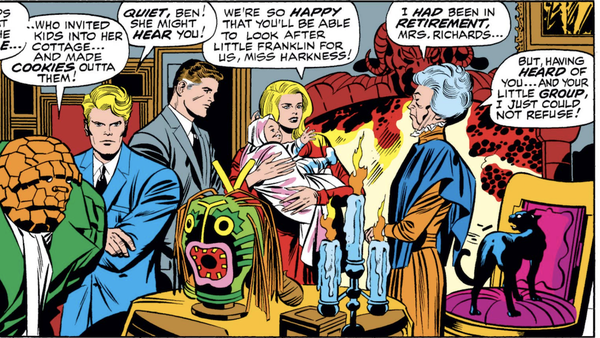
Much of Agatha's backstory covered here was established in books that released years after her original debut, which came in the pages of Fantastic Four #94 in 1970, courtesy of Stan Lee and Jack Kirby. She was a retired tutor who agreed to watch over the Richards' newborn son, Franklin, and in the same issue uses her supernatural powers to fend off attacks from the Frightful Four, who The Thing accidentally awakens.
Agatha became a mainstay of the Fantastic Four's comics for quite a while following her first appearance, mentoring Franklin and assisting Mister Fantastic and co. with all sorts of threats, and was a key ally of the team. Harkness didn't have an ulterior motive, and while she didn't don a cape or costume, she was essentially one of the first supernatural heroes of the Marvel Age of comics.
[Article continues on next page...]
How Agatha Ties Together Two Of Wanda's Biggest Story Arcs
Of course, Agatha's connection to the Fantastic Four in the context of WandaVision is, for the time being, immaterial. The point though is that Agatha was far from the master manipulator presented in the series' seventh episode, and that she was actually an ancient and wise sorceress who used her abilities to help some of Marvel's most powerful and important heroes, which is how she came to find Wanda Maximoff.
Agatha and Wanda first crossed paths in The Avengers and later appeared in Vision and the Scarlet Witch, a key inspiration for WandaVision and the first comic to focus on the Avengers couple outside of the main series. It's the same series that introduced Wanda's twin sons, Tommy and Billy, and it's also the same one that brought Mephisto into the equation.
Needless to say, Vision and the Scarlet Witch has become a topic of key importance for fans desperate to unravel the mystery of Westview, especially in relation to Wanda's twins and their (initially) tragic fate, but how does Agatha factor into all of it?
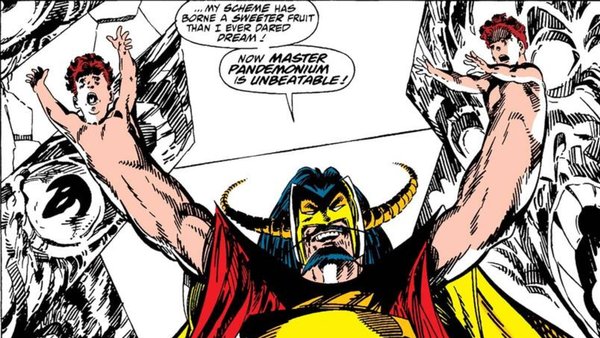
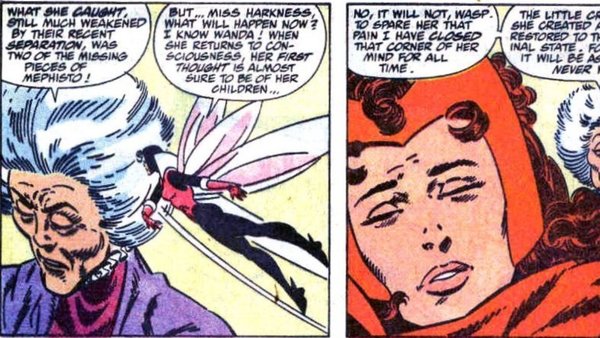
In that series, Wanda unwittingly uses a fragment of Mephisto's soul to create her and Vision's two children, following an encounter with the Salem Seven, who had seemingly executed Harkness months earlier. Agatha soon returns though, and informs Wanda of Mephisto's involvement. Another villain, Master Pandemonium, briefly absorbs Tommy and Billy in a nightmarish sequence where he wears them like finger-puppets (big oof), only for Mephisto to emerge and claim the children, thus erasing them from reality.
Agatha, not wanting Wanda to have to deal with the trauma such an event would understandably cause, wipes her memory of her children, who were eventually reincarnated and reunited with their mother, but not for a further three decades, by which point Wanda had murdered Agatha for her initial deception during one of her more unstable periods.
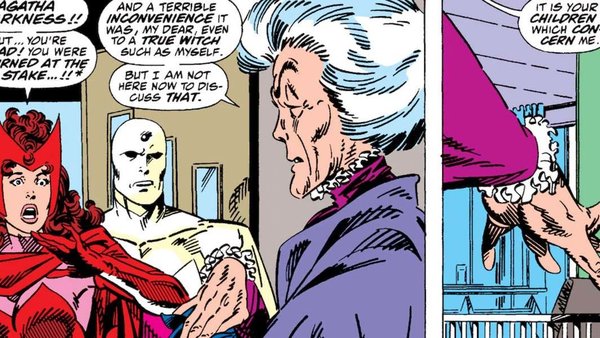
But there's more too, and it's of just as much importance as Vision and the Scarlet Witch. Long before Wanda would eventually rediscover her children and Agatha's mind wipe (plus the unpleasantness involving her death), she and Harkness travelled to New England in a search for answers regarding Wanda's visions of a dark version of herself terrorising an alternate reality.
The events take place in Andy Lanning and Dan Abnett's Scarlet Witch comic, and it's the series that also reveals Wanda to be a Nexus Being - a figure of key importance in the Marvel multiverse. Specifically, Wanda discovers this by reading from the Necronomicon, before doing battle with Master Pandemonium and then her evil self she'd envisioned earlier in the run.
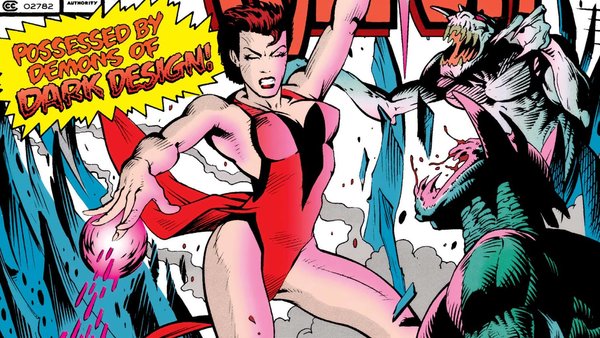
The throughline through both of these pivotal moments in Scarlet Witch's history is Agatha Harkness. She's there when Wanda loses her children to Mephisto, and she's also the mentor who helps the Avenger realise her place in the multiverse as a Nexus Being. Given the nods towards both the Nexus and the Necronomicon in episode seven, plus the focus on the multiverse in MCU phase four, it wouldn't be disingenuous to assume that Marvel are adapting both of these moments into WandaVision's conclusion (but with their own twist obviously).
It's also important to remember that Wanda and Agnes' relationship isn't wholly positive, and by making Harkness the villain of WandaVision, it could be argued that, in a way, Marvel are acknowledging how messed up it was for her to take away Wanda's choice to confront her own trauma by wiping her memory - good intentions or not.
[Article concludes on next page...]
Agatha Might Not Be WandaVision's True Villain

Before getting to the end of this, I do want to reiterate that this isn't me banging the iT wAs MePhIsTo AlL aLoNg drum to death, or that Marvel are going to do a beat-for-beat adaptation of both Vision and the Scarlet Witch AND Wanda's 1994 solo series, because clearly neither of those things are going to happen.
WandaVision, like all MCU adaptations, is taking inspiration from different arcs and also has the task of laying the groundwork for the multiverse to become a major force in phase four. The aforementioned comics lend themselves well to exploring Wanda's trauma while also giving her a new role onscreen, but they'll in no way play out exactly as they did on the page.
It's all worth reiterating that Marvel could well have chosen to make Agatha the villain and not Wanda's mentor, and that she stands to benefit from the creation of Scarlet Witch's twins because she has her own designs on the multiverse.

There are still two episodes to go though, and the "Agatha all along" number could very well have been done tongue-in-cheek. It wouldn't even be the first time the series has pulled that very trick; episode three ended with Monica exclaiming "it's all Wanda", but we now know for certain that it wasn't.
There's still more to this story that we don't know, and whether it could well be that someone like Mephisto, Nightmare or Master Pandemonium is involved. There's also the matter of Agatha's grim reaper broach, which could be a sneaky callback to Vision's own arch nemesis of the same name. It certainly feels like something is waiting in the wings. It just remains to be seen what that thing is.
Regardless of whatever comes next, though, it's worth keeping Agatha's comics history in mind. This regular ally and mentor to Scarlet Witch in the comics may yet be the series' big bad, but as with everything in WandaVision, few things are regularly as they seem.
Watch Next
MCU Quiz: How Well Do You Really Know Scarlet Witch?
