10 Despicable Double Standards We See In WWE
Turns out it pays to be a part-timer, or to have the name McMahon on your birth certificate.

In 2015, Seth Rollins' Curb Stomp finisher was quietly phased out after it was perceived to be too violent, amidst concerns that kids might attempt it on their mates. These days, rather than stomping people’s faces on the ground, he instead now bashes them in the chin with his knee, which is apparently much more acceptable.
Granted, it’s slightly more difficult to emulate, but the whole thing does seem like a bit of a contradiction. Still, it’s arguably a relatively pedantic one, given some of the other contrasting principles observed in WWE.
From onscreen etiquette to public relations stances, including a number of notably weightier issues, it seems there’s often one rule for certain folk and another for everybody else. And unlike the case of Rollins’ curb stomp, very few of them can be described as pedantic, especially those that relate to incidents in which employees have been injured or lost their jobs, or when real-life transgressions have been so blatantly overlooked.
Here, we delve into ten of the more noteworthy double standards that we've previously seen in WWE and that have somehow, in certain circumstances, almost been normalised...
10. Wellness Testing

When Brock Lesnar failed a USADA drugs test while training for his UFC return last year, the Nevada State Athletic Commission slapped him with a $250,000 fine and a one-year suspension from competition.
Yet, there was no such punishment from WWE.
That’s because, somewhere down the line, WWE had quietly adjusted its Wellness Policy to apply exclusively to full-time performers. The argument was that, as a part-time talent, Lesnar was exempt from Wellness testing and therefore no disciplinary action was required. Which, by the way, means that the likes of the Rock, Triple H and the Undertaker are presumably also exempt from testing.
Lesnar went on to headline and win at that year’s SummerSlam with no hint of his push being impeded. Meanwhile, had a full-time performer been flagged for the same offence – and assuming the substance was on WWE’s blacklist – they’d be facing a fine, suspension and a strike against their name, three of which would see them lose their job.
What makes this worse is that part-timers are invariably already the bigger stars, and yet here they are allowed to take supplements - not that they do, of course not! - to further differentiate themselves from the pack.
9. Bleeding

Another double standard that's involved Brock Lesnar in the past relates to the company’s policy on bleeding on camera.
In 2008, WWE implemented a blanket ban on bleeding in the ring, with Shawn Michaels since revealing that the "no colour" policy came into play after he bled a little too much during his match with Chris Jericho at the Great American Bash.
Strangely enough, though, matches involving Lesnar invariably seem to feature the red stuff. In his first match back, he left John Cena a bloody mess, and subsequent meetings with Roman Reigns at WrestleMania 31 and the controversial SummerSlam clash with Randy Orton also saw his opponents busted open.
And not only that, but at least one of those instances Lesnar has been openly instructed by management to intentionally draw blood the hard way in order to circumvent the blading ban.
Once again, it seems being a part-time, special attraction-type performer comes with its own additional set of benefits and, not for the first time, there's a degree of finger-pointing that could be aimed at company higher-ups.
8. Blading

Similar to its rule on bleeding, WWE also has a ban on blading.
Though the two often come hand-in-hand, the distinction is that the latter is often far more intentional. Bleeding can happen accidentally or, as we saw at SummerSlam 2016, without the use of an actual blade. Cutting yourself open with a razor, on the other hand, is slightly more difficult to justify as an accident.
Which is why it was so surprising when Vince McMahon, the company chairman, seemingly bladed on SmackDown in September during a segment with Kevin Owens.
Granted, he didn’t do it on camera, but the general consensus was that McMahon bladed ahead of time, sealed the wound but had Owens re-open it when shooting the angle on television. And though the official company line was that no blade was involved, the pattern of the cut didn’t look like the kind you’d expect to get from a headbutt.
Assuming a blade was indeed involved, for the head honcho to be doing this seems a little rich, given that he infamously fined Batista $100,000 for blading back in 2008.
7. Swearing

In November 2015, Brad Maddox was released from WWE for reasons that weren't quite clear at the time. Though that soon changed when Maddox gave an interview the following month in Rolling Stone magazine, in which he revealed he’d been let go for swearing during a dark segment.
When asked what led to his release, Maddox explained, "I called the Indianapolis crowd "pricks." I didn't think anything of it. That's never been a bad word to me. I didn't think it was inappropriate. Vince [McMahon] was watching and did not like it. That was pretty much the reason."
So again, it seems rather unfair that a few months later, Vince himself was dropping an F-bomb live on Monday Night Raw.
Vince told his son Shane "I can’t wait to give you one last f***ing beating," although the expletive was edited off the show. Still, later that very same night, Paul Heyman used the term "p*ssed off" while in August 2016, Brock Lesnar told Heath Slater "I don’t give a s**t about your kids," so it's not just McMahon who's been running his mouth.
Not for the first time, it seems there’s one rule for the top guys, and another for everyone else.
6. Scripting

These days, members of the roster seem somewhat shackled by the strictness of the scripting of the product – unless your name’s the Rock, that is.
Perhaps it has something to do with his Hollywood credentials, but whenever he’s back in the frame, the Rock seems to get a free pass when it comes to deviating from the script. In January 2016, he improvised in singling out a group of fans in the front row – one of whom was dressed as the blacklisted Hulk Hogan – and then in February of this year, he was said to have phoned CM Punk, another guy out of favour with the company, after Raw went off the air.
Meanwhile, everyone else has to follow a script that often makes them sound like robots, using clunky, verbose language that scarcely resembles real-life speech.
In fairness to the Rock, though, his digressions aren’t necessarily a bad thing. Here, it seems less of an issue with double-standards in the scripting, and more of an issue that there’s such rigourous scripting in the first place.
5. Booking

Much like with its scripting, WWE often shoots itself in the foot when it comes to booking habits, while there’s also a tendency to play favourites.
The 50-50, even-steven booking patterns are often more of a hindrance than a help, and it affects the majority of the roster. Talented guys like Finn Bálor and Bray Wyatt are pencilled in to trade wins back-and-forth in months-long programmes that seem to tread water, making for a formula that rarely serves to get either guy over.
Plus, the overriding focus is all very pro-McMahon.
Unless it’s at WrestleMania, Stephanie McMahon rarely, if ever, gets her comeuppance. That, despite the fact that she used to slap around anyone and everyone who crossed her path on weekly television. Triple H, meanwhile, is regularly inserted into the main event angles – as we saw recently at Survivor Series – while Shane McMahon’s been lucky enough to face AJ Styles and the Undertaker at back-to-back WrestleManias.
That perceived favouritism, combined with the 50-50 booking elsewhere on the card, feels like a major double-standard - and makes it even more difficult for the non-McMahons to establish themselves as major players.
4. Intellectual Property

A few months back in September, WWE made headlines when the company issued the Young Bucks with a cease and desist letter.
The action came after the indie stars, along with their fellow Bullet Club members, had "invaded" an episode of Raw and filmed it for their YouTube channel Being the Elite. They hadn’t entered the building or anything, but evidently, the stunt was enough to tick WWE off, with the company responding by demanding the group stop using the "Too Sweet" hand gesture - as well as any other intellectual property that was purported to belong to WWE.
On the one hand, you can see the company’s point, though on the other, it’s difficult to pin down who a hand gesture actually belongs too…
Either way, WWE’s position is starting to look a little contradictory after clips recently surfaced of Corey Graves referring to the Meltzer Driver – a move that belongs to the Young Bucks – on the WWE 2K18 video game.
Perhaps the term "Meltzer Driver" hasn’t been copyrighted by the Bucks, but even so, there’s more than a tinge of hypocrisy about this one.
3. Bullying

Despite preaching its anti-bullying stance with the Be A STAR initiative, WWE has often churned out programming that seems to contravene that message.
Perhaps the most infamous example took place on the June 11, 2012, showing of Raw, in which company chairman Vince McMahon mocked Jim Ross’ Bell’s Palsy.
Over the course of his career, Ross has been afflicted by three separate bouts of the condition, symptoms of which include an inability to control one’s facial muscles. He also happens to be one of the company’s most valued employees - yet here was his boss appearing to ridicule him, pulling distorted faces and impersonating the announcer, live on national television.
Some may argue that this was simply McMahon’s onscreen character performing, but even so it was in very bad taste, completely flying in the face of that anti-bullying message.
It also seems this culture has occasionally bled through into backstage matters, with Mauro Ranallo – a known sufferer of bipolar disorder – recently taking leave from the company amidst rumours of bullying from fellow employees.
Suddenly, this whole Be A STAR campaign is starting to look like little more than a PR exercise...
2. Dealing With Arrests

In August 2012, Ariane Andrew – better known in WWE as Cameron – was arrested for driving under the influence and allegedly trying to bribe an officer. The following year, Jack Swagger got himself into similar bother when he was charged with DUI as well as speeding and marijuana possession.
Neither talent was fired, and though Cameron was handed a two-week suspension, Swagger went on to compete for the World Heavyweight Championship a few weeks later at WrestleMania.
Compare that with the fortunes of Emma, who was briefly fired in 2014 over a shoplifting incident, and it seems a little unfair.
Emma was arrested on Jun 30 in Hartford, CT, for allegedly stealing an iPad case worth less than $22. Within hours, WWE had released her, though she was soon rehired after her lawyer put the incident down to an innocent mistake at the self-service checkout whereby Emma simply forgot to pay for the item.
Granted, WWE made amends by reinstating Emma, but the fact that they’d been willing to terminate her contract in the first place seems rash to say the least, given the wider context.
1. Rewriting History
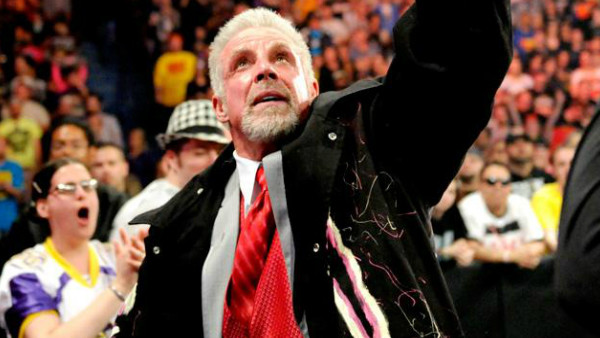
WWE has a knack of rewriting history to fit its own narrative, and it’s a knack that often produces one of the biggest double-standard of all.
On the one hand, we’ve seen Hulk Hogan blackballed from the company following a 2015 scandal in which he was revealed to have made racist and homophobic remarks in his now-infamous leaked sex tape. And on the other, we have WWE lionising the late Ultimate Warrior, despite the fact that he himself had made a series of controversial remarks of his own.
Warrior’s comments included "queering don’t make the world work," his suggestion that the destruction in New Orleans following Hurricane Katrina was no big loss, as well as his conclusion that Heath Ledger was "a great father" who "did what it took to kill himself" and remove the "negative influence" from his own child’s life.
Not that the intention here is to vilify the now-deceased Warrior for no reason, nor is it to suggest that Hogan doesn’t deserve to be blackballed. Rather, the issue in this situation revolves around the way the company picks and chooses, and has turned a blind eye to Warrior’s hate speech.
And never was that selectiveness more apparent than in October of this year, when Warrior – who once said that Bobby Heenan’s throat cancer was "karma" – was used as an emblem for a WWE-backed cancer awareness campaign.