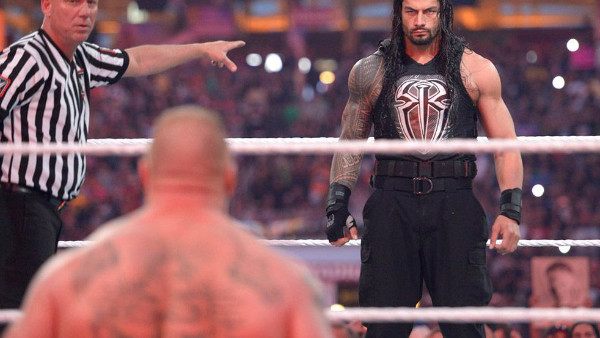
There are "wrestlers," there are "superstars" and then there are "epic, once-in-a-lifetime competitors." For most of The Undertaker's career (1990-1997 or so), we knew he was a "superstar," but we had no idea if he had the ability to eclipse the standard set by those like Ric Flair and Hulk Hogan, who knew how to make a main event match into an epic in-ring confrontation at every turn. Somewhere between the introduction of Kane, tossing Mick Foley off the side of a cage, riding his motorcycle to the ring at Wrestlemania X-7 and having two great matches with Shawn Michaels and Triple H, he's there. Comparatively, one can argue that ever since Brock Lesnar arrived in WWE in 2002, he's been the most epic performer that the company's seen in the past 15 years. Similar to the Undertaker as described above, careers are best as stories told in moments. Any moment that The Undertaker has had, Brock Lesnar has had in a different, yet just as impressive way. Brock beat an Olympic gold medalist at Wrestlemania, returned to WWE after winning the UFC Heavyweight Championship, F5'ed the Big Show and Vince McMahon, retired Hulk Hogan, broken many performer's arms (in storyline) with the kimura and unleashed one of the most incredible one-sided beatings in wrestling history on John Cena. In accomplishing in nine years what it took The Undertaker 25 to do, it's entirely plausible that in assuming an "Undertaker"-like role in WWE's future, Brock will continue to standard started by Andre the Giant that the Undertaker improved.
Besides having been an independent professional wrestling manager for a decade, Marcus Dowling is a Washington, DC-based writer who has contributed to a plethora of online and print magazines and newspapers writing about music and popular culture over the past 15 years.