8 Times Real-World CHAOS Derailed WWE
Even the market leader has been forced to bow to real-world pressures from time to time.

“Card subject to change.” It’s a ubiquitous phrase that appears on wrestling promotional material to warn audiences that the advertised matches and appearances might not necessarily take place as promised. It gives the company a bit of wiggle room if there are injuries, scheduling snafus, or other reasons to not deliver the card being promoted.
WWE has changed its advertised card many, many times through the years, but it has mostly adhered to the “show must go on” adage, sometimes to diabolical and morbid lengths. Over the Edge in 1999 – where Owen Hart tragically died due to a stunt gone wrong – is perhaps the most notorious example of WWF/E continuing forward despite a real-world disaster.
More recently, Crown Jewel 2018 stands out as an example of WWE barreling through controversy and roadblocks to hold an event. The assassination of a United States-based journalist by the Kingdom of Saudi Arabia a month before the Saudi PLE threatened to cancel the show, but it ultimately moved ahead.
This year’s edition of Crown Jewel similarly is facing questions of whether it will go off as planned. Saudi Arabia is involved in an ongoing conflict, with the PLE host city facing attacks to its airport and other structures. The United States government has issued a travel advisory urging Americans to reconsider travel, but WWE remains (as of the publishing of this article) committed to holding Crown Jewel in Riyadh.
Despite these examples, there have been times when the real world has intervened and prevented WWE from following through on its planned events. Whether it’s poor ticket sales, an act of terrorism, a global pandemic, or Mother Nature, the sports entertainment leader has seen its plans interrupted by life and thrown in a blender set to frappé.
Let’s take a look at some notable stories of WWE bowing to the chaos…
8. The Steroid Trials Change The Course Of WWF
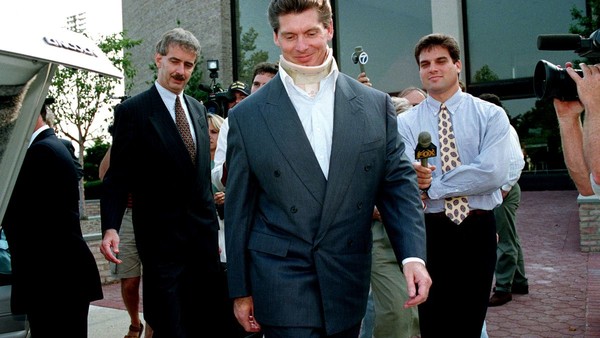
It’s hard to overstate the impact that Vince McMahon being on trial for obtaining and distributing steroids had on the WWF in the 1990s, even though the chairman ultimately emerged victorious from the federal suit.
While Vince battled federal prosecutors in U.S. District Court, his company underwent a dramatic shift in presentation. Many of WWF’s larger-than-life muscle men of the '80s were phased out, and the federation began pushing smaller, more athletic wrestlers at the top of the card.
Gone were Hulk Hogan, Randy “Macho Man” Savage, and the Ultimate Warrior. Replacing these cartoonish men chiseled from granite were wrestlers with comparatively smaller physiques, like Bret “Hitman” Hart, Shawn Michaels, and Razor Ramon.
The New Generation was WWF’s way of turning the page from the He-Man behemoths of the '80s and early '90s, even while the steroid trials were ongoing.
It’s entirely likely that the WWF would have moved in a similar direction even if McMahon hadn’t faced federal charges. Several of those stars from the '80s were already being phased out, and more would have simply aged out over time. But the steroid trials helped facilitate the shift toward a younger, more athletic roster at a time when WWF couldn’t have Hercules, Warlord, and Warrior running around flexing for the camera.