The Secret History Of WWE’s Ruthless Aggression Era | Wrestling Timelines
January 23, 2006 - It’s Not Just Attitude
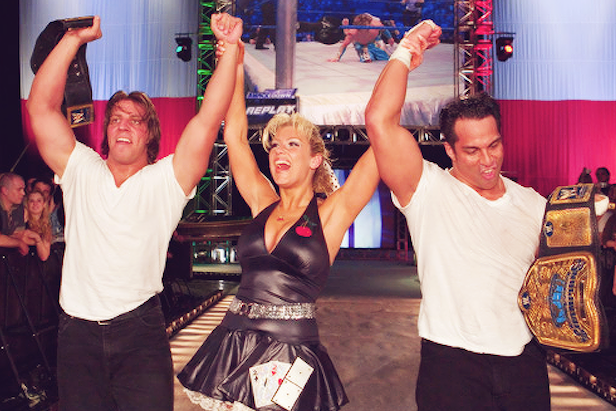
The conceit of this article is that the Ruthless Aggression era is a mere continuation of Attitude - but that’s not all. In 2006, WWE almost reboots the 1980s and early-to-mid 1990s at the same time.
Throughout the mid 2000s, Vince McMahon grows obsessed with characters again - wacky caricatures who could not possibly exist in a realistic fictional world. Now, you could argue that there’s no such thing in pro wrestling, but the various acts that pop up are very much a return to the heightened days of the 1990s.
The tone is set through the January 23 debut of the Spirit Squad: a group of wildly obnoxious male cheerleaders. In the summer, the former Akio becomes a cowboy performing under the name ‘Jimmy Wang Yang’.
In January 2007, Deuce and Domino debut on SmackDown. They are greasers who talk as if they travelled forward in time from the 1950s. They aren’t merely styled after the fashion trends of the day: they are meant to be from the day. A year passed between those debuts; this is longer than Paul Heyman’s stint with the book on SmackDown. The wackiness actually stretches further than that. This all followed the 2005 debut of the Boogeyman: a face-painted worm-eating monster character who patterned his movements from depictions of voodoo in popular culture and somehow did not wrestle the Undertaker in 1993. The Dicks, very briefly, are chippendales in that same year.
This is a sexualised occupational gimmick - a New Generation/Attitude Era hybrid that underscores how WWE shifts between two identities, rather than creating a new vision.
June 22-24, 2007 - The Chris Benoit Double-Murder Suicide
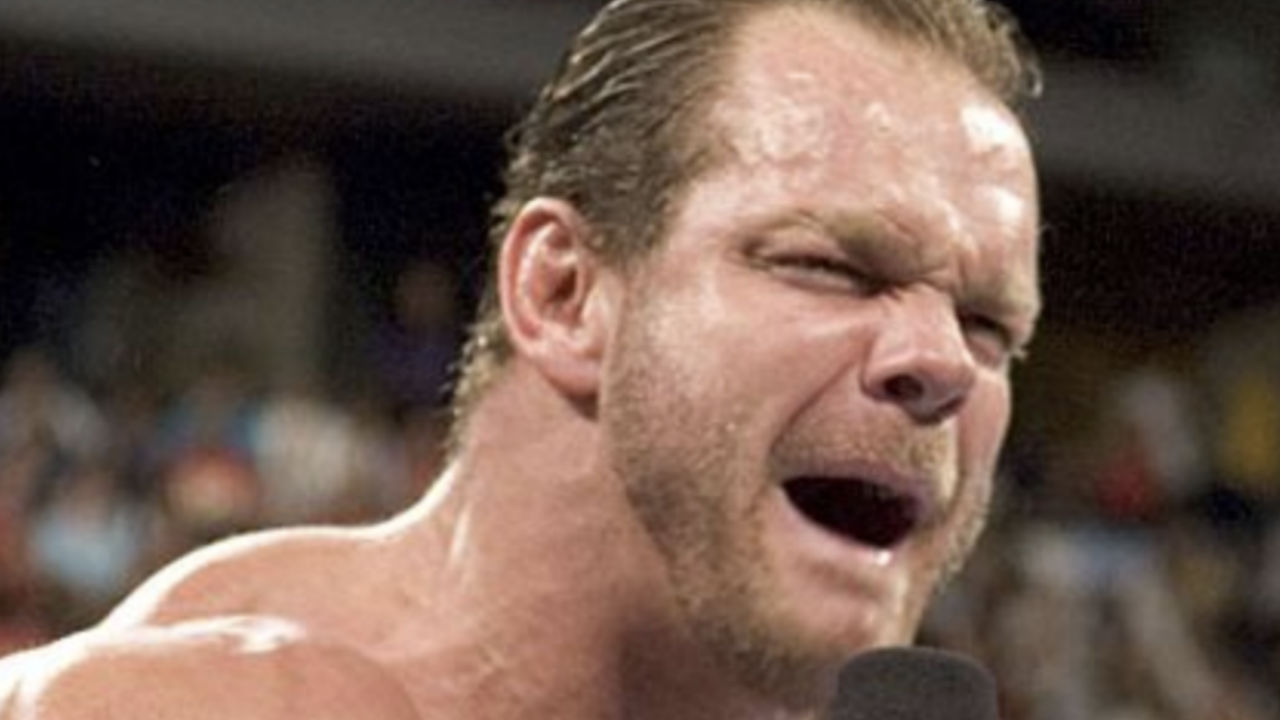
Chris Benoit, the wrestler, does not warrant the descriptor “ruthless”. He is by several accounts a sadist bully, but not a savvy, mercenary politician. He is however aggressive in his in-ring approach. He shows enough of that to win the World Heavyweight title at WrestleMania XX.
It’s a surreal sight - utterly ghastly to think of it like this in 2025, but in 2004, it’s moving. Benoit is never meant for this. He can barely cut a promo, he looks like a midcard hand built from the ground up, not a star, and he doesn’t radiate anything approaching superstar-level charisma. He is simply so electrifying at the craft of pro wrestling that he eventually commands the respect of a man, Vince, who has tried throughout his entire life as a promoter to banish that very word.
Tragically, this aggression and intensity results in countless agonising and terrifying shoot blows to the head, resulting in a posthumous diagnosis of Chronic Traumatic Encephalopathy (CTE). This is cited as one contributing theory to the horrific events of June 22-24, 2007.
It’s more complex and disturbing than that. The entire truth will never be arrived at. Chris Benoit took joy in tormenting people. He was a domestic abuser. He was so fervently dedicated to his craft that he knowingly destroyed his mind and body to continue doing it. The grief he endured as a result of Eddie Guerrero’s death, on November 13, 2005, caused a full psychotic breakdown.
Across June 22-24, Benoit murders his wife Nancy, his son Daniel, and then kills himself. WWE, per Irvin Muchnick’s book ‘Chris & Nancy’, knows of the timeline and the cause of deaths, but proceeds with a tribute show regardless. This horrific murder-suicide is incomprehensibly evil. It happens all too often, but rarely against such a public backdrop.
Everything changes after this darkest hour. WWE must cleanse itself - optically - to become an attractive proposition to sponsors and advertisers. A year later, after a nine year stint, WWE RAW is no longer rated TV-14 (a change that came into effect in January 1999).
June 29, 2008 - Triple H Wins LOL
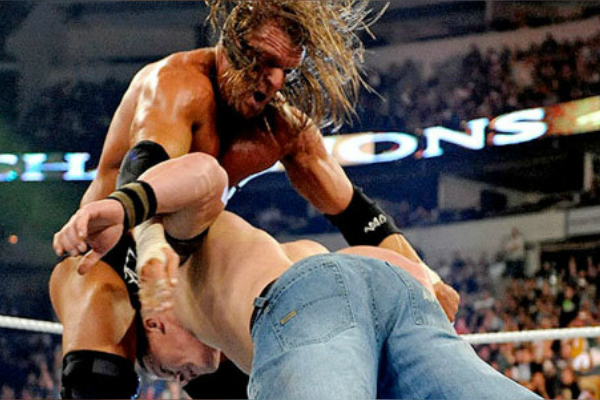
Triple H gets his win back.
Triple H had lost to John Cena at WrestleMania 22 on April 2, 2006. This match was designed to fully establish Cena as the face of the company. Triple H did the honours, but not before undermining Cena in the build. Triple H accused Cena of being a mechanically poor goof who “happened to not be a very good wrestler” and whose big move was “pumping up his Reeboks”. These were accusations that Cena could not answer by triumphing in a fictional story. It hardly mattered - but this sort of tactic did not help the millennial males accept the John Cena character, who generated mixed reactions thereafter in the defining thread of his career.
At Night of Champions 2008, Triple H goes over John Cena clean. There’s a slight suggestion that Cena suffers an injury near the finish - an “out” of sorts - but this isn’t followed up on television.
Cena easily absorbs the loss, which is designed to strengthen Triple H as the top babyface on SmackDown, to which he was drafted days earlier. The idea is to rehabilitate the blue brand, which by 2008 is very much secondary to Raw. Triple H just happens to be the guy they choose to lead it, that’s all.
The response amongst hardcore fans is what you’d expect. They think Triple H is using this big push to make SmackDown more important as mere pretext to win big matches all the time and hold onto his main event spot. If that is too cynical a take, it might be substantiated by what happens a month later…
July 22, 2008 - The End
Drawing to a close to the so-called Ruthless Aggression Era, a new era begins when WWE formally reclassifies itself. WWE is now “PG”. Again, there is no formal change to the format of WWE television. Authority figures still preside over the narrative; long promo segments continue to open the show; the matches, many of which are booked on an impromptu basis, are still worked in an increasingly generic style. The tone is very different, in an enforced way. WWE is no longer seeking to titillate the audience and distract them with vile, grabby material. Sponsors don’t like it, and that’s where the money is. WWE is about to enter an actual new era on the business side of things; through this new initiative of procuring big money sponsors, in a few years, corporate-driven revenue streams will outdraw the money generated by the fans. The tone of WWE television is pathetic, childish. You can scarcely believe even children find it amusing.
July 22, 2008 is a Tuesday. What is the state of play in WWE as ‘Ruthless Aggression’ comes to an end?
On July 20, WWE presents the Great American Bash from Uniondale, New York. As a show, it’s decent at best - elevated massively by another chapter of the superb Chris Jericho Vs. Shawn Michaels rivalry. Elsewhere, the idea that the WWE main event scene is there for the taking, if you display sufficient Ruthless Aggression, evaporates. CM Punk is the World Heavyweight champion, but doesn’t exactly feel like it. A glorified upper midcarder, he goes to a double disqualification draw with Batista. Why does Punk have the belt, when WWE doesn’t really want him to beat anybody?
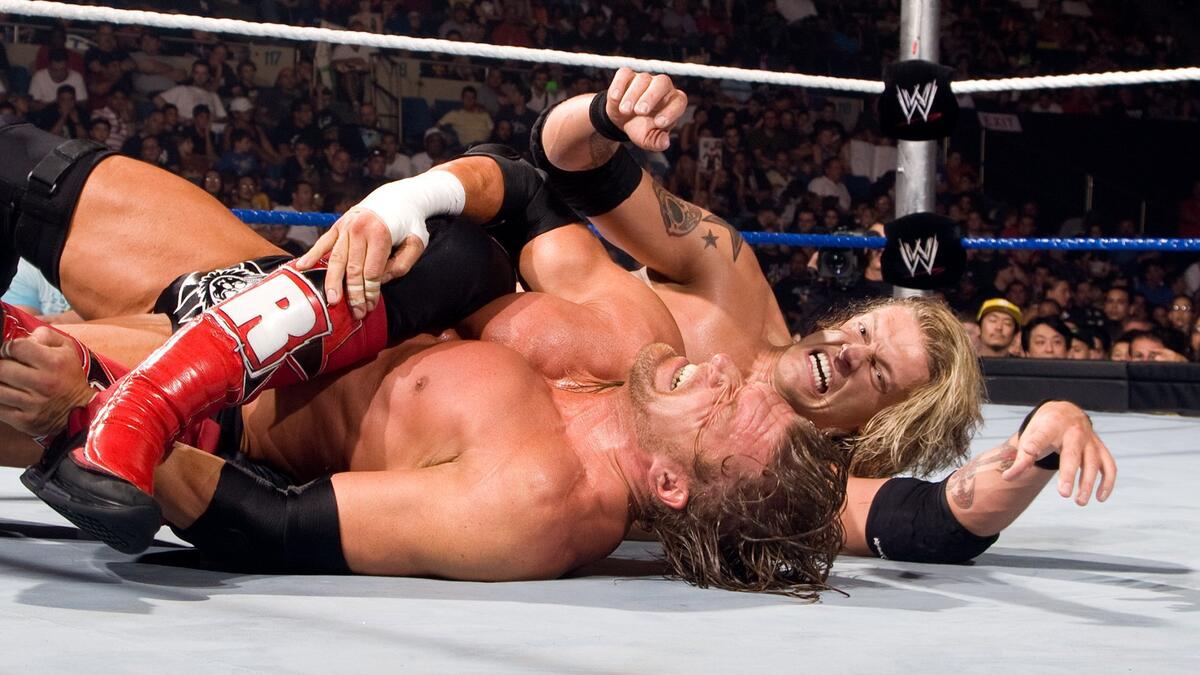
The main event is thoroughly - conspicuously - pointless. It’s Triple H Vs. Edge, and guess who wins?
It is hardly a classic; mirroring Unforgiven ‘04, the main event is a match of two halves. The first is boring; the second is a wildly overbooked extension of the Edge/Alicia Fox/Vickie Guerrero love triangle. Triple H wins after Edge inadvertently spears Vickie, capitalising on Edge’s shock to blast him with the Pedigree. The key thing about this match is that it doesn’t need to happen - certainly not on a B-level pay-per-view. It’s one of the few WrestleMania-sized first time meetings WWE has left. (A singles encounter between the two men had taken place on Raw, but this was before Edge made it as a bonafide main event performer).
You could easily argue that WWE is acting too hastily here. At WrestleMania the following year, Triple H works Randy Orton in the main event in what is a woefully uninspired and overdone pairing, as John Cena takes on the Big Show and Edge in a Triple Threat. These are matches you would not be remotely surprised to see on a No Mercy-style event.
So why does Edge Vs. Triple H happen at the Bash?
The generous take is that WWE feels they need a big match, and believes there is plenty of time to build something even bigger for WrestleMania 25. The cynical take is that Triple H sees Edge as a political threat. The fans love to hate this version of Edge, who is an entertainment machine in the top heel role. This has to be at least big enough for SummerSlam, which is scheduled for the very next month. Is it too conspiratorial to suggest that Triple H, using his creative leverage, wants to position Edge as a mere B+ player?
You could say, yes, that is the ranting of a “smark” - but then, Triple H himself will later state on TV that Edge (and Chris Jericho and Rob Van Dam) was never a top guy. This is in character, but Authority-era Triple H is basically a barely fictionalised extension of Paul Levesque.
John Cena is still, unmistakably, the biggest star in WWE. By 2008, the Reign of Terror has long subsided. Triple H is actually significantly better in the ring during the latter half of the decade than he was in the early 2000s. Still, this idea of a new era is not the reality. It’s not complete fantasy, either, but the years between 2002 and 2008 are as much a Triple H vanity project as a youth movement. Who is the top heel in 2002, and who is the top babyface in 2008?
The King of Kings. The Game. The Cerebral Assassin.
Ruthless Aggression was something Vince McMahon said for a few weeks. It’s the strangest name for an ‘era’ imaginable - or is it? Are most of these designations flawed?
‘PG’ makes sense, to a degree. The feel of the product changes, at least - but what really is the ‘Reality Era’, which supposedly runs between 2014 and 2016? Is the Authority so different from the other McMahon-led alliances? This stuff was premised all along on the idea that they were playing themselves and interfering with your favourite wrestlers. There is nothing realistic about WWE between 2014 and 2016, either. The same invisible camera-driven idiot plots are still in play. Is 2014-2016 classified as ‘Reality’ - a consensus that has made it to Wikipedia - because fans recognised improvements in the product and wished to make it clear that it was better than the dreaded PG Era?
WWE itself billed 2016 as a ‘New Era’, which stuck. Wikipedia also reflects this “change”, but again: what did change? Shane has not been around for a while, but a McMahon acting as an authority figure is, definitionally, not remotely new. SmackDown resembles its own show with a different, almost remarkably feel-good identity for much of 2016, but it doesn’t last.
The Pandemic Era is its own thing, but not through some carefully considered strategy. It was obviously thrust upon WWE.
Ruthless Aggression did not really happen because WWE didn’t change during or since, to a truly significant extent, until Paul Levesque grabbed the pen. Today’s WWE is still distinctly WWE, but there’s a less asinine and more sophisticated quality to it. The brand of melodrama; the vastly improved production; the dignity afforded to wrestlers jumping from other promotions; the genuine attempt at fan-friendly, long-term storytelling: it is a new era. It just took a long time following the days of Attitude to arrive at it. It is more accurate to describe 1999-2008 as the TV-14 era. Everything between 2008 and 2022?
Vince’s Egotistical, Counterproductive Brain-Rot is not snappy, but very accurate.