12 Must-Read First Issues From The New DC You Line

It's all about the DC You!

Back in September of 2011, DC rebooted their universe creating the controversial New 52 imprint. This imprint consisted of 52 new books in a tonally homogenised universe where everything was dark, edgy and gritty. With gimmicky 3D covers, a hyper realistic Jim Lee house style, and an infinite number of crossovers, reading DC felt like the 90€™s comics scene all over again. Amongst the aforementioned issues, DC€™s editorial staff maintained a tight control over their creative teams €“ continuity trumped story forcing many writers to rewrite previously approved scripts. It was rough times for DC all around. Finally, three-and-a-half years later, DC has pretty much overhauled their entire approach to their line. For the first time in a very long time, story trumps continuity and diversity of style and tone abound. Under the current DC You imprint, things are far more loose and free flowing. Creators are allowed to shape the DC universe €“ not editorial. The DC You initiative is DC€™s attempt to reinvent themselves by creating a book for every reader; accessibility and inclusivity are their goals. We are officially one month into the DC You, and things could not be looking better. With 24 new titles (some of which haven€™t been released yet), DC€™s post-Convergence landscape has been a diverse goldmine of comics...

12. Green Lantern: Lost Army

Once upon a time, the Green Lantern franchise was one of DC€™s top sellers; with Geoff Johns and Pete Tomasi steering the lantern ship, it seemed like the franchise would only continue to grow. Then along came the Green Lantern movie, and suddenly Green Lantern readership plummeted. Fast-forward to present day: the Green Lantern universe looks completely different. Where Green Lantern remains as the flagship title fore the franchise, its companion book, Green Lantern Corps, was replaced by Green Lantern: Lost Army. Written by Cullen Bunn with Jesus Saiz and Jaci Pina on art, Green Lantern: Lost Army follows the adventures of the remaining members of the Green Lantern Corps who have been suddenly transported to an unknown place/universe where everything is trying to kill them. The first issues focuses on Jon Stewart in a leadership capacity, as he deals with being thrust into a dire situation. The issue delivers some major surprises from big players in both the Green Lantern world as well as the larger DCU. Plus the art was extremely well done. Saiz and Pina€™s work is detailed, smooth, and crisp all at the same time. Overall, this issue accomplished what every good first issue should: it makes you want to read the second one.

11. Bat-Mite

One major goal of the DC You initiative is to produce a book for various demographics outside of the stereotypical comic geek; this includes creating books for younger readers. Considering that Batman is by far DC€™s most lucrative franchise, it€™s no surprise that they chose Bat-Mite as one of their launch titles. Bat-Mite has a long-standing history in the DCU. Created by Bob Kane and Bill Finger, Bat-Mite made his first appearance in Detective Comics #267 (1959). Since then, Bat-Mite was written out of €œofficial cannon€ and was used sparingly until Grant Morrison€™s Batman: RIP (2008) storyline, where the character was re-established as a part of the Batman mythos. Written by comic veteran, Dan Jurgens, with Corin Howell on pencils, Bat-Mite is a six-issue mini-series that follows the misadventures of a fifth-dimensional imp named Bat-Mite as he tries to €œfix€ the characters of the DCU. The most current incarnation of the character is a departure from Morrison€™s vision, as Jurgans dials up the humour in this first issue. Bat-Mite has the distinct voice of an obnoxious imp who, if you met in real life, you would most likely want to punch. Howell€™s art is whimsical and fun, as Bat-Mite€™s facial expressions are energetic and bombastic. It€™s obvious what these guys were aiming for in this first issue: by the end of it, you€™ll be humming the Animaniacs theme song.

12. We Are€ Robin!

What better than four distinct Robins with individual and unique back-stories? 400 Robins with individual and unique back-stories! Spinning out of the Batman: Endgame storyline, We Are€ Robin! follows the adventures of Gotham€™s disenfranchised youth who band together to form an army of crime-fighting Robins. The first thing that stands out about this book is the art. It€™s beautiful in an elegant yet urban sort of way. Reminiscent of Huberto Ramos€™s recent work on The Amazing Spider-Man, Khary Randolph pencils capture the essence of Gotham€™s urban youth, rendering the streets of Gotham in a unique way. Story-wise, Lee Bermejo does a fantastic job easing the reader into this new, unexplored section of Gotham with its new cast of characters. This issues focuses on a single character, Duke Thomas €“ an African American teenage boy whose parents went missing during Batman: Endgame. Duke€™s voice is real and sincere; he feels like a genuine urban teenager. Other supporting characters are given little screen time, which works surprisingly well. By the end of the issue, you€™ll feel very well acquainted with Duke, interested in learning more about the other Robin characters, and dying to know who the shadowy figure is on the last page.

9. Doctor Fate

Harkening back to the Golden Age of Comics, Doctor Fate is one of DC oldest characters. Debuting in More Fun Comics #55 (1940), Doctor Fate has been around for over 75 years. Nevertheless, none of Doctor Fate€™s numerous incarnations and publications have ever looked or felt like the most recent DC You version of the character. Written by Paul Levitz with Sonny Liew on pencils, Doctor Fate is not your typical superhero book. In fact, this could easily be an indie title from Image or Dark Horse title; it is distinctly un-DC in its presentation and execution. Like many of these new DC You titles, what stands out the most in Doctor Fate is the art style. Sonny Liew has managed to strike a delicate and astonishing balance between terrifying and cartoony. This art style is perfect for the premise of the book, as it focuses on a young Egyptian-American medical student named Khalid, who finds himself caught in-between the natural and supernatural. Levitz€™s script is exponentially better than his most recent DC work, which suffered from frequent editorial meddling. Khalid is a sympathetic lead character with a supporting cast ripe with potential. For those of you who are interested in picking up the first issue, make sure that you read the free preview DC released during Convergence; it integral to the story. You can download this free preview on the DC Comics app store.

8. Constantine: The Hellblazer

DC/Vertigo screwed the pooch when they cancelled Hellblazer in an attempt to reintroduce the character into the DC New 52. It flat out did not work €“ simply because Constantine was the same. Vertigo Constantine was a complex, multifaceted degenerate, whereas the New 52 Constantine was a smarmy ass that enjoyed playing superhero. He wasn€™t Constantine; he was Constantine light. Now that The New 52 is dead, and long live the DC You, Constantine is starting the feel like his old self again€ for the most part. With Ming Doyle and James Tynion IV sharing writing duties, Constantine: The Hellblazer, John Constantine is much more of the street mage, reprobate that fans grew to love compared to his watered down superhero from The New 52. In this first issues, he cons a shopkeeper out of a new set of cloths while naked and bloodied, hits on a male bar tender, and ends up sleeping with a female demon. The main thing that set this series apart from Vertigo€™s Hellblazer is the art. Where the art in the Vertigo Hellblazer leaned towards the gothic, Riley Rossmo€™s penicils and Ivan Plascensia€™s colours for Constantine: The Helblazer are cartoony and vibrant yet are still keeping with the macabre tone indicative of a Constantine title. And though the art is a bit jarring at first, this unique rendering of everyone€™s favourite gutter-mage works very well within the new DC You wheelhouse.

7. Justice League Of America

Undoubtedly, Bryan Hitch€™s Justice League Of America was one of the most anticipated titles from the new DC You line, and boy does it live up to its hype. In this title, Bryan Hitch does what Bryan Hitch does best: grandiose, bombastic, detailed comics. This title might as well be a summer blockbuster, as almost every scene in every panel feels like a wide-screen shot from a movie. Artistically, every member of the Justice League is rendered in high-definition splendour: Hitch€™s pencils are meticulously detailed. This issue is particularly strong for the beginning of a new series. Hitch wastes no time by explaining who these characters are and how they met. He assumes that his readers are familiar with the Justice League cast, giving him more time to sow the seeds for the plot of this first arc. And though this issue is mostly exposition that focuses on Superman€™s visit to The Infinity Corporation and Aquaman€™s dealings with the United Nations, it doesn€™t feel laboured but rather relevant to Hitch€™s story. Yet while most of this issue revolves around the two aforementioned characters, when the action cranks up, each Justice League member gets a moment to shine. If you are looking for a fun self-contained Justice League story, check out this title. You won€™t be disappointed.

6. Batman Beyond

For years fans have been clamouring for Batman Beyond to be introduced into DC€™s main cannon and for Tim Drake to get his own, ongoing title, yet little did they expect for both of these wishes to be fulfilled at the same time. Spinning out of the pages of Futures End, this new canonical Batman Beyond title follows the adventures of former Red Robin, Tim Drake, who was flung 35 years into the future. Taking the place of Terry McGinnis as the new Batman Beyond, Tim Drake is forced to deal with a post-apocalyptic Earth most of which has been taken over by Brother Eye, a sentient surveillance system created by Bruce Wayne and Michael Holt. Written by comics veteran, Dan Jurgens, Batman Beyond picks up literally right where Futures End finished. This issue does a great job bringing those readers who didn€™t read Futures End up to speed while explaining the status quo of this new Batman Beyond world (which is drastically different yet strangely familiar to the world portrayed in the Batman Beyond cartoon). Bernard Chang does the art for this title, and his pencils are exquisite. Along with the help of colourist Marcelo Maiolo, the art of Batman Beyond captures the dystopian futuristic setting of the book perfectly. The backgrounds are lush and expansive, while characters are detailed and emotive. Chang and Maiolo have created a perfect world for the tone of Dan€™s script.

5. Omega Men

To say that Omega Men is an edgy book is an understatement: DC went balls-to-the-wall when they decided to publish this title, as Omega Men addresses the hot-button issues of terrorism and cultural imperialism. Written by Tom King with art by Alec Morgan, Omega Men focus on a group of freedom fighters appropriately called the Omega Men who are in rebellion against The Citadel also known as The Alpha Empire. This issue is the equivalent of the opening scene for an action flick, as a group of Alpha soldiers prepare to raid an Omega Men base. The story is fast paced, confusing, and will most likely require multiple reads. King throws you into the middle of the action, making it challenging to get your bearings. With multiple races speaking different languages, King does a wonderful job world building while playing to the themes of oppression and imperialism. Barnaby Bagenda€™s art is dark and cluttered, creating an atmosphere of fear and uncertainty. The panelling is reinforces the fast paced, chaotic nature of King€™s script, as the use of splash pages and off screen violence is particularly effective. Overall, this book is striking yet terrifying, as the story hits just a little to close to home. DC hasn€™t published anything this daring in a long time, and there€™s nothing on the market that even remotely resembles this explosive title.

4. Black Canary

Who would have guessed that punk rock and superheroes would go so well together? Apparently, Brenden Fletcher did. Spinning out of the pages of Batgirl, Black Canary is an exhilarating punk rock explosion brought to you by the writer Brenden Fletcher and artist Annie Wu. Following Dinah Lance as she plays front woman for her new band, Black Canary combines band politics, the perils of the music industry, and superhero shenanigans in the most brilliant of ways. Fletcher script is exposition light, which makes this issue quite compelling. Readers don€™t aren€™t given full character sketches for each supporting cast member, leaving Fletcher plenty of room to grow and develop Black Canary€™s cast. If he remains consistent in this strategy, readers will be driven back to the book month to month, as they slowly learn more and more about this interesting supporting cast. God bless Annie Wu; she was born to draw this book. Her art is sharp and inky rendering Black Canary€™s world in bright neon colours contrasted with splotches of muted tone interspersed as thick black lines create a cartoonish atmosphere. Imagine Scott Pilgrim meets DC Comics. Wu€™s character designs ooze style and flare, as they capture the current hipster trends within youth culture. Needless to say, if you have been a fan of hipster Batgirl, you€™re going to enjoy this title.

3. Prez

Some books just should not work, yet some how they do. Prez is a perfect example of this principle. First off, this is not a superhero title, which begs the question as to why DC is publishing this book in their main line. Second, the premise of this title simply sounds stupid: the first teenage president was a failed concept back in 1973 when Joe Simon and Jerry Grandenetti published the first version of this title. Nevertheless, Mark Russell and Ben Caldwell took this outlandish idea and created a fantastic social and political satire. Prez is a 12-issue mini-series that flashes forward to the dystopian America of 2036. For most of this first issue, writer Mark Russell focuses on establishing a dysfunctional future comprised of taco delivering drones used to feed and clothe the poor, corporations who are in full control of American culture, as well as life-sized hologram pop-up adds. The main character, Beth Ross, gets little screen time, which isn€™t really a problem considering her story only make sense in the context of the American society where the President is elected via Twitter. Artist Ben Caldwell sets the perfect tone; rendering this capitalistic setting, where technology has dehumanised the population, in a cartoonish fashion makes Russell€™s satiric script all the more effective. Caldwell€™s art is disarming, leaving the reader vulnerable to Russell€™s wit. Scarily enough, this visualised future is familiar not so different from 2015; a sobering fact revealed in a comic book that hits just a little too close to home.

2. Bizarro

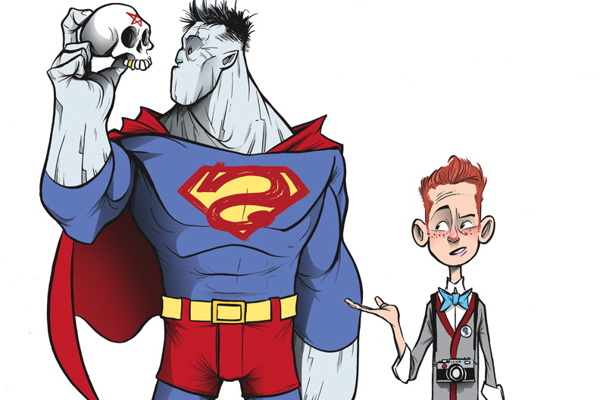
Like Bat-Mite, Bizarro is DC€™s attempt to create an all-ages title, and boy do they knock it out of the park. In this title writer Heath Corson tells the misadventures of Bizarro and Jimmy as they undertake a road trip from Metropolis to Canada (or as they call it €œBizarro America€). Corson€™s script is hilarious as it pits the backwards-talking, buffoon Bizarro alongside the strait man Jimmy Olsen, whose plan is to document his trip in order to write a coffee table book and make millions. Corson€™s script is fast paced and funny, as it cuts quickly from scene to scene delivering quick and snappy punch lines. Gustavo Duarte€™s art is charming, as every character is drawn as a caricature. Bizarro is rendered as a charming, idiotic hulk with a heart of gold; Jimmy Olsen is wiry and pencil thin with outrageously long, gangly limbs; and even the first €œfoe€ they meet is a short, fat, foppish used-car salesman who has a strange obsession with the pharaohs of Egypt. Each panel is exquisite and visually hilarious. Unlike Bat-Mite, which feels derivative of the Animaniacs, Bizarro feel fresh and new, both in writing and art. Bizarro #1 is a fresh reminder that comics can be both quality and fun.

1. Martian Manhunter

Martian Manhunter is a hard character to write: he€™s as powerful as Superman with an incredibly small rogues gallery/supporting cast. Yet out of all the first issues released in the DC You line, Martian Manhunter (J€™onn J€™onzz) is by far the most surprising and exciting title of the bunch. Story-wise, this issue accomplishes many things a first issue should. Writer Rob William introduces the Martian Manhunter in a compelling scene where he rescues a crashing plane. Williams continues to establish the main conflict within the first arc by revealing that J€™onn unknowingly is a sleeper agent in a Martian invasion. As this conflict unfolds in the first issue, we are introduced to a diverse supporting cast, including the strange Mr Biscuits (more on him later). And the issue is capped off with an interesting twist/cliff-hanger. Undoubtedly, the strongest thing about Martian Manhunter #1 is Mr Biscuits: a mysterious new character who frames the issue. Mr Biscuits is a gangly malformed Martian dressed like a Victorian gentle man with underwear on his head. He interacts with a child, who gives him a bag of cookies that he devours instantly. Nothing is really known about this character; however, his bazaar design and strange introduction will leave you wanting to know more about him. Eddy Barrows pencils are fantastic throughout the book. Along with his creative character design for Mr Biscuits, Barrows€™s art succeeds in showcasing the Martain Manhunter€™s shape shifting abilities. Barrow€™s art is crisp and detailed, making each panel a joy to study. Overall, this issue is a perfect place for newcomers to the Martian Manhunter. Williams and Barrows succeed and creating a compelling Sci-Fi/Horror book that€™s epic in scope while still remaining to be character driven.

Contributor
Contributor

Since childhood, Bryant has been an avid fan of superheroes, and he has been reading comic books since 2006. His full name is "George Bryant Lucas"; however, after enduring countless Darth Vader jokes, he has chosen to go by his middle name. Born and raised in the United States, Bryant is currently living with his lovely wife in the country side of Wiltshire County, UK. Bryant does suffer from a mild case of dyslexia; misspellings and homonyms are to be expected on occasion.