A Brief History Of The Joker
A crash-course in the Clown Prince of Crime's horrifying history.
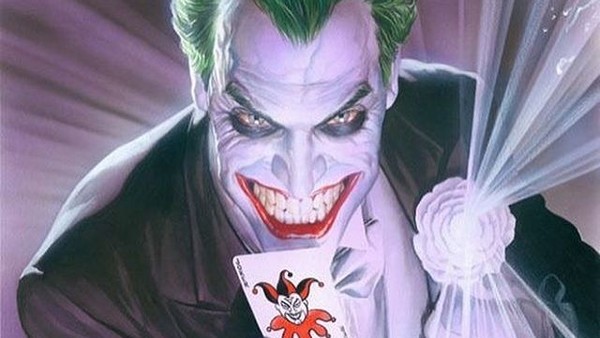
When it comes to fiction, let alone the comic book medium, there are few villains as iconic - or as memorable - as the Joker.
Whether it be in film, TV or of course the comics themselves, the Clown Prince of Crime has fostered a diabolical reputation for carnage, destruction and violence. He's the worst of the worst, but with a 75 year history to speak of, the Joker's past can get a little... confusing, to say the least.
This is largely because it gets changed every other year. First there's one origin, then there's two; first there's one Joker, then there's three (yes, three), and with so many different versions, incarnations and designs to point to, it's little wonder that the character means different things to different people. He's a Dick Sprang-style connoisseur of grandiose schemes, but also a sadistic knife-wielding murderer, depending on the interpretation, and that's without even broaching the various alternate-universes, one-shots and specials that have deviated even further from the norm.
That in itself possesses its own appeal, but in discerning the true history of the Man Who Laughs - both on and off the page - you have go back a long time; back to when a trio of comic book professionals came together to create a villain of nightmarish proportions, and with a menacing grin that no one would soon forget...
3. The Man Who Laughs - How The Joker Came To Be
The Man Who Laughs - the silent 1928 adaptation of the famous Victor Hugo novel - is commonly cited as the main inspiration for the Joker, and for good reason.
Conrad Veidt's rendition of Gwynplaine - the eponymous character from the novel - is thoroughly unsettling, and it proved to be enough to spark interest for the trio of Bob Kane, Bill Finger and Jerry Robinson - the latter two of which held the most influence on the Joker's creation and subsequent development in the years immediately following the character's introduction - to create a villain in his image.
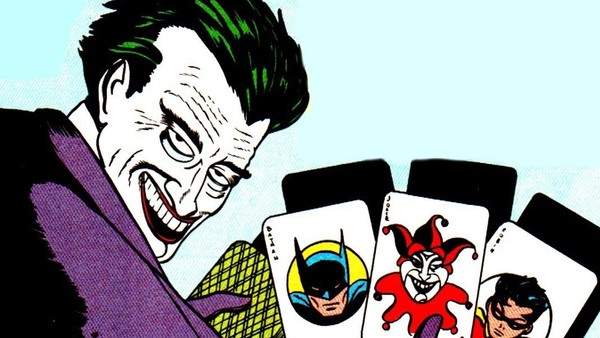
The story of the Clown Prince's creation is hotly contested however. Bob Kane, a person usually reluctant to share any credit with his coworkers, stated that it was he and Finger who first conceptualised the concept of the Joker, and that Robinson offered nothing apart from the character's iconic playing card. Historians have, however, more often cited Robinson and Finger with the character's creation and subsequent development, with both the artist and the writer having presided over the Joker's formative years as Batman's arch rogue.
And so, the Joker first debuted when Batman transitioned from the pages of Detective Comics to his own series in 1940, with Kane's pencils from the issue providing the character's now definitive look. His first appearance was far more macabre than most would perhaps suspect as well, with the Clown Prince having marked his entrance by murdering several characters in a one-man crime spree. It would also mark the first use of the character's iconic 'Joker Venom' - a chemical concoction designed to kill and leave victims with a hideous grin on their face - with the Boy Wonder himself almost being drugged close to the story's conclusion.
The character would take on various forms in the years following, but interesting to note is that it would take decades for him to return to this original depiction, as the Golden Age of comics soon became a Silver Age of sci-fi, fantasy, and light-hearted story-telling.
2. "If I'm Going To Have An Origin Story, I Prefer It To Be Multiple Choice!"
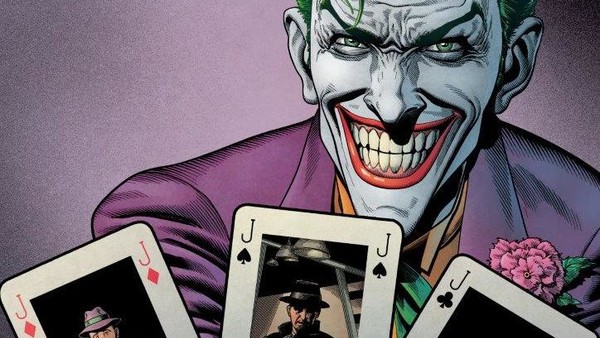
The Joker is obviously a charismatic character, but one of the most fascinating things about him is that no one knows how - or where - he came from. Countless origins have been told, but as the character says in his most famous story - Alan Moore and Brian Bolland's seminal (and controversial) The Killing Joke - if he's going to have a past, he'd "prefer it to be multiple choice."
That in itself has presented endless opportunities for writers determined to place their own stamp on the villain, whether it be in Paul Dini and Bruce Timm's Mad Love, wherein Joker emotionally manipulates a vulnerable Harleen Quinzel with tales of his abusive father, or in Dini and Alex Ross' 1996 story that positioned the character as a gangster bored of untheatrical crime. There are dozens of tales that depict the Clown Prince's rise to prominence, each more compelling than the last, but it's really a case of the less we know the better.
Why does the Joker do what he does? The question is best left unanswered because, well, that's what makes him so terrifying. There is no method to the madness, and while various incarnations of the villain have come and gone, a fascinating explanation for his fluctuating personality has already been optioned by one famous comic book writer - everyone's favourite occult expert, Grant Morrison.
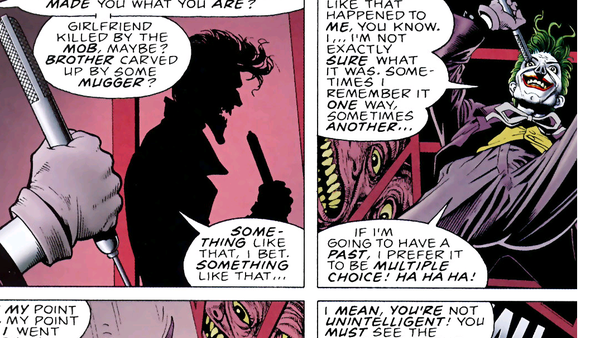
Morrison's interpretation of the character accounts for his entire history, and provides a reasonable and considered explanation for why he's undertaken so many different shifts throughout his life. It applies the mantra of Moore's Killing Joke, but instead of focusing solely on the character's origin, it goes one step further and applies it to his very being; if the Joker is to have a personality, why surely, he'd prefer it too to be multiple choice?
Morrison's interpretation of the character posits that the Clown Prince isn't necessarily 'insane' in the traditional sense, but rather 'super-sane'. This level of 'super-sanity' thus engendered the clown with the ability to change his entire personality on a whim, shifting from the lethal killer from the original Kane, Finger and Robinson comic, to the high-stakes prankster of the Dick Sprang-era, before then reverting to type with the ascension of Dennis O'Neil and Neal Adams' seventies Batman comics. It establishes a precedent for writers to deviate from past depictions, and in accounting for these shifts, Morrison's contributions to Batman's lore are invaluable.
But, with comics being comics, Morrison's interpretation has recently been overridden. DC Rebirth has now optioned the theory of there having been multiple Jokers, each with their own distinct style and blueprint. It's rather literal, all things considered, but with the character's history in a constant state of flux, it too isn't without precedent.
1. "Look Out, Gotham! Joker's Back In Town!"
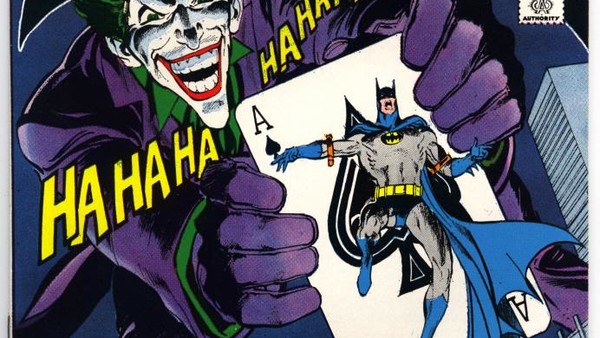
Though the Joker's history might be ever changing, one thing that definitely won't be are the character's most iconic storylines - the reads that shaped him, made him, and changed him.
Chief among these stories is Denny O'Neil and Neal Adams' Five Way Revenge, a comic that divested from the character's Silver Age tendencies and returned him to his original ghoulish demeanour. The Joker of this story is homicidal, bombastic and horrifying, with Adams' design in particular having shaped the character's look in a way no other artist has since been able to achieve.
O'Neil and Adams wrote the book on modern Batman in a way no one else did, but it's their reappraisal of the Joker that will perhaps go down as their most enduring contribution. It's an interpretation that has informed countless other comics, but it's not the villain's only must-read book. Grant Morrison's run is worth reading in its entirety for what it does with the character, as is his one-off special Arkham Asylum: A Serious House on a Serious Earth; then there's Steve Englehart and Marshall Rogers' famous Laughing Fish story - adapted for the small-screen in Batman: The Animated Series - along with the aforementioned Mad Love and Killing Joke, all seminal in their own right.
That being said, it's also important to remember that some of the greatest Joker stories ever told weren't actually comic books. BTAS has countless classic tales of the clown in Joker's Favor, Return of the Joker and Mask of the Phantasm, and of course, both Tim Burton's Batman 1989 and Christopher Nolan's second Bat-film, The Dark Knight, are all veritable classics of the genre.
All have helped shape the Joker in their own, and while he might be overused on occasion, there's no denying the clown's preeminence. He's horrifying, humorous and hated in equal measure - no villain could possibly compare.
What do you like most about the Joker? Be sure to let us know in the comments below!