10 Ambitious Video Games With Immensely Disappointing Stories
Sometimes it's okay to stick to the basics.

Creating a video game with a compelling story is no easy task. If the gameplay and the graphics don't live up to expectation, no one will really care about the characters and narrative in the first place.
We all know that video games follow certain formulas and frameworks, so for example, it's okay for Nathan Drake to kill thousands of people during gameplay and still be a warm, likeable individual during cutscenes. Why? Because it's 'expected' of him to walk this sort of line on his adventures, lest Uncharted be the story of a complete psychopath.
However, this is one of those rare instances when acting out of character is forgiven. The real problem occurs when games should have great stories, yet they either fail horribly, hilariously, or both.
It may be because the story - which was the selling point - didn't come together, perhaps because the source material was so great and yet the end product wasted all that potential, or sometimes just by virtue of being a AAA game our expectations are far higher.
While all of the following titles should be applauded for their ambitions, unfortunately they fall under one of the three aforementioned categories.
Heavy spoilers ahead.
10. Heavy Rain

Yes, Heavy Rain was creepy and engaging. Yes, it changed the way people think about video games and their possibilities. However, for such an ambitious title, there are some serious plot holes in what is literally a plot-driven game.
The gamer is supposed to suspect Ethan Mars of being the Origami Killer. He has these terrible blackouts which are mentioned at the beginning of the game, yet forgotten afterwards. They are the sole reason why he's the main suspect in a murder case.
Oh, that, and he wakes up with origami models in his hands for no apparent reason - something that never gets addressed or answered.
The worst moment comes when detective Scott Shelby is revealed as the main antagonist, despite being one of the four 'heroes'. The main problem is that during one of the killings he's show in a totally different place, but later on, when recollecting and informing the audience, he's shown killing the victim. Come on!
Heavy Rain is a great experience and very immersive, it just doesn't make a lot of sense.
9. Prey

Prey was supposed to deal with themes like enhancement or consciousness, though despite what it wants you to believe, these themes barely resonate.
Arkane Studios can't be accused of a lack of ambition and, to be honest, they really did their best to achieve it, creating a lot of notes and journal entries to make the experience more convincing. Yet, they just doesn't make a lot of sense.
The goal of the TranStar-ordered test, as revealed in the ending, is to asses if the Typhon, a race of outer-space beings, is capable of empathy. However, the experiment does nothing to actually check if the character is able to exhibit empathy.
Yes, it checks his/her analytical abilities, and it also works out well as a story about the hero being manipulated by both his brother and January, the operator he/she created anticipating his/her memory loss. Though, it's hard to say what motivated him/her to do so.
The big test of empathy therefore boils down to whether you'll decide to trust your brother or your former self. Somebody needs a dictionary.
8. Beyond: Two Souls

Developer Quantic Dream hired acclaimed actors Ellen Page and Willem Dafoe to star in their non-linear narrative, disguised as an action/adventure/drama video game. Based on the success and popularity of Heavy Rain, they decided to embark on an even more ambitious task and create another touching interactive story.
Since she was eight, Jodie Holmes felt a connection to a strange entity called Aiden. A child of two psychics, the girl is kept company by her dead twin brother, who often protects her, although in ways which are pretty hurtful to others. As she becomes an adult, Jodie tries to cope with her extraordinary powers and lead a normal life.
And yet, during the game she joins the CIA, kills an African warlord, helps a homeless lady give birth, saves a Native-American family from a bad entity and faces off against the Chinese military.
Apart from all this being a bit too much, remember that these actions are delivered with a truly cringeworthy script, and performed by a petite, CG Ellen Page.
It all makes the described events look far more absurd than they sound, which is quite the feat, when Page has to go up against a giant, possessed wall of sand.
7. Quantum Break

Featuring prominent TV actors who starred in such high-profile shows like The Wire, Lost or The Game of Thrones, Quantum Break was supposed to merge TV and video games like never before. How did the creators indent to do that?
Quantum Break is a five act time-travelling story. Four 20-minute episodes show the results of your in-game choices after every part of gameplay is over.
The main problem was that the scenes weren't really interesting. Whereas during the gameplay you were blowing stuff up and killing people in imaginative ways, during the TV segments you had to listen to a guy who doesn't like stuff put on his desk, or a pair sweet-talking in bed. The episodes were supposed to reward your efforts, but sitting through them turned into a real chore.
Also, throughout the game you're informed that what you do doesn't matter, the ending is always the same. What's the point of gameplay influencing the cutscenes, while the result is always the same? It's like the creators doubted the game's ability to tell a story and instead relied on a low-budget TV show to do it.
Games can tell stories on their own. They also tell more compelling and interesting than this one.
6. Daikatana

The list of failed ambitious video games would not be complete without one of the most ambitious video games ever.
Yes, everybody was supposed to be turned into a "bitch" by the game's creator John Romero. Yes, the final product looked dated despite numerous re-writes, and the gameplay simply sucked.
But let's not forget about the plot.
Daikatana takes place in 2055 AD. After a 10 minute cutscene - which can stand as proof that the story is actually important - we learn that the present-day plague that's infesting the world has its roots in feudal Japan, because of a rivalry between two clans. The source of power is a magic sword, the titular Daikatana, which must be found in order to rewrite history.
The FPS games back then didn't need to make a lot of sense, but because Ion Storm was so ambitious and set hopes very high, the story really needed to be polished. Instead, the final product was a disappointment in all aspects, narrative included.
5. Command & Conquer: Red Alert

With such an amazing premise, this game should be among the best, most introspective and interesting of all time. Instead, it prefers to rely on easy laughs rather than a deep historical analysis.
Albert Einstein travels back in time to kill a young Adolf Hitler just after he leaves prison. This creates an alternative timeline, in which USSR rises to power and takes complete control over Eurasia. Einstein doesn't prevent World War II - it still takes place, only between years 1946 and 1953, positioning the Soviets against the Allies.
This should be awesome, right?
Well, not really. For starters, if they were able to kill Hitler, why didn't they kill Stalin as well?
The man was an actual monster and a bureaucratic genius, but throughout the game Stalin is presented as an idiot and a joke. He's tricked by Kane, the Command and Conquer fan favorite, to start a war and is killed at the end, no matter if you play as the Allies or the Soviets.
It takes just basic historical knowledge to see the ridiculousness of this plot.
4. Watch Dogs

When you're supposed to play as someone known as The Vigilante, you know they're either really bland or the game is just lazily written. In the case of Watch Dogs, it's both. The game's failure made its successor's success all the more surprising, since no one expected Watch Dogs to be so fun or clever.
The Vigilante, Aiden Pearce, is a typically straight protagonist. He has no depth, nor is he able to evoke any emotions in the player. His family members are constantly either kidnapped or threatened, which doesn't make him a good protector. He's also not a good vigilante. At one point Aiden is exposed in front of the whole city of Chicago, and yet he's able to continue hacking.
What's more, when he's on the street, people at times will take out their cameras and take his picture. Isn't remaining unidentified the whole point of the game?
While the game's open world feels alive, there's really no tension or emotions involved in this uninspired story. Since the puzzles aren't that much interesting either, there's really no reason to reveal other layers of the game.
3. NBA 2K16 (Livin' Da Dream: A Spike Lee Joint)
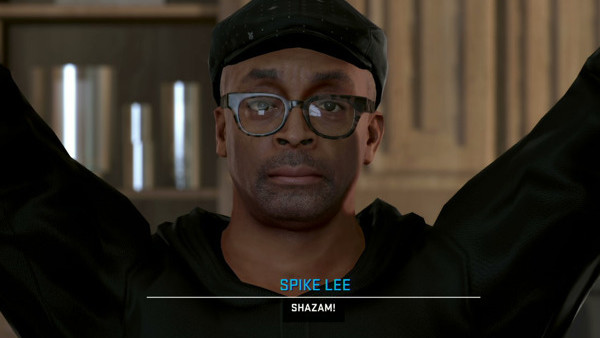
When you attach a big name actor to your game, you better have a good story to tell.
Though, when you attach a big name to write the story to your game, you better have the courage to tell him that his idea sucks.
Spike Lee is one of the best modern movie directors, with classics like Do The Right Thing or Clockers in his filmography. Because he made arguably the best basketball movie of all time, He Got Game, Lee seemed like the perfect man to create a deep and emotionally engaging story mode for the best basketball video game franchise of all time.
Awfully predictable, boring and with no emotions attached to it, the worst feature of the NBA's Story Mode was how detached it felt from the actual experience.
Creating yourself in the game and becoming basketball's next best thing is one of the coolest features of NBA 2K. The fact that you were forced into a certain narrative, which revealed the same scenes no matter your on-court actions (your player could suck, but he was still compared to LeBron James by the commentators), didn't let you actually enjoy them.
Good thing it was over after the rookie season.
2. Call Of Duty: Advanced Warfare

Creating a story for this game presumably took two and a half years. That's really impressive, considering that one of the previous entries in the series, Modern Warfare 2, basically copied Michael Bay's The Rock and got away with it. Here the hype was pretty big, but that's what you can expected when hiring Kevin Spacey to play the game's antagonist.
The deeper level of the game is based on the opposition between masculinity and technological advancement. Jack Mitchell is a soldier wounded during battle.
Thanks to the newest technology he's able to continue fighting. He's experiencing some malfunctions of his equipment, which is supposed to stand as proof that the best tool the soldier has is in his head. This is quite promising and leaves some space for the exploration of said opposition, right?
However, he's fighting using the newest technology against a company which produces the newest technology. He even literally cuts off his ties with enhancement by cutting away his bionic arm. But.. how then will he be able to remain an active soldier? He gets rid of the one thing that allowed him to remain in battle, but... is still able to fight?
Those are just the contradictions in the main story, which was unfortunately as predictable and cliche-ridden as any other Call of Duty game.
1. Fable III

Peter Molyneux is characterized by Jason Schreier as The Man Who Promised Too Much. Rightfully so, as his claims and ideas grew more and more ridiculous with each entry in the Fable series. The creator of the games used to throw around a lot of great concepts which usually didn't come to fruition.
Fable III was beautiful, yes, and the premise of the first part of the game played out quite well. But... was it really that creative? It can be summed up in one sentence: You gather allies to overthrow the king.
Things got worse when you became the king, though. You were presented with choices that were either unpopular but useful or useful but unpopular. You have to admit that preparations for the invasion were really boring.
Soon you found out that the choices between good and evil were oversimplified. Fable III was not a bad game, it's just that it promised too much. Molyneux himself called the game a "trainwreck", which is really telling.