10 Brilliant Video Games That Surprised Everyone
Who'd have thought Uruks would be more engaging than the Fellowship Of The Ring?

Don't you just hate it when an awesome looking game is announced, marketed to breaking point, and a hype train gathers steam only for its release to be a disappointing damp squib that alienates its burgeoning fanbase? Looking at you, WATCH_DOGS and Aliens: Colonial Marines. Similarly galling is when an established franchise releases its latest entry only for it to be a squeaky fart - Mass Effect: Andromeda springs to mind.
But what about the other, altogether more pleasant side of this coin? That lovely surprise we all get when a game that no one expected to be any good turns out to be a new classic? Sometimes developers can pull it out of the bag, restoring our faith in the medium just as we were feeling resigned to accepting more Call Of Duty sequels and lootbox-riddled live-service tat.
Whether it's a new IP that sounded poor on paper, a surprisingly solid movie tie-in or a game that finally escapes its franchise's less-than-favourable legacy, there are plenty of games that gives us that warm fuzzy feeling in a sea of disappointments. Let's give some of those dark horses the recognition they deserve.
10. Assassin's Creed Syndicate

Whilst not a masterpiece, and by no means the greatest entry in the Assassin's Creed series (that honour will always go to Black Flag), Assassin's Creed Syndicate was awaited with dread rather than excitement. Unity, released the previous year, was rife with technical issues and dogged by microtransactions, and many considered it the death knell for Assassin's Creed.
However, the release of Syndicate was a pleasant surprise for a weary fanbase. Its Victorian setting was exceptionally well-realised, dual protagonists Jacob and Evie Frye were likeable and engaging, and combat had had a much-needed revamp. Hand-to-hand brawling was the order of the day, and fights frequently involved large groups of urchins in dust clouds of flailing limbs and broken teeth.
Central assassinations were also vastly improved, and were much more rewarding player than in previous entries. Here the player is simply given a multifaceted location and their assassination target, and is free to go about their kill as they see fit. Want to sneak up on the evil doctor and give him the classic hidden blade treatment? Perfectly viable. Want to pose as a corpse then leap off the operating table and stab him up in front of a theatre full of horrified onlookers? Infinitely funnier.
9. Middle Earth: Shadow Of Mordor

Since Melbourne House's early Lord Of The Rings text adventures released in the 1980s, the Lord Of The Rings franchise has had a bumpy ride in gaming. The film trilogy's video game adaptations were fun enough, but were short, linear and carried the odour of hacked-out licensed games. A slew of dry real-time-strategy games followed, and aside from successful MMORPG Lord Of The Rings online, nothing lived up to the legendary franchise.
That is until Middle Earth: Shadow Of War. An original story bridging the gap between The Hobbit and The Lord Of The Rings, the game focused more on uruks and their role in Mordor than the stories of elves, dwarves and wizards. Quite the risk, considering the lack of depth uruks have been afforded previously.
This risk paid off very well indeed, as the game's much-touted Nemesis System presented a nuanced hierarchy full of power struggles, lively characters and that one uruk who would hound you right up until your final confrontation at The Black Gate. It helped that the combat was both visceral and challenging, and made every battle with this endless army of evil goons feel intense and rewarding. Solid proof that an unusual focus and some narrative risks are worth taking in the world of AAA gaming.
8. Mad Max

Despite releasing in 2015, the very same year as the release of George Miller's masterful Mad Max: Fury Road, Avalanche's entry into the Mad Max mythology is not a direct adaptation or spin-off. It is, in keeping with Mad Max's ambiguous continuity, a separate chapter in the legend of the preposterously-named Max Rockatansky. And it's absolutely head-crushingly awesome.
Taking elements from the original trilogy of films and the newest entry alike, Mad Max places the player in a vast, hostile desert (a lot of which turns out to be a dried out ocean floor). True to form, Max's overarching goal is simply to get his car back from the even more preposterously-named warlord Scabrous Scrotus. The gameplay focuses on vehicular combat, a genre which has barely seen the light of day since the late 90s, and executes this with incredible style and aplomb. Suped-up cars thunder across the wasteland, battling it out and exploding in a showers of white hot metal and glass, and the trail of destruction left behind is a sight to behold.
The game's other elements also fit together very well, with hand-to-hand combat feeling weighty and muscular and the game's central car-customisation mechanic allowing the player to construct their very own magnum opus of a vehicle.
7. Batman: Arkham Asylum

2009's Batman: Arkham Asylum was an unexpected entry in Batman's gaming portfolio, and one which made a greater impact than could have possibly been imagined at the time. After a string of mediocre side-scrolling beat-em-ups in the 80s and 90s, and then a host of 3D games that ranged from forgettable to atrocious, there was no real benchmark.
Arkham Asylum was released slap-bang in the middle of Christopher Nolan's Dark Knight Saga, with the franchise enjoying a renewed level of appreciation a decade after Joel Schumacher's bad acid trip that was Batman & Robin. Rather than cash in on Nolan's universe, however, Rocksteady opted to take primary influence from the universally beloved Animated Series, bringing in veteran voice actors Kevin Conroy, Mark Hamill and Arleen Sorkin to voice Batman, The Joker and Harley Quinn respectively.
The result was a game with exceptional atmosphere and design, and perfectly balanced gameplay. A well-crafted mix of methodical detective work and a balletic, free-flowing combat engine that has since been co-opted by almost every melee-focused gaming franchise. This is a game where you truly feel like Batman - a master of bat-deduction, bat-stealth and bat-punching dudes.
6. Mario + Rabbids Kingdom Battle

What happens when you take gaming's most beloved mascot and pair him with gaming's most irritating, obnoxious army of screeching sidekicks? And what happens when you pair them in a game whose genre is completely alien to both franchises? Somehow, you aren't greeted with the stream of diarrhoea one would expect from such ludicrous choices - instead, you're treated to Mario + Rabbids Kingdom Battle, an incredibly well-executed turn-based tactical RPG in the vein of the excellent XCOM: Enemy Unknown.
The gameplay itself is deep and well-balanced, requiring a lot of thoughtful strategy - but featuring special abilities such as bouncing off teammates to deal damage and traverse the battleground. These additions refer effectively to the Mario series' platforming roots, resulting in a neat blend of strategic action and acrobatic fun. The heightened mobility of both enemies and player characters promotes an aggressive play style, and the game therefore keeps pushing forward rather than getting bogged down.
The game's design is dripping with visual personality throughout, and its beautifully animated cutscenes convey a lot of satisfying physical comedy - the Mario/Rabbid hybrid characters are nothing short of genius in their portrayal. And of course, you get to shoot Rabbids in the face with a shotgun. What more could you ask for?
5. The Mummy Demastered

Whether your favourite cinematic iteration of The Mummy is Universal Pictures' 1932 pre-code masterpiece, Hammer's macabre and atmospheric 1959 work or the swashbuckling 1999 remake of the original is entirely up in the air. Nobody's favourite, however, is the utterly forgettable 2017 Tom Cruise vehicle, which resulted in Universal's abandonment of their much-touted upcoming cinematic Dark Universe.
A tie-in video game was developed for The Mummy 2017, and somehow managed not to be the usual hacked-out, tired action-adventure that blights most movie tie-in games. In a bizarre inversion of the classic "excellent movie, terrible game" trend, The Mummy Demastered was a 2D Metroidvania reminiscent of the absolute best entries in the genre. Taking place concurrently to the events of the film, the player controls a Prodigium soldier under the command of Dr. Henry Jekyll - and interestingly, when killed, is thrust into the body of a different soldier who then has to retrieve their equipment from their zombified former self.
The game's pixel art is gorgeous, closely resembling later 2D Castlevania titles, and the gameplay shows a mastery of the genre, showing it a level of respect not commonly seen in tie-in works.
4. Resident Evil 7: Biohazard
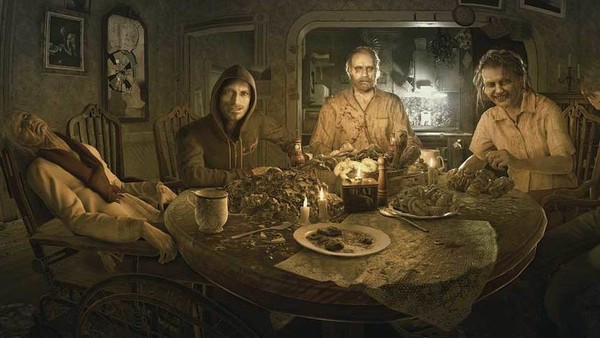
The Resident Evil Franchise has a fascinating cycle of death and rebirth over its nearly 25-year history. Its original trilogy on the PS1 was clunky but effective and tense, codifying survival horror as we know it. Just as it was starting to feel tired and repetitive, Resident Evil 4 dramatically shook up the formula with its campy, action-oriented romp - and massively influenced the action and shooter genres as a whole. The next two games and their respective expansions marked a steep decline, resulting in messy, cluttered gameplay, atrocious writing and an absence of horror.
How then, could the series possibly recover? Once again, the formula was shaken up, taking influence from titles such as Amnesia and Outlast - a new wave of first-person survival horror titles low on combat and high on tense, high-stakes evasion of unbeatable enemies. Resident Evil 7: Biohazard took those titles' claustrophobic first-person insta-kill horror and mixed in just enough combat segments to create a unique blend that was both tense and terrifying, and exciting and cathartic.
The game's DLC has already stripped away a lot of the soft reboot's mystique and charm but with Capcom's excellent RE2 remake garnering critical acclaim and the upcoming RE3 remake (Resident Evil Threemake, anyone?) on the horizon, the series is definitely enjoying a renaissance of sorts.
3. Wolfenstein: The New Order

The first-person shooter is king, and Wolfenstein was where it all started. Okay, so technically FPSs existed as far back as the early 1970s, but 1992's Wolfenstein 3D truly ushered in the genre with its ultra-violent action. Reducing Hitler to a pile of giblets was one of gaming's defining moments. After a string of sequels that were decidedly lacklustre, with the exception of 2001's fantastic Return To Castle Wolfenstein, the series was floundering. World War 2 was a stale setting, with the industry turning its gaze to modern settings, and Wolfenstein's bombastic tone was falling behind more nuanced, character-based storytelling.
And then MachineGames struck gold with 2014's Wolfenstein: The New Order. Set in an alternate 1960 after the Nazis secure victory, The New Order succeeded in both exhilarating Nazi head-stomping and tender, emotionally resonant character interplay. B.J. Blazkowicz, a man the size of a tank with the ability to dual-wield automatic shotguns carried a sense of vulnerability - a tragic weariness at a war that he may never be able to win. His determination, however, resulted in gameplay that was louder and more exciting than ever. And there's a bit where you drown a Nazi in his own piss. Perfection.
2. Spider-Man 2

Until 2004's Spider-Man 2, video games had not been kind to the wall crawler. After his early 2D outings, most of which were generic beat-em-ups and appearances in the Marvel Superheroes and Marvel Vs. Capcom series, the webslinger starred in two serviceable PS1 titles and a short, dull entry on the PS2 as a tie-in to Sam Raimi's 2002 movie. These 3D titles all made the same mistakes: setting too many missions in pokey indoor environments and relegating Spider-Man's most iconic trait (the web-swinging, not his insufferable sense of humour) to a perfunctory, automated method of getting from rooftop A to rooftop B.
It was Spider-Man 2, another movie tie-in, that finally hit home. Loosely based on the Sam Raimi sequel and this time set in a reactive, open-world realisation of Manhattan, swinging around the city and living the life of your friendly neighbourhood Spider-Man was front and centre. The art of swinging between buildings and traversing the landscape was wonderfully implemented - each web actually had to attach to an object and further swings needed to be timed properly to maintain momentum and steer Spidey properly. It was endless fun, and had us swinging about thwarting random crimes and rescuing lost balloons for hours.
1. DOOM (2016)

If Wolfenstein was where first-person shooters truly began, then it was Doom that propelled them violently and gorily to stardom. Such is its universal recognition, it was even referenced in Friends. It's interesting then that while Wolfenstein has spawned a large number of sequels, spin-offs and reboots, Doom has had comparatively few.
Doom II, whilst a solid game, was essentially just more Doom. Very little had been done in terms of graphical or gameplay enhancements, and areas of improvement concerned the use of larger levels above all else. Doom 3, released 10 years later, was technically groundbreaking, but lifeless. Its simplistic AI and over-reliance on cheap jump scares in uninspired environments made for a game that was playable but forgettable. As the years passed, realistic military shooters such as Call Of Duty dominated the scene, and storytelling took centre stage. Was a franchise based on bombast and raw, aggressive gameplay, for lack of a better word, doomed?
Was it f*ck! Id's 4th entry, simply titled DOOM, ripped and tore its way onto systems in 2016, treating players to a true-blue update of Doom's original premise: to kill demons and never goddamn stop. With its unrelenting action, crushing industrial djent soundtrack and visuals stained red with fire and gore, Doom is a game so intense you'll feel both empowered and exhausted.