10 Dialogue Choices That Were Devastatingly Different From What Your Character Actually Said
Fallout 4's dialogue wheel is the worst.

Many great video games are built on the promise of freedom, of allowing players to explore vast, sprawling environments and truly transport themselves to another world.
In the RPG genre in particular, this also typically extends to giving players dialogue options to choose from, with the intent of creating a more personalised experience, where the player feels ownership over both their protagonist and the branching story.
But as fantastic as dialogue options can be, it's also extremely difficult for developers to get it all totally right, as evidenced by the countless games which have ended up leaving players confused if not furious with the misleading dialogue choices on offer.
These 10 games all infamously misled players with their vague or paradoxical dialogue options, ensuring that many players were left to deal with an inappropriate response or aggressive over-reaction from their protagonist, to the extent of perhaps even restarting the mission itself entirely.
Nobody's saying that creating complex dialogue trees is easy, but is it really that difficult to ensure players at least have a clear picture of their choices?...
10. "Shove Dijkstra Aside. Forcefully" - The Witcher 3: Wild Hunt

One of the most infamously off-base dialogue choices from any game occurs in the brilliant The Witcher 3.
During the main story mission "Blindingly Obvious," while speaking with Dijkstra you're given the option to either make a deal with him in order to be let go, or simply shove him aside, forcefully, and go on your merry way.
Players who pick the latter option will then be treated to the sight of Geralt brutally punching Dijkstra to the ground, then grabbing his leg and breaking it.
It's a wildly disproportionate response to both the situation and the option the player selected, and doesn't in any way approximate a firm but reasonable shove.
Furthermore, this option ends up affecting the ending the player receives, largely for the worse, despite there being no clear indication that Geralt was about to unload an enthusiastic and excessive can of whoop ass on the guy.
9. "Don't Trust Connor" - Detroit: Become Human

Though Detroit: Become Human boasts an impressive number of narrative permutations, with characters able to die long before the game reaches its actual conclusion, the vague, often single-word dialogue and action options available to the player can result in frequent misunderstanding.
This reaches its infuriating apex when, as android revolutionary Markus, the player is asked whether or not to trust android cop Connor. It seems like either option will lead to an intriguing dramatic dialogue, right? Well, not quite.
Players who pick "don't trust" will then be shocked to see Markus immediately pull his gun and shoot Connor in the head, which is obviously a million miles away from the action most players intended.
Granted, this results in a new, non-deviant version of Connor being sent out into the field rather than the character being gone for good, but even so, it's pretty damn traumatic to see him needlessly mowed down after the player has spent most of the game slowly warming up to him.
8. "Good Cop, Bad Cop" - L.A. Noire

Nobody can deny the impressively innovative technology behind L.A. Noire, a game which placed a huge emphasis on players reading the photorealistic facial expressions of the suspects and witnesses they interrogate.
Except, the game's original release was hobbled by Team Bondi's peculiar decision to give the player three vague tonal dialogue responses - "truth", "doubt", and "lie."
The main issue was with the doubt option, which would too often result in protagonist Detective Cole Phelps angrily shouting at sometimes vulnerable witnesses despite that not in any way being the player's intent.
Ultimately, it made Phelps look like not only a poor detective but, frankly, a bit of a psychopath.
Though the recent remaster did try to clarify these options by altering them to "good cop," "bad cop," and "accuse," it arguably only made things more ambiguous and confusing.
Clearly, the game needed more specific lines of dialogue for the player to choose from, because many were left sitting through hilariously uncomfortable scenarios where Phelps would bully sobbing witnesses who clearly didn't do anything wrong.
Given that we're supposed to actually feel sad when Phelps dies at the end of the game, the dialogue system didn't help endear players to him in any way whatsoever.
7. "Tell Him Off" - The Walking Dead: A New Frontier

It's fair to say that Telltale's episodic adventure games have been relatively disappointing on the freedom front, offering up a shallow, superficial illusion of choice at best.
Equally frustrating was the series' oft-vague and non-specific dialogue options, which came to a memorable head in the second episode of The Walking Dead's third season, A New Frontier.
When protagonist Javi's brother David starts giving him some lip, the player has two options - "Tell him off" or "Let it go."
Picking the former quite clearly implies that Javi will simply stand up for himself, but in actuality, it results in Javi wildly over-reacting, telling David that his wife Kate is planning to leave him, which surely isn't what any players actually wanted.
It's bad enough that there are forums full of players admitting that they restarted the episode after encountering this misleading "choice," due to how abruptly and needlessly it disrupted the central character dynamic. Like, what the hell?
6. All The Paraphrased Dialogue Options - Fallout 4

In the case of Fallout 4, we're not so much talking about a specific dialogue exchange as we are the game's depressingly reductive and vague dialogue tree.
While previous games in the series gave players entire lines of dialogue to choose from, Fallout 4 instead offered up brief, paraphrased approximations which were often infuriatingly opaque and difficult to parse.
So often it feels like you're simply picking the least-confusing option and hoping for the best, though as is typical of Bethesda, they left it to their community to fix the issue, and shortly after the game's release, a "Full Dialogue Interface" mod was released.
This mod replaced the paraphrasing with the full line of dialogue your character, now fully voiced for the first time in the series, was about to speak.
The unfortunate side effect of this mod, however, is that it also made painfully clear just how limited and non-varied the four dialogue options really are in the game.
Still, the mod provides a simple alteration to a game that, out of the box, doesn't nearly present enough nuance to players, resulting in them frequently picking an undesired string of dialogue. Terrible.
5. "Thoughts, Solas?" - Dragon Age: Inquisition

As beloved as BioWare is for its imaginative RPG games, the company is also frequently raked over the coals by fans for their tendency to defer to weirdly misleading dialogue choices.
This is apparent throughout the Dragon Age franchise, but never more than in Inquisition, and most memorably, in the main quest "Here Lies the Abyss."
When the player and their party ends up in the metaphysical realm known as The Fade, party member Solas will comment that the Black City is nearby.
The player is then given three dialogue options - "It's amazing," "Thoughts, Solas?", or "Focus, Solas."
Selecting the second option would seem to suggest the player wants Solas' insight on their present location, but instead The Inquisitor will mockingly tell Solas, "This must be very exciting for you, Solas. Any advice you have on what exactly's going on would be wonderful."
It's a needlessly mean and totally unwarranted put-down, and honestly feels more fitting for the third dialogue option than the second.
It's possible this was as much a result of improper voice direction as anything else, given that without the same sneering tone, the line wouldn't sound nearly as antagonistic.
4. The Post-Race Interviews - F1 2019
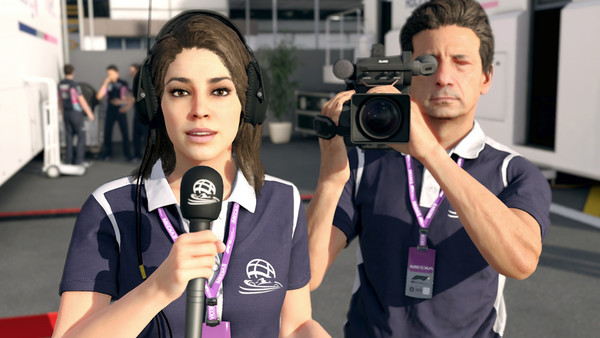
The more recent F1 games have introduced post-race press interviews, in which the player is grilled by the Scottish lass Claire, and given three dialogue options to respond to a variety of questions.
One answer will be the sportsman's answer, another will be for the showman, and the third will be neutral, though often there's a frustrating ambiguity between which is which, and as a result you won't always get the desired outcome.
For example, if you lose a race and Claire gives you the opportunity to assign blame to your teammates, a seemingly neutral response that blames nobody can still cause your reputation to drop.
The questions and answers really feel semi-random at times, often only scarcely relating to the events of the race you just partook in, which doesn't make it any easier for players to try and figure out the most advantageous answer.
3. "Sigh" - Mass Effect
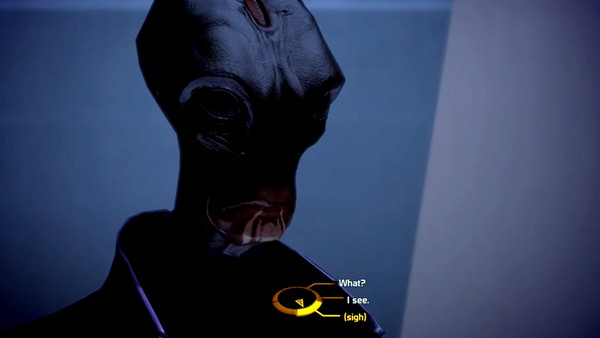
With another BioWare game comes another needlessly cruel dialogue response far away from what most players actually wanted.
When the player crosses paths with Chorban and asks him about him supposedly trying to kill his partner, you're given three rather piecemeal responses to his admittedly flimsy excuse.
Those options are "What?", "I see," or a simple sigh. Picking the latter would suggest the player would simply sigh in exasperation at Chorban, right? Except, this leads to Commander Shepard quipping back, "I should kill both of you idiots."
While the comment is said in a certain snarky jest, it still feels like a needlessly aggressive, mean-spirited retort compared to what most players were actually wishing to convey.
2. All The Vague Dialogue Choices - Star Wars: The Old Republic
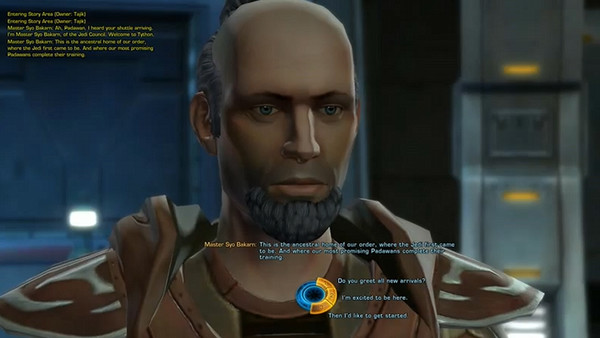
Our third and final BioWare pick is from their under-appreciated MMORPG Star Wars: The Old Republic, which while hardly the "World of Warcraft killer" it was promised to be, nevertheless offers one of the most cinematic and involved MMO stories on the market.
A shame it was, however, that this didn't extend to the game's lacklustre dialogue and action options. Players could choose from three responses, which were typically paraphrased down to a few short words, while the actual response could be up to a few sentences long.
But more frustrating was how the upfront choices gave zero impression of tone, and so it was extremely common for a seemingly innocuous remark to come across far more snide, even aggressive, in actuality.
At least long-time BioWare players should know by now that the third option is always the evil, blood-thirsty one.
Also, quick-thinking players could at least mash the escape key and cancel the conversation, allowing them to start it all over again. However, if the conversation was completed before you were able to act, it stuck for good.
The frustration among fans led to the creation of this famous meme:
1. "Glass Him" - The Wolf Among Us
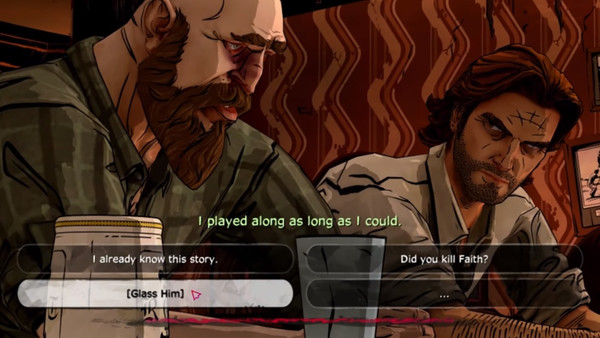
But in what must surely be the most infamously off-kilter dialogue choice in recent video game history, we return to Telltale for their (mostly) fantastic fairytale noir romp The Wolf Among Us.
While protagonist Bigby is chewing the fat in a bar with The Woodsman, the player is given four options - "I already know this story," "Did you kill Faith?", "[Glass him]," and typically, a non-response option.
Picking the third option will result in Bigby grabbing his drink glass and smashing it over The Woodsman's head out of nowhere, and while this might've been obvious enough to British players more familiar with the colloquialism, to players in other English-speaking regions, it wasn't quite so clear.
Many assumed that "glassing" Woodsman meant to get him another drink, rather than, you know, violently assaulting him.
The option is honestly totally out of place no matter your playstyle, but all the more hilarious and shocking to those not familiar with the term.