10 Iconic Moments That Defined Assassin's Creed As A Series
 Remember 2007? Me neither, but in the time between then and now the Assassin's Creed franchise has spawned six main instalments, three portable spin-offs, six supplementary mobile games, a wealth of graphic novel accompaniments, and even three short films. Ubisoft have managed to weave a fairly rich tapestry of historically-accurate locales twinned with an ever-intrusive sci-fi element that reached its zenith in the third instalment, only to be given a brilliant revival in Black Flag. Perhaps at this point youre still sitting on the fence in regards to the series, thinking that all the talk of precursor alien races and magical apples has passed you by. Well to you, I point over here, and to the rest of us who have enjoyed all the main console entries to the series, lets dive back into the annals of the franchise to celebrate why its become one of the most successful video game franchises of the current generation. Spoilers will be liberally tossed about, so please feel free to jump in with your comments on all aspects of the series.
10. Your First Flawless Assassination
 Ill take a wild stab in the dark (with a pun fully intended) and assume that most people ended up getting spotted at the last minute, or otherwise fumbled their approach to kill in the first few games. This was mainly due to a lack of visual systems accurately telling you where you were in relation to the enemy, as well as animations that favoured the more open-world aspects of the game as oppose to the rarer small corridors or indoor markets. However speaking of market stalls, one of the first assassinations the game has you do is approach a man who is milling around amongst a swarm of innocent people. Like a hooded Agent 47, you make a beeline straight through the crowd, and using the hidden-blade casually gave him a cheeky one in the kidneys, before disappearing into the furore of gasps and swarming attention the crowd exhibit upon the discovery of your deed. Moments like this were sublimely iconic, and although Ubisofts trailers for the games leaned more heavily on taking your enemies on head-first, those of us with a penchant for some ultra-slick ninja-embodiment always at least tried the silent approach first.
9. That First Viewpoint Synchronisation
 For many the first Assassins Creed was a system-seller, being that a combination of exotic locales, rooftop free-running and hidden-bladed assassinations was all too much to pass up. Some still regard the first AC as something of a misstep due to its reliance on repetitive build-ups to the main missions, however what completely sold me on the franchise from the off, was the gorgeous vistas you get to inhabit. Synchronisation is the gameplay element of darting up the side of the highest building in a given area, prodding a corresponding button, and having the camera whoosh away out and around as you take in the phenomenal amount of man-hours that must have produced such an insanely detailed cityscape. Sitting there comfortably as you breathe in the ancient world(s), a sudden thought of but how do I get down!? sinks in, just as the game prompts you dive into a tiny bale of hay that was some 250ft below. Cue the introduction of the now infamous eagle-scream sound-effect as you deftly dove down, Jesus Christ-posing as you went, into the all-catching safety of the hay, or even just a pile of grass. You were after all, in your mind at least, Lord of The Skies at this point.
8. Eventually Fighting as Desmond in AC II
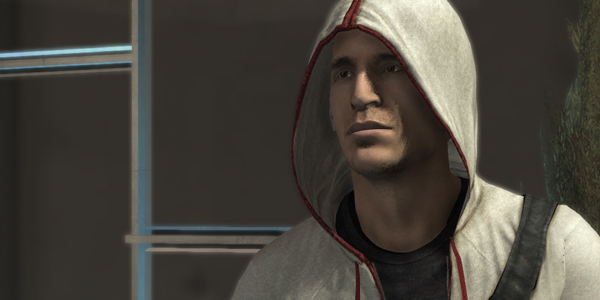 Following the convergence of timelines at the end of Assassins Creed II by way of the prophetic message Ezio receives, you then awake as Desmond in the present day, under-siege by Abtergo scientist Vidic and his troops. Up until this point in the game Desmond had been a tool for exploration, yet this follows a previous cutscene where fellow modern-day Assassin Lucy Stilman gives Desmond his own hidden blade. Thanks to the Bleeding Effect of Altair and Ezios weapon skills transferring through, you finally got the chance to wield the blade in the present day, cutting through small numbers of goons with ruthless efficiency. Although you manage to get pretty close to Vidic, he taunts you and takes off in the back of a van, although that would only be the start of many Desmond-fronted combat scenarios.
7. Using the Golden Apple
 The plot-twist-reveal that your mentor Al Mualim actually wanted to harness the power of The Apple for himself is in itself one of the most memorable moments from the first game. However it was with the subsequent deploying of the artefacts power that the series did its first and most remembered tonal gear-change. No longer were you bound by the relative realism of Altairs tale, instead the modern sci-fi elements seeped through into his timeline, as Al Mualim uses the magical Piece of Eden to restrain Altair in mid-air, as well as creating various clones of himself to do battle. Its a very potent thematic-shift, and one that immediately established the franchise as its own entity, pairing the extremely-accurate historical landmarks and affectations with a more science-fiction-esque backdrop. Whether or not you could fully get onboard with this would be the deciding factor on whether or not you found the resulting Desmond Sections to be something of a grind, and as has been somewhat proven in Black Flag, the studios strength most definitely lies in letting you spend as much time inside the Animus as possible.
6. Calling In Your Assassin Reinforcements
 Brotherhood remains one of the strongest, most easily-revisit-able entries to the series. Taking the solid locales and advanced mechanics of Assassins Creed II, what was layered on top were more brilliantly fun missions for a game engine that was in its prime, and an abundance of infectious remarks from fan-favourite Ezio Auditore de Firenze. However the biggest addition was that of a 'Contracts' mode that put into play the idea that you were actually building the Assassin Order you'd heard so much about in the present day. Sending assassins off on various errands and separate missions in a managerial-style was a slick way of advancing the influence of the player in the world around them, without forcing you to play through a load of what would surely have been recycled environments, somewhat akin to the moon bases within the inaugural Mass Effect. The biggest benefit of all of this behind-the-scenes-tinkery was that in battle you now had a button specifically for calling your reinforcements in. Queue many instances of being The Boss-man, nonchalantly strolling through a compound as guards around you are being roundly ventilated. As well as this, if you needed a target taken care of from a distance, a quick tap of the button would yield the iconic Assassins Creed eagle-cry, and one of your guys would drop in out of nowhere to take them out. Amazingly fun stuff.
5. The Subject 16 Reveal
 Back in the first game, when the modern-day plot elements were still being drip fed to you, as oppose to thwacking you over the head in a manner akin to one of Halos Gravity Hammers, the offices of Abstergo were actually a joy to poke around. This is an idea that has made something of a return in Black Flag, but for the most part, the reason Ubisoft have gotten away with such increasingly-crazy plot threads, is due to laying so much solid groundwork. One such golden nugget of information you can uncover on your travels is figuring out that someone prior to you has been experimented on. With the game slowly putting into play the notion that you as modern-day Desmond were gradually learning the abilities of your ancestors through the Bleeding Effect, a post-credits wander may have made you flick on Altairs Eagle Vision only to see a wall-full of scribbling from the (then-unknown) Subject 16; Clay Kaczmarek. The information within hinted at the wider narrative that would eventually come to be, although Im sure at that point in the series Ubisoft hadnt planned out just how many twists and turns they were going to throw at us.
4. Ezio meets Altair
 Although Assassins Creed II ends on one of the best plot-bombshells in gaming history, Brotherhood almost destroyed all that momentum trying to outdo its brethren, by having a possessed Desmond kill the nerd-baitingly alluring Lucy Stilman (brought to life by Kristen Bell) to close the game. However the now spiralling fiction was saved by giving original hero-turned-mystery-man Altair his due with a final resting place. Even though (outside of the main console entries) until Revelations wed only played as Altair once, in a rather Metal Gear Solid 2-esque way, the actions of his later life were constantly referenced and seen throughout Ezios games. This meant that the finale of Revelations, where Ezio finally finds the decayed body of Altair sitting proudly in his library chamber, was a great way to literally tie their two paths together, ending with Ezio instructing present-day-Desmond to make sure all his effort was not for nothing.
3. Getting Your Double Hidden-Blades
 With the first game being much heavier on tension, the frequently-stylish fights being more of an indulgence than a vital part of the game, so it was over to Assassins Creed II to take all the potential the first instalment had, and make the game they always should have. What's the best way to make it immediately apparent that a development team means business? Double-up on the signature weapon of course! Whilst we all wait for some future instalment of Gears of War to allow dual-wielding of their chainsaw-fronted Lancers, that moment in Part II where as Ezio you first take to a nearby rooftop and spy a two-man foot-patrol down below, only to leap off and come crashing down on both of them, remains a defining reason as to why AC II is the best in the franchise.
2. How Dya Like Them Apples? Achievement
 In a move more ballsy than a childs play area, Ubisoft opened Assassins Creed III not putting you in the shoes of the man youd seen adorning every piece of promotional material surrounding the game. Instead you were Haythem Kenway, a perfectly serviceable ass-kicker in the ways of the Assassin discipline, or was he? After what became an extremely arduous and drawn-out prologue the length of which would make Battlefield 4 baulk, Haythem eventually revealed to his band of (who we thought were) Assassins, that the group are actually Templars, the antagonistic force that has permeated every entry into the series thus far. After spending such an amount of time with this character, he was then turned into the villain, which after the absurdity of everything else in the franchise thus far was a breath of fresh air, injecting a much-needed drive into the proceeding game that sadly ended up dissipating as time went by.
1. The Minerva Reveal
 Remember back when Assassins Creeds storylines were actually brilliant? Back when they knew what they were doing, and hadnt fell off the deep end, frantically trying to put together a semi-plausible plot that equally upped the ante, yet stayed true to the historically-accurate fiction? That was many moons ago, so many in fact that Ubisoft really had to pull something special out the bag to resuscitate this aspect of the game with Black Flag. Anyway, back to that moment in AC II when it was revealed an ancient race of godlike-beings were actually choosing Desmonds bloodline to be their salvation. Ezio has just defeated the evil Rodrigo Borgia. You enter a dark chamber illuminated by many futuristic-looking lights and dials, clearly not in-keeping with Renaissance Italy. Then the holographic Minerva appears, and literally addresses the player by looking straight at the camera. Narratively she was speaking to Desmond who had been in control of Ezio the entire time, yet with player agency in full-effect, this was a landmark moment for the overall Assassins Creed canon, instilling the same what the f**k?! as Desmond exclaims after he sees the same event. Her resulting exposition planted many seeds that the series would never be able to keep track of in a satisfying manner, but for those few minutes where the entire game was jumping the shark in the most delightfully absurd way possible, it was amazing. So what did you guys make of the series as it went on? Have you managed to stick with it through the ups and downs, or was it just one or the other? Let us know in the comments!