10 MORE Video Games You Didn't Know Were Connected
Metal Gear and Silent Hill exist in the same twisted universe.
The very best video games are usually defined by their potent world-building and imaginative storytelling, such that they tantalise their players with endless possibilities often left unfulfilled or only hinted at.
And what better way to leave players wanting more than suggesting a wider, more sprawling universe beyond the game's bounds, and perhaps even one where another video game property might co-exist?
In these 10 cases, two hit games, typically AAA franchises (but not always), paid homage to one another beyond dropping a mere Easter egg - they implied, subtly or not, that they may well share the same physical world.
Now of course, it's unlikely most of these franchises will ever give fans concrete confirmation by way of a crossover title, but the prospect of their worlds being intertwined, no matter how loosely, is extremely exciting all the same.
Whether simply a case of a publisher deciding to advertise one of their games in another, or a former developer wanting to pay homage to a previous game they worked on, these seemingly diffuse franchises are connected in ways you surely never expected...
10. Dead Rising/Left 4 Dead
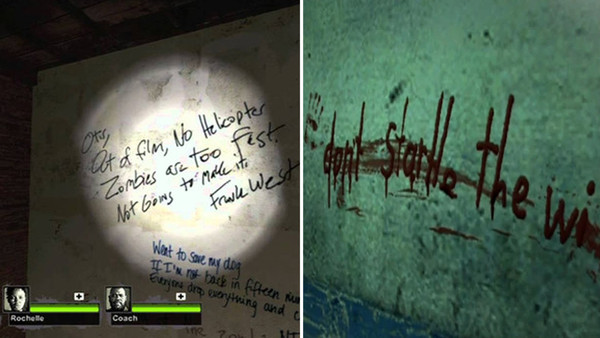
The Left 4 Dead franchise is an utter goldmine of sneaky Easter eggs and references, and while the majority of these nods are pretty throwaway, there's one that connects the co-op zombie series to its undead brethren, Dead Rising, with an elegant simplicity.
In Left 4 Dead 2's DLC campaign "The Passing", one of the safe houses has graffiti scrawled by a familiar name.
It reads, "Otis, out of film, no helicopter. Zombies are too fast. Not going to make it", signed by Frank West, who was of course the protagonist of the first and fourth Dead Rising games.
Roughly a year later, Dead Rising 2 returned the favour with its "Case West" DLC, where players could find the phrase, "Don't startle the wi-" written in blood in an underground tunnel beneath the Phenotrans Facility.
The "wi-" is a nod to the Witch enemy from Left 4 Dead, which upon being startled by the player can dole out an insta-kill.
Between these two well-placed tips of the hat, is there any dispute that these games reside within the same universe?
9. Grand Theft Auto/Manhunt
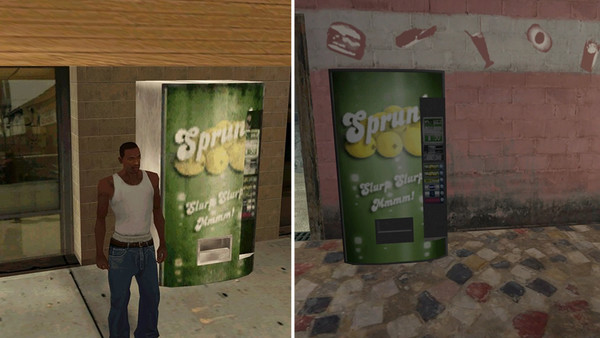
Rockstar Games is no stranger to implying causal links between their various video game franchises, but none fit together quite as neatly as Grand Theft Auto and the ultra-controversial Manhunt.
There have been countless references between the two series over the years, though the majority of them are subtle enough to be easily missed.
One of GTA III's radio stations mentions Carcer City's proximity to Liberty City and namedrops its corrupt police chief, Gary Schaffer, who is an unseen fixture in Manhunt.
Vice City features several stores which are also seen in Manhunt, as well as the Sprunk soda vending machines, which would subsequently appear in both Manhunt and every major GTA game since.
San Andreas and GTA IV include many more visual and verbal references to the city, while Manhunt 2 liberally mentions Vice City and San Andreas, and also features numerous cars seen in the GTA games.
And if that's somehow not quite enough, in GTA V Michael even directly mentions Carcer City as the location of his first score. But again, if you haven't played Manhunt in quite some time - and let's be honest, most of us haven't - these connections are all easily missed.
8. Jak & Daxter/Uncharted
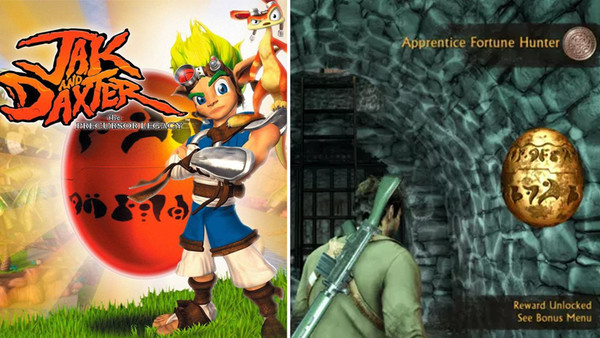
Years before Naughty Dog blew everyone's minds with the Uncharted franchise, they were scoring consistent acclaim for their Jak and Daxter platformer franchise.
The very first game, Jak and Daxter: The Precursor Legacy, was released back in 2001, and one of the game's most memorable collectables was the Precursor Orb, an orange egg-like object with a distinctive, esoteric design printed on it.
The Orbs re-appear in the Uncharted series as the singular, tough-to-find "Strange Relic", and though it's easy to pawn this off as a quite literal Easter egg, there are those fans who believe it suggests the games (somehow) share the same continuity.
If you want to get into more definite Easter egg territory, then Nathan Drake's wetsuit bears the logo "Ottsel", which also happens to be the name of the species Daxter belongs to (an otter-weasel hybrid).
This isn't the only of the developer's games Uncharted has a link to, though: Uncharted 3 features a newspaper referring to the Cordyceps fungus from The Last of Us, and Uncharted 4 of course sees Nathan and Elena playing Crash Bandicoot on a PS1.
But the Jak and Daxter connection is much tougher to come by, and it's ultimately the most tantalising of the lot.
The Last of Us and Uncharted co-existing in the same world makes too much sense, but Jak and Daxter and Nathan Drake chasing the same shiny Orbs? Why the hell not?
7. Metal Gear Solid/Silent Hill
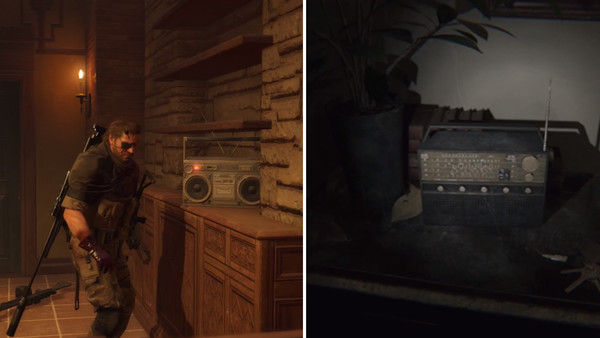
The Metal Gear Solid and Silent Hill franchises were of course both published by Konami, but the nods between the two series ultimately prove a little too intimate, pointed and downright discomforting to be merely playful, disposable references.
For starters, in the Graniny Gorki lab section of Metal Gear Solid 3, enter a library-like area and you'll see paintings of Alessa Gillespie from the first Silent Hill and also of God from Silent Hill 3.
Things get much more interesting when we consider Metal Gear Solid V, which includes numerous nods to Hideo Kojima's P.T., the Playable Teaser for what was intended to become the new Silent Hill game, Silent Hills (before Konami unceremoniously canned it).
Originally, Hideo Kojima intended for Big Boss to be able to deploy a decoy version of P.T.'s terrifying Lisa to distract enemies, but it was cut from the final game. As for what actually made the retail release?
In the Ngumba Industrial Zone, you can find a tent with a radio (well, a boombox) airing the very same deeply unsettling broadcast about a series of murders that was featured previously on P.T.'s grotty radio.
Elsewhere, you can find a song from P.T. on one of MGS V's cassettes, and numerous other sound effects and environmental objects which were "re-purposed" for the AAA sequel.
On the flip side, a teaser trailer for P.T. provided a grotesque cameo for Chico, who rather infamously appeared in the MGS V prologue Ground Zeroes. In the P.T. trailer, his severed head can briefly be seen screaming as it sprouts tentacles from its mouth. Charming.
It follows that a games developer as singular - and, let's face it, as bats*** crazy - as Hideo Kojima would find a way to link two otherwise disparate IP together.
Quite how the internal logic operates is anyone's guess, but hasn't that always been the case with Kojima? And isn't that why we love him so?
6. Just Cause/Sleeping Dogs

It's not much of a secret that Square Enix's Sleeping Dogs and Just Cause 2 enjoyed a neat little crossover, with players able to download Rico Rodriguez's iconic duds for Sleeping Dogs' hero Wei Shen to wear.
And while it's easy enough to pawn that off as nothing more than a cute cross-promotion, a sneaky sliver of dialogue in Sleeping Dogs hints at a shared world between the two games.
Listen to the radio carefully in Sleeping Dogs and you might hear a commercial for the island of Panau, the fictional setting of Just Cause 2.
The advertisement even name-drops two mission-centric buildings from the game, the Three Kings Hotel and the Panau Falls Casino, but even so, it flew over most players' heads.
Given how easy it is to imagine these two games existing on the same version of Earth, it makes all the sense in the world to play up the connection.
5. Hitman/Kane & Lynch

Though the Kane and Lynch franchise came and went without much fanfare about a decade ago, that didn't stop IO Interactive giving the characters a fleeting, final farewell in 2012's Hitman: Absolution.
Its predecessor, 2006's Hitman: Blood Money, featured a newspaper clipping alluding to the demented duo's crime spree over a year before the first Kane and Lynch even came out.
Absolution meanwhile opted to give them a sneaky cameo outright, with the player able to find Lynch hanging out at a bar and later a prison, while Kane can be found letting off some steam at a firing range.
But the best part of all? You're actually able to kill them both, effectively giving the characters a suitably violent ending after the series was canned due to the second game's commercial failure.
4. Mario/The Legend Of Zelda

Fans are going to debate the possibility of Mario and Zelda existing within the same universe until the end of time, but what can't be denied is that these franchises, both created by Shigeru Miyamoto, love to reference one another.
Perhaps the all-timer example appears in The Legend of Zelda: The Ocarina of Time, where in Hyrule Castle you can find paintings of Mario, Luigi, Peach, Yoshi and Bowser visible through a window.
While at first glance these paintings might seem like harmless Easter eggs, when you consider that paintings in the Mario franchise typically act as portals to warp to levels, one can't help but wonder if they might work similarly in Hyrule.
This ties in to a long-standing theory that Hyrule and the Mushroom Kingdom could be neighbouring nations, especially as the two franchises have occasionally borrowed each other's enemies or feature designs bearing a significant similarity (Zelda's Deku Baba compared to Mario's Piranha Plant, for instance).
Seriously debating the possible shared continuity of Mario and Zelda is probably a fools' errand, yet the nods to one another are significant enough to raise eyebrows, if still easily missed by the more casual player.
3. Red Faction/Saints Row
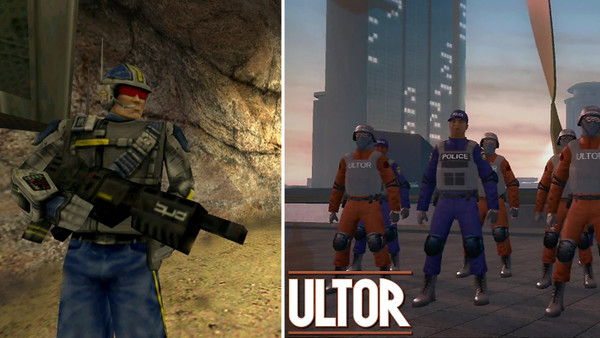
Nobody could really blame you for not paying too close attention to the Saints Row games, ludicrously fun though they are to play.
From the second game onward, the series has counted the Ultor Corporation, known for its clothing, media and military operations, among its many villains.
This name wasn't merely rustled up out of nowhere for Saints Row, though: it had its origins many years earlier in the original Red Faction - also developed by Volition - which depicted Ultor as an evil mining outfit seeking to exploit desperate miners, Total Recall-style.
Red Faction takes place in a far-flung future many decades after Saints Row, so the obvious implication is that Ultor moved to mining on Mars after Earth's resources were depleted. Except...the Earth was destroyed in Saints Row IV, before Ultor could set up colonisation on Mars. Right.
Then again, the Saints Row series has always had a most loose grasp on reality and continuity, so is the prospect of a multiverse where Ultor flourishes on Mars really that tough to buy?
It would only be the 8th or 9th most ridiculous moment in a franchise where you can murder a giant rabbit.
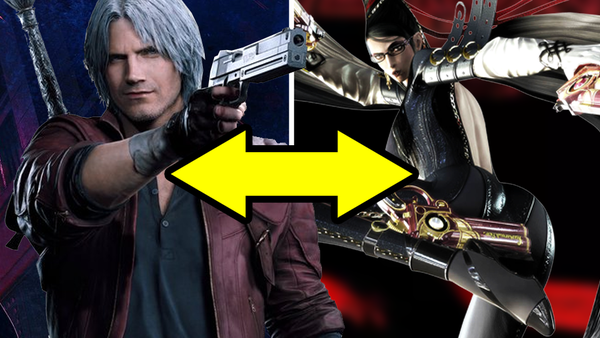
2. Devil May Cry/Bayonetta
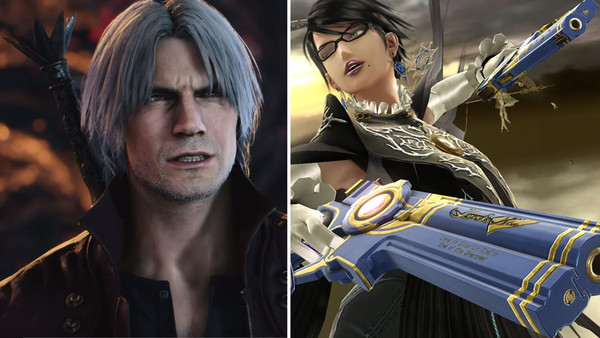
Though the Devil May Cry and Bayonetta franchises aren't developed by the same company, they were both created by Hideki Kamiya, and so it's tough to ignore the many, many similarities between the hit character action games.
Even accepting their existence with the same genre and similarly over-the-top tone and aesthetic, they share enemies down to specific traits and attacks.
A re-designed version of DMC's giant spider Phantom appears in Bayonetta, renamed to Phantasmaraneae presumably for legal reasons, and DMC's time-slowing Bangle of Time re-appears in Bayo as the Bracelet of Time.
Moreover, the Bracelet of Time's item description refers to a "legendary dark knight" almost certain to be DMC's Sparda, but again, legalities prevented Kamiya from outright namedropping him.
Bayonetta invokes DMC constantly, and while Kamiya himself has deemed the two franchises to share a universe, this can't be taken as gospel because Capcom gave the DMC series to Hideaki Itsuno from the second game onward, while Kamiya moved on elsewhere (and eventually to Bayonetta).
The one big roadblock to accepting their shared world is the lack of angels in DMC, implying differing Heaven and Hell dynamics that don't really gel together.
Many fans have essentially accepted that DMC splinters off into two separate continuities - the Kamiya universe, encompassing the original DMC and all the Bayonetta games, and Itsuno's version outside of this.
Either way, Kamiya managed to slyly get away with intimately linking his two hack 'n slash titles while just barely avoiding Capcom's legal ire. It's not perfectly neat and tidy, but provides some tantalising food for thought regardless.
When will fans finally get that long-requested DMC/Bayo crossover? Kamiya sure is keen.
1. Bioshock/Gone Home

At first glance, AAA first-person shooter Bioshock 2 and indie "walking simulator" Gone Home might seem like the last games you'd expect to see sharing any common DNA.
That is until you realise that three members of Fullbright, the devs behind Gone Home, previously worked on Minerva's Den, the DLC expansion to Bioshock 2 which features a 1950s-style video game called Spitfire.
In a lovely homage, Gone Home allows intrepid players to stumble across the Super Nintendo game Super Spitfire, clearly a "modern" update of Spitfire and seeming to imply that Bioshock and Gone Home transpire in the same continuity...somehow.
Better still, Super Spitfire's dev name is "CMP", a clear nod to the protagonist of Minerva's Den, Charles Milton Porter.
In a 2014 interview, Fullbright co-founder Steve Gaynor confirmed that this was all their intended implication. He said, "In a totally non-litigious way, we very lightly imply that it also takes place in the same universe as BioShock."