10 Reasons You Were Wrong About Assassin's Creed 3

From Eagle Vision actually making sense, to the coolest location in the whole franchise.

Like the runt of a farmyard litter, Assassin's Creed 3 is not a game that has ever fared well in comparison to the other titles in Ubisoft's flagship series. It's mostly referenced as the weakest instalment to this day, and was even seen as a step backwards by some. Truly the game didn't quite capture the majority of players in the way that the adventures of the remarkable Ezio did, but does it really deserve to be so readily criticised? Of course not. While it may not be the strongest of a very established franchise, AC III was certainly still a very good game. The game's adventure saw players leave the familiarity of towering cities for the first time in favour of offering up wild forests and snow plains as the best playground the series has seen so far, and the insight into the lineage of the Templars introduced some of the series' best moments by far. Rather than change the formula of the series, Ubisoft simply honed the recipe. While it could be suggested they made the mistake of pushing change on an audience that wasn't willing to accept it, there can be no real suggestion that Assassin's Creed 3 was a bad game. With all this in mind, it's worth putting together a list of the ten things that the game did very well; ten things that players regularly forget about when flippantly criticising it as the 'worst in the franchise'. Assassin's Creed 3 really was a worthwhile step for the series, and it's high time people realise that.


10. Combat Fluidity Was Perfected

After Ezio's adventures were stretched out over three full games, parts of the Assassin's Creed 2 trilogy started to feel played out. One such example was the movement of Ezio himself. While the subsequent two titles after AC:2 did a good job of adding labour to the ageing Italian's body, his general motion capture never really changed after his first appearance. AC:3's protagonist, Connor, provided the spark for change in that regard. Introduced to the Assassin's Creed at a younger age than Ezio was, he retains much of his brashness throughout and after his training. As a result there is a strange, rough fluidity to movements built more upon instinct than fearlessness. The game played this well, using more detailed motion capture to add combat options that suited this unfamiliar approach. Running double kills, as well as double or even triple counters were introduced to allow players to take a greater control of their character's combat. Ezio's style was great, but a lot of the animations stagnated his movements towards the end. As the series progressed the then abilities given to players had to as well, so Connor's brash, headstrong style suited this perfectly and the game's combat took massive strides forward with this instalment.

9. A Fantastic Change Of Scenery

All prior instalments of this series took place around cities and regions with warm weather systems. This means that players had previously only ever had the chance to traverse the assassin's playground basked in sunlight or dodging raindrops in the occasional storm. In Assassin's Creed 3, however, you were treated to a dramatic game-changer. A new period and setting allowed for Ubisoft to switch everything up, and through the course of the game you'd traverse in deep, fresh-fallen snow which looked great and placed alterations on the way the game played. Most obviously, the thick snowdrifts had limiting factors on how quickly Connor could make his way across the terrain, meaning that smart use of available escape routes was more important than ever. In addition to this, clumps of snow that hugged the trees provided extra cover, and the ability to spot targets in the distance was limited while heavy flurries fell. These are never the things that stand out to make a game great or good, but they are a large part of what gamers now demand from a complete and engrossing experience. AC 3 really set the standard with this, with the best use of setting in the series yet.

8. A Whole New Playground

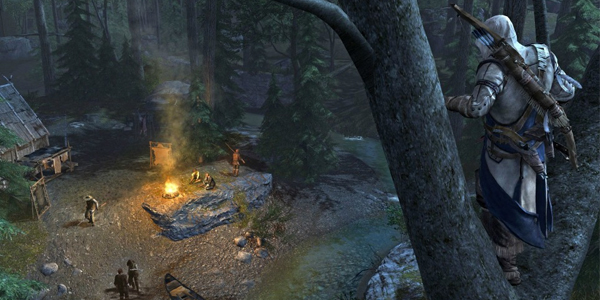
While the addition of more challenging and unfamiliar weather systems was a triumph itself, it was built perfectly into the new terrain and landscape of AC:3's American Frontier. These came hand in hand to offer longtime players of the series a whole new prospect compared to the similar-feeling cities they'd come to expect. Most notably was the way Assassin's Creed 3 thrust its players into a wilderness that proved to be just as traversable as the standard blocks of Italian cities. Reality dictates this should be the case, given how much easier it is to climb a tree than scale a building, but it was refreshing to see Ubisoft realise this nonetheless given what the series thus far has suggested about their thoughts on 'reality'. Much was made of "motion" in the game's pre-release footage and this new region played a huge part in that. While the population may be far scarcer in AC 3's forests and plains, moving through the trees allowed players to feel more of a malevolent threat to Connor's enemies. Stalking prey through forestation just had a more genuine feel than stumbling across city rooftops has ever managed to attain in other instalments. The fact that Ubisoft still heavily employ the use of trees and natural landscapes even now speaks volumes to the importance of this innovation.

7. Hunting Animals Was Excellent

Talking prey, Assassin's Creed 3 also added a great feature in the way players were able to interact with the region's wildlife as Connor. Bringing in a basic but intelligent hunting system meant that the early days of Connor's growth as an assassin felt far more natural, while also allowing for plenty of challenges with which players could continue to test themselves later. Using Connor's upbringing as the logical reasoning for his ability to track and locate animals (and others, as you'll see later!) in their natural habitats, Ubisoft built a system whereby animals could either be lured into traps or simply chased down and killed. With a variety of wildlife filling the region, this was either a useful method of obtaining pelts and materials or a bigger challenge where large, dangerous animals fought back against Connor's efforts. In some cases they would strike first, with 'quick time events' making for great encounters against packs of wolves. All this meant that there had to be actual thought in the process for the player. While they may get lucky once by felling a bear in close combat, this was not a sustainable strategy for success and it forced the planning back into a series that had started to lose it amongst Ezio's over-powered ability in his latter games.

6. Connor's Character Design Was Awesome

It may sound trivial, but the attire of Connor in Assassin's Creed 3 was genuinely one of the points that made this game so instantly appealing. His whole look was a real shake-up for a series where, thus far, the previous protagonists had both followed a strict and fairly boring uniform. Connor retains several of the iconographies - the pale cloak and beaked hood, for example - of the style that Ubisoft had forged back in the series' first instalment. Where Altair and Ezio maintained a kind of precise and clean-cut order to their traditional robes, Connor's ragged, functional gear far better suits his brash, aggressive style. He's unmistakably a member of the Creed, but the style makes him seem more resourceful as there is evidence of his environment and nature on his person. While Ezio's later appearances did break the mould a little bit, adding some basic fur-lining and neglecting the traditional Assassin's white, Connor's style was the first proper shake up for the franchise. His style allowed for Ubisoft to consider the setting a little further; taking Ezio's appearance to the wilderness would just not have fit at all. Traversing American wilds as Connor's mix of noble assassin and ragged hunter was perfect to drag players into the atmosphere of the game.

5. Connor's Nobility And Character Arc Was More Relatable

The idea of truly relating to a video game character is something that's seen about as many ebbs and flows as there's been game engines to provide them. Given the unrealistic, often impossible worlds these characters inhabit, being able to truly relate to them simply becomes a question of being able to empathise with elements of their character, grounded in real-life attributes and/or behaviours. For example, in AC 2 chances are that very few people playing the game could truly relate to a nobleman from an affluent family. Connor, on the other hand, has more of the typical 'rags to riches' story that the majority of his players would be able to feel akin to. Ezio's fall from grace and subsequent re-rise is far harder to feel parity with than Connor's strive-to-survive motivation. While both share obvious similarities in their suffering loss of parental figures and both overcome this to become noble heroes, Connor's struggle will have felt more instantly familiar to the majority of his players. Ezio's fall from his affluent enjoyment is heartbreaking for him, but you'll always feel more for a character like Connor who had so little to lose, but still managed to do so. It makes the motivation to help him succeed afterwards far stronger as a result.

4. A Better, More Realistic Range Of Weapons

By the end of his final adventure in the Assassin's Creed series, Ezio Auditore had been granted the use of a huge variety of remarkable inventions and gadgets. While these made for some truly fantastic kills and skills within the games, the enjoyment started to wane as each new addition drew players just a little further out of any realism the series was otherwise maintaining. Assassin's Creed 3 addressed this, and it did a damn good job too. Replacing far-fetched gadgets like Ezio's hidden gun or flying machine with a more realistic assortment of weapons that better suited Connor's place in history was a great move, especially given how the gameplay and player's abilities did not suffer for it. Connor's use of bows and improvised rope darts coupled with occasional use of pistols and rifles (actually available in this time period), added much appeal to a character already proving to be resourceful and intelligent. Ezio's gadgets and gizmos were undoubtedly fun, and Ubisoft did manage to make a good enough job of covering them by having master inventor Da Vinci responsible for their creation. With Assassin's Creed 3 taking a turn for a grittier tone however, a more realistic weapon range was an absolute must - something Ubisoft delivered perfectly.

3. It Laid The Groundwork For 'Black Flag'

With the saga around Assassin's Creed 2 managing to take Ezio's quests across multiple games, it made things run smoothly between all three releases releases for Ubisoft. However, following this Connor then only saw one title and some DLC, showing that Ubi weren't going to repeat the past too much, instead laying the groundwork to expand and shake things up going forward. With much of Assassin's Creed 3's early gameplay making sure Connor's parentage was clearly outlined, it became obvious that Ubisoft were working on something larger than just laying the foundations of one game. This turned out to be true and the legacy of the Kenway line was built into the series' next release: Black Flag. While neither was a true successor to the other, it was great to see how canon introduced in AC:3 continued to bear fruit for the history of known assassins when Black Flag came around. Not only did the legacy of the Kenway family allow Ubisoft to keep building the rich heritage they have forged in this series, but it also meant that Edward Kenway became a far more viable playable. With nothing more than a tenuous early encounter with an assassin linking him to the creed otherwise, the Kenway name was enough to make Ubisoft's pirate adventure fit into the timeline of the series.

2. Eagle Vision Actually Made Sense

'Eagle Vision' has become one of the most recognisable gameplay mechanics in the Assassin's Creed series, but until AC 3 it was one of those video game techniques that are simply dropped into the game for the player's benefit, without any real explanation of how it's actually working for the protagonist. In the series' first title, Eagle Vision is introduced early as how Altair's skills as an assassin allow him to identify enemies and targets even if they aren't within his lines of sight. Sounds fair enough, right? Well no, not really. Until AC:3, this modey had to fall into the 'willing suspension of disbelief' category to stop common sense from overriding the experience. Then things changed... In the AC:3's early sequences, players control a young Connor and get to see how his heritage and upbringing have made him such a potent hunter in the wilderness. The hunting sequences showed players that Connor had the instincts to use his surroundings to help him track down his prey. This means that the use of eagle vision is far easier to justify with a character like Connor, as if he can track animals and birds that he can't see, then why not guards and Templars?

1. Backdrop Of American Revolution Was Truly Exciting

While the Assassin's Creed series follows an alternate historical timeline to suit its narrative needs, the whole thing has always been placed within some sort of reality. Real locations and historical events are used, with Ezio's saga around AC:2 building a whole conflict around the real Borgia family, for example. In Assassin's Creed 3, this trend was followed but built upon in such a way that playing as Connor felt like a genuine step back in time. Struggling to survive against the backdrop of the American revolution put Connor in an environment of enormous tension and political strife. There was a real sense of being part of something huge for players jumping into the American frontier. The backdrop allowed for the previously passive crowd elements of the game to become far more active, with NPCs engaged in skirmishes and even full battles. The unrest in the game's cities also allowed for more blending and distraction opportunities than ever, too, making stealth a more viable option despite moving around in plain sight. Assassin's Creed 3 placed itself so well into history that the gameplay and environments of its story were more engaging than any other Assassin's Creed game managed before or since. Hopefully reading this has you yearning to dive back in and realise why you should have loved this game in the first place. Still not convinced? Join the discussion with your thoughts of Connor's adventures in the comments below!

Contributor
Contributor

Gareth is 28 years old and lives in Cardiff. Interests include film, TV and an unhealthy amount of Spider-Man comics and Killers songs. Expect constant references to the latter two at all times. Follow on twitter @GJCartwright.