10 Totally Broken Parts Of Video Games We Somehow Put Up With
Four years to fix a game must be a World Record, right?

When you think about it, this generation's overall quality control has been... severely lacking.
More than any past console cycle, the eighth generation literally started with bugs, visual glitches and a bevy of problems right out the gate.
Things like Watch Dogs being a letdown or The Order 1886 being a glorified cutscene may seem like a distant memory now we've had The Witcher 3, Breath of the Wild and God of War, but video games creaking under the visions of their developers was commonplace from day one.
Hell, it's the reason we got "half-step" systems like the PS4 Pro and Xbox One X - systems released "with developers in mind", to finally allow for final products that weren't falling apart at the seams.
Still, even with greater horsepower available, scores of publishers or money-hungry devs kick projects out the door, knowing patches or touch-ups will make them playable somewhere down the line.
Technical inefficiency is just one of the MANY ways video games can be genuinely broken or unfinished though, and from design goals to miscommunication, sometimes it all just falls apart.
10. A Boss Fight Against... Time?! - Quantum Break

What's the weirdest boss battle? Fighting a moon in Dead Space 3? Cobweb crotch grandma from Resident Evil 7? A chainsaw-wielding baby from Catherine?
How about light itself?
Well, light and... time.
Yup, the plot of Quantum Break involves time itself coming to a halt, and the ensuing apocalypse of darkness and demons that involves. Evildoer Paul Serene - played by Littlefinger himself Aiden Gillen - manages to weaponise this version of time, now turning into force pushes and physics manipulation, and sets about trying to attack you with it.
Look, to be honest, none of the "time powers" made any sense in Quantum Break, and come the final fight when Jack Joyce and Serene have a "time fight", it was a big mess.
However, all that is conceptual. The real problem came with time being visualised as an encroaching light source.
Serene would power up, and if you were standing in just the wrong spot... that was it. Instant game over.
No feedback, no idea of where you went wrong. Just the realisation that a combination of light and... time, has killed you.
Terrible.
9. The Skyscraper Server Crash - Battlefield 4

2013 was a bad year for video games, and the video game industry.
After investing a lot of planning into PC hardware and PC gaming, scores of developers were caught short when "hey, it turns out people still want to play on newer systems!'.
This would lead to the rollout of half-baked games across 2014, but Battlefield 4 also released on both previous and the newer generation, suffering immensely in the transition.
One particular map, the multiplayer showpiece Siege of Shanghai, was set to demonstrate EA's new buzzword for the time, "Levolution" - a term given to how environments would change as players fought amongst them.
The only problem? Trying to get Battlefield 4 to sync its Shanghai tower collapsing at the same time across all connected players would tank the server and sever all connections.
Every.single.time.
This was the tip of the iceberg. EA created a website for players to log issues, only for the post-launch patch period to go on so long, DICE were forced to abandon it in favour of Star Wars Battlefront. EA would later label the handling of all this "unacceptable"... only to repeat this mistake multiple times across the generation itself.
8. The Bounty & Wanted System - Red Dead Redemption 2

Red Dead Redemption 2 is arguably the most impressive of everything released on PS4 and Xbox One.
It's not without it's faults though, and while you can have an incredibly immersive time as Arthur Morgan; shooting up saloons, skinning animals for food and all-round living in virtual reality without the goggles, the game's wanted system drew criticism for good reason.
Assumedly coded as a way to keep tabs on players no matter what, even if you make sure no one is around - like you're up in the mountains with just a mouse's fart for company - firing guns or killing someone will ALWAYS put a bounty on your head.
It's not just proximity, either. Items like face-covering masks wouldn't hide your identity, and even if you took out a number of enemies with silenced weapons like knives or stealth takedowns, you'd still have the law breathing down your neck in seconds.
To this day there is no definite way to avoid a bounty in Red Dead Redemption 2, and it's testament to how stellar the rest of the game is, that we couldn't care less.
7. Those Interrogations - L.A. Noire
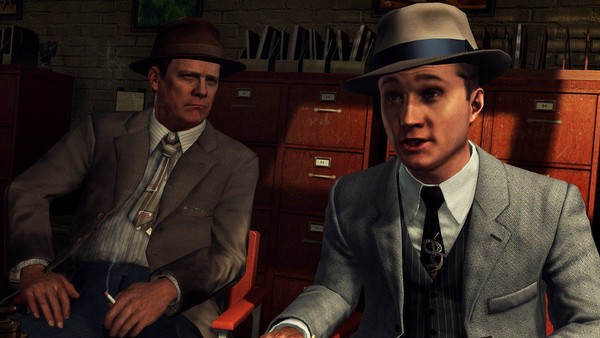
As a game that suffered development hell thanks to Team Bondi boss Brendan McNamara reportedly enforcing horrific work practices and treating employees as disposable drones, L.A. Noire still became a recommendable crime thriller, but its core mechanics suffered.
One of the most obvious was the game's interrogations, which saw main character Cole Phelps fly off the handle at even the calmest of lead-in sentences, only to resume his candour the next time around, then freak out again.
The reason was entirely routed in such a scattershot development, as McNamara revealed to Eurogamer that Phelps' actor Aaron Staton recorded the dialogue options as "Coax, Force and Lie", only for this to change after recording, to "Truth, Doubt or Lie".
As you can imagine, there's a wealth of difference between actively forcing a suspect to say something and just being doubtful, resulting in such a massive mixup.
The game's 2017 re-release attempted to change this once again to "Good Cop, Bad Cop and Accuse", but these too were too vague, and L.A. Noire's interrogations remained, for want of a better word, broken.
Thankfully, it didn't stop an entire fandom declaring it one of Rockstar's best titles.
6. Mortal Kombat 2011's Netcode

If there's one thing you need for a functioning multiplayer fighting game, it's a functioning multiplayer mode.
Sounds obvious. Sounds like the first thing you'd perfect before rolling any build out to the public, but this was a time before widespread public betas and testing.
For Mortal Kombat 9 - a soft-reboot of the franchise, being the first from NetherRealm since being acquired by Warner Bros. - this would be the first major Mortal Kombat on PS3 and Xbox 360 hardware.
All fans had before was MK Vs. DC, and all eyes were on MK 9 to knock it out the park, in an age where online play was increasingly popular.
Sadly, MK 9's online components were completely busted. To this day NetherRealm never managed to get its netcode stable, and although King of the Hill, "winner stays on"-style modes were a genius innovation, they just weren't accessible or fun to interact with.
On the flip-side though, Mortal Kombat 9 debuted a revolutionary approach to storytelling in fighting games that's still being used across the genre today. Its combat was exemplary and the roster nigh-on perfect - which at least softened the blow a little.
5. Finding Dead Bodies No Matter What - Splinter Cell: Pandora Tomorrow

Splinter Cell remains a supremely recommendable stealth series... but if you're going in without the nostalgia goggles, you should probably stick to third instalment, Chaos Theory.
Why?
Because although Pandora Tomorrow contains a phenomenal train infiltration and an iconic level where you sneak through a marijuana field, its stealth mechanics are totally busted.
Borne out of the idea that Ubisoft wanted a way for guards to actively look for bodies or scan the area in general, they coded a series of invisible "scan points", where the game checks to see where you left unconscious guards, and automatically penalises you if they weren't fully in shadow.
Understandably this didn't take into account stashing people down back alleys, underwater or in any number of places where no one would look, and it always resulted in an immediate strike. Three strikes, and you were back to the beginning of the whole level.
Even worse, was these scan points doubled as autosaves and checkpoints, dooming you to a cycle of reloading and stepping forward, only for a body from 20 minutes ago to send you back to the restart screen again.
4. Horrifically Implemented Stealth - Final Fantasy XV
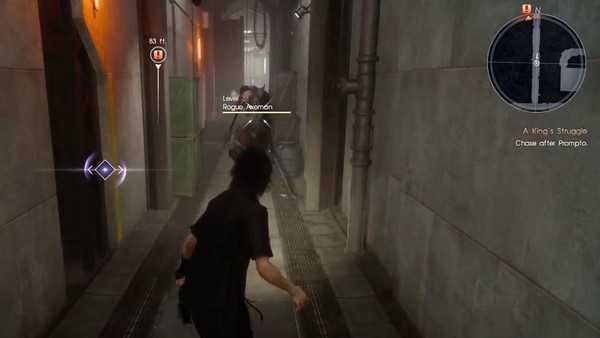
Hands down, this is the worst "chunk of game" I've ever played.
A full chapter of a game so unfinished; so broken and ill-conceived, it resulted in being completely gutted and replaced, some months after release.
Back to what was initially in the game though, as FF XV's 13th chapter went down in history for all the wrong reasons.
Besides terrible level design that forces you to take the long way around waist-high walls, and a terrible "plot revelation" involving Prompto being a robot, there's over an hour of being near-weaponless, avoiding invisible enemy vision fields, as contextual prompts tell you when to hide.
I cannot stress how terrible this was to play; to feel how much it didn't belong in an otherwise fairly solid Final Fantasy.
This section's placement in the game's final act completely killed the pacing, was clearly something that shouldn't have been greenlit in the first place, and post-patch, is only remembered by the creators, and those unlucky enough to have experienced it.
3. The Anchor's Boss Fight Method - Control
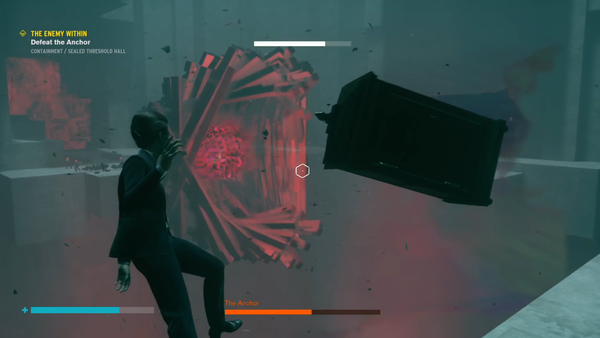
Control is an exemplary game when it comes to world-building and especially combat. For the latter it damn-near feels like playing as a suped-up Jean Grey, lobbing everything from forklift trucks to office equipment at whatever's in your way.
For the former... well, despite really not knowing how to end, a large part of Control's world involves supernatural energy being associated with everyday objects.
As the game plays out, this is how optional boss battles are handled, and from fridges to mirrors, it's over to you to tackle them whenever you like.
Only, one of them - the Anchor - has a specific method you can totally miss, by deploying it too early.
See, this thing is practically a giant metal Pac-Man, and you defeat it by standing on platforms and lobbing discarded clocks into its mouth.
Start the fight by doing this before its fired the first shot though, and... nothing happens.
You can continue the fight - as I did - wondering how the hell to even damage the thing, when the solution was right in front of you the whole time.
2. Terrible Matchmaking - Halo: The Master Chief Collection

It took four years.
Four.long.years for the Halo: Master Chief Collection to finally become reliably playable.
Such was the reality of a broken product being released in 2014, only for so many patches and tweaks to be applied that it crossed over into Halo 5's development, as priorities changed and the Collection was left behind.
In those four years though, it's not like fans weren't going to play the games, because the original Halos are still some of the best sci-fi shooters in gaming history.
It just meant we were stuck searching for games for literal minutes at a time, suffering endless disconnects, incorrect statistics on active player numbers and everything in between. Actually getting into a game was pot luck, and half the people waiting would've likely given up.
This really was unacceptable, and represented just one of the many mistakes that got this generation off to a terrible start.
1. Everything - Superman 64

Widely regarded as one of the worst games of all time, if we're talking about titles rife with broken elements that kids and teenagers put up with because hey, it was still Superman, look no further than Superman 64.
An utter turd of an experience, actually controlling Superman was hopeless as he had a mind of his own, but more fascinating was the reality of the game's development, where creative opportunities were quashed at every turn.
According to the game's producer Eric Caen when speaking to ProtonJon.com, DC were impossible to deal with, forcing Titus Interactive to remove the vast majority of the ideas they had for the full game.
The whole idea of a "virtual world" rather than actual Metropolis was because they didn't like Kal-El "kicking real people", and after an initial shipping date was missed by 6 months due to constant in-fighting, Caen noted that Superman 64 was "not even 10% of what we intended to do", saying "the licensor killed us".
Superman 64 was so reviled and laughed at, that a "75% complete" PS1 version was cancelled altogether.
Still, maybe you were one of those kids or teens trying desperately to enjoy the fact you could still fly... kinda, and throw cars... kinda.