10 Video Game Sequels That Look NOTHING Like The Original
Street Fighter without the punching? Pac-Man without the maze? No thanks.

If a video game is successful, it's clear that consumers want more. However, the next entry can't just be more of the same. It needs to build on the mechanics that made its predecessor special. Otherwise, it'll just feel like the same game repackaged.
The tricky part is making enough changes so the follow-ups feels fresh but still capture the spirit of the original. Fans were skeptical when Metroid Prime discarded the 2D action-adventure set-up and was turned into a first-person shooter. However, this drastic alteration helped Metroid Prime focus on the series' most integral feature; exploration. Despite changing genre, it still felt like a Metroid game.
Unfortunately, this is much harder than it sounds. Usually when a game franchise goes in a different direction, they go too far. Whether it's reimagining characters, adding unnecessary mechanics, or removing key components, there are some sequels that bare little resemblance to the original.
Bizarrely, these changes don't necessarily mean the games are bad. In fact, some of them are great. But they feel so disconnected to their precursor, you wonder why the developers classified them as sequels in the first place.
10. Banjo-Kazooie: Nuts & Bolts

For over a decade, Rare made some of the best games for Nintendo including Goldeneye 007, the Donkey Kong Country trilogy, and Banjo-Kazooie. So, when Microsoft purchased Rare in 2002, gamers were worried the proposed Banjo-Kazooie threequel would never come to pass. So when Banjo-Kazooie: Nuts & Bolts was announced to be released in 2008, fans were thrilled. Even though Rare's games for Microsoft's consoles were disappointing, gamers believed this one would turn everything around.
At a glance, the sequel seems relatively similar to its predecessors. The titular duo start in a hub and travel to different worlds by collecting Jiggies. So, what's wrong with it?
Well, remember all those awesome moves Bottles taught you in the first two games? They're all gone. Instead, Nuts & Bolts centres around collecting vehicle parts and constructing automobiles to navigate around levels.
This idea could work if it was for one or two missions. Instead, this concept revolves around THE ENTIRE GAME! Now, it's not uncommon to throw in a new idea to spice up the gameplay. But building cars and planes feels so out of place in Banjo-Kazoiie, it boggles the mind why the developers it was what the franchise needed.
9. Skullmonkeys (Sequel To The Neverhood)

The Neverhood is a claymation-styled point-and-click game released in 1996. As soon as it was released, it was praised for its beautiful stop-motion, hilarious characters, and inventive puzzles. It won tons of awards including Best Adventurer of the Year, Best Adventure Game, and Special Award for Artistic Achievement.
Sadly, being revered isn't the same as being successful. Despite all its creativity, The Neverhood didn't sell well. That's why the developer, Doug TenNapel, played it safe and turned the sequel, Skullmonkeys, into a standard platformer. For the first time, the protagonist of the franchise, Klaymen, could run, jump, shoot enemies, and use magic. TenNapel also did away with the 3D sections from the original, saying he had depth-perception issues while formatting them.
Not only does the follow-up take a drastic departure from the previous entry, the title gives no indication this is a Neverhood game! Many people who loved the original have never played Skullmonkeys, oblivious that it was a sequel.
Ironically, Skullmonkeys is a really fun platformer. But if anyone bought this, assuming it was another point-and-click adventure, they were left sadly disappointed.
8. Final Fight Streetwise

Final Fight is a scrolling beat-em-up, much like Streets of Rage or Double Dragon. Even though the formula couldn't be simpler, the 2006 entry, Final Fight: Streetwise, managed to screw it up.
As soon as the disc loads up, you will receive an on-screen warning smeared in blood that informs the player the game contains scenes of violence and gore. Since the first level revolves around two bare-chested dudes pummelling each other in a dirty basement, you have to doublecheck if you accidentally popped in the Fight Club CD.
Even though the game does have the street-brawling you would expect, it also has a lot tile-puzzle sections, which clash with the rest of the gameplay. Instead of bashing gangsters and thugs, you have to take on an evil priest who's trying to initiate the apocalypse with his army of mutants. While battling 20-armed monsters and carbon-copies of Bane, it's easy to forget this is a sequel of Capcom's iconic beat-em-up.
Even though this disaster came out 14 years ago, there's never been a follow-up, implying that Streetwise killed the Final Fight series. If the game maintained the same gameplay as the original, maybe the franchise wouldn't have fizzled out.
7. Front Mission Evolved

Front Mission was a tactical role-playing game for the SNES. Using a turn-based system, the player had to move giant robots called wanzers in a grid formation in order to defeat enemy forces. The game was well-received and spawned many follow-ups over the years.
But in 2010, the developers wanted a shake-up and turned the latest entry, Front Mission Evolved, into a third-person shooter. Even though both games still centre around the wanzers, you would never guess they are from the same franchise. There is no turn-based system, grid formations, or point-and-click gameplay. Instead of relying on meticulously planned out strategies, you just blast everything in sight.
Even when a franchise goes off the rails, you can still commend it if the game is good in its own right. But that's not the case with Front Mission Evolved. If Front Mission Evolved was its own separate entity, it paled compared to other third-person shooters at the time. It received a Metacritic score of 58% on the PS3 and the Xbox 360, making it the worst-rated entry in the series at the time.
6. Pac-Man 2: The New Adventures

The format of Pac-Man was so simple and yet, so addictive, it wasn't a surprise when Namco churned out countless variations including Ms. Pac-Man and Baby Pac-Man. Knowing they couldn't just repackage the game with mild tweaks forever, Namco had to do something bold to stop their moneymaker from growing stagnant.
Four years after the original came out, they released a side-scrolling adventure game called Pac-Land. It may have seemed like a disastrous idea to do away with the maze-style gameplay but Pac-Land was well-received.
And when the sequel, Pac-Man 2: The New Adventures, was announced for the SNES, the gaming community was excited. That is... until they played it. Although it maintained the side-scrolling mechanics of Pac-Land, gamers were disappointed to learn Pac-Man 2 was a point-and-click game.
Instead of chomping his enemies with his disproportionally large mouth, Pac-Man attacks... with a slingshot. You also have to monitor the circular hero's mood or he won't perform certain missions (oh yeah, he has missions now) if he is too happy, angry, or scared.
If you took the title character and the ghosts out of the game, you would never be able to guess that this has any connection to Pac-Man.
5. Starfox Adventures

While Rare were working on a Nintendo 64 game called Dinosaur Planet, Super Mario creator, Shigeru Miyamoto, decided to revise it into a Star Fox sequel for the next generation console, the Gamecube. Rare developers disapproved of this idea but had no choice but to drastically alter the game to implement Miyamoto's vision.
Because Dinosaur Planet was designed as an action-adventure game, it seemed jarring to repurpose it as a Star Fox sequel, considering that franchise was a space shooter. But since Rare were considered one of the most consistent gaming companies, Nintendo fans didn't dismiss this change straight away. They needed to give the game, now called Star Fox Adventures, a chance.
Sadly, all skepticism was justified. The Arwing, which is a fundamental vehicle in the other games, appears in Star Fox Adventures for less than ten minutes. You don't even see Fox or his teammates for the first half hour since you start the game as a completely different character called Krystal.
Even though the gameplay is fun (sometimes), collecting Bafomdads, teaming up with a Triceratops, and conversing with Scottish golems and dinosaurs didn't feel right in a Star Fox game.
4. Faces (Sequel To Tetris)
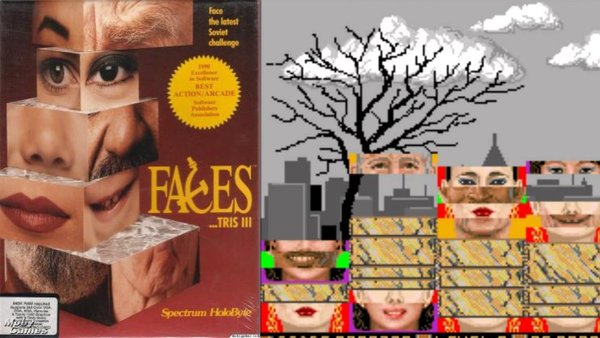
Tetris was such a phenomenon, there was no way it wasn't going to have a sequel. There was just too much money to be made to leave the Game Boy classic as a standalone game.
Five years after the original took the world by storm, Tetris' co-creator, Alexay Pajitnov, finally released the sequel, Welltris. It had the same falling-block concept as its predecessor but took place into a three-dimensional pit that.
Although the game was well-received, gamers still wanted more. Only a year later, Pajitnov followed it up with Hats; a game where the player has to match falling hats on people's heads. That same year, he released ANOTHER sequel called Faces where the player has to match falling facial features accordingly.
By this point, it was clear the legendary programmer was just churning out entries that had little in common with what made the series iconic in the first place. (Also, the cover poster for Faces was freaky.)
Some of the later sequels were praised like 3D Tetris and Tetris 99 but none of them came close to surpassing the original and none were ever as surreal as Faces.
3. Street Fighter 2010: The Final Fight

The only reason anyone bought Street Fighter 2010: The Final Fight is because "Street Fighter" was in the title. This is ironic since the biggest criticism this NES title received is that you could never tell it was connected to the initial beat-em-up.
In this doomed platformer, you play as one of the most iconic characters in Street Fighter (and video games in general), Ken Masters. Despite being a martial artist champion, Ken was reinvented as a cybernetic scientist who battles invading aliens. Consumers felt cheated when they purchased the game since they assumed Street Fighter 2010 would have hadoukens and shoryukens galore but instead, got a platformer more in line with Contra.
You know what's worse? The game is actually pretty good! Despite its brutal difficulty, it was considered a better platformer than most titles available at the time. Even though slapping on "Street Fighter" on the title made it more successful, it would've been looked at more favourably by critics if it had no association with the series at all.
Even though this misfire could've tarnished the franchise' reputation beyond repair, the series reached a new level of popularity the following year with its sequel, Street Fighter II.
2. Space Raiders

It's hard to comprehend how lucrative Space Invaders was. This 1978 shooter was the first game to sell a million cartridges and has made over $10 billion in total. Upon its release, there were a shortage of 100-yen coins in Japan because everyone was using them to to play this classic arcade game! It's crazy to think that a simple shoot 'em up would have such an impact on the world of gaming.
So when Taito announced they were making a reboot called Space Raiders in 2002, no one was expecting them to re-invent the wheel. Many gamers assumed it would be the same shooter in essence but with modern graphics.
And Taito couldn't even give us that. Instead of whizzing through the cosmos, Space Raiders takes place in a dank and dirty alleyway. Armed with a gun, your character must blast at a horde of extra-terrestrials as they descend upon you. Here's a question; why is "Space" in the title if the game doesn't even take place in space!?
This only redeemable feature about this abysmal remake is that it was bundled with the original Space Invaders.
1. Bomberman Act Zero

How did Hudson Soft and Konami do it? They made a video game where people hunt each other in a grid-like maze to blow them up and somehow, made it cute and charming. The Bomberman franchise may not be as popular as it once was but it was a dominating series during the 1990s.
But when the adorable bomber tried to make the transition to 3D, the quality in the games suffered. With a slump of sales, it was decided to reboot the cutesy game into the gritty reboot, Bomberman Act Zero.
You have to admire Hudson Soft for making such a bold decision but WOW was it the wrong one. The anime artstyle was ditched. The inventive mechanics were simplified, making the gameplay tedious and monotonous. All the wacky power-ups like the Roller Skates and the Detonator were replaced with blander ones. And they got rid of Louie the space kangaroo. (What game could possibly be made better by removing space kangaroos!?)
There have been a few stinkers in the series but none of them have come close to topping Bomberman Act Zero as the worst in the franchise as well as one of the worst reimaginings of a video game.