10 Video Games Whose Best Ending Was In DLC
You want to punch god in the face? That's gonna cost you extra.

There are few things an audience unanimously demands more from a story than a satisfying ending. The perfect wrap up to everything the story had been building to from the start, a good ending can be all that determines whether your story will actually stick in the general audience's mind after they're done with it.
Some games have good endings, some have great endings, and others...well, we don't like to discuss the others. But even when an ending is fantastic, there can still be room for more. Maybe some lingering questions that need to be addressed, or a sequel whose plot points can be set up early in a climactic cliffhanger, or maybe your original ending did suck because you didn't have enough time to actually finish your game before the deadline.
Whatever the reason, DLC and expansion packs are a concept the gaming public has accepted for decades. And some of them even contain what fans consider to be the actual conclusion to the story. Whatever the quality of the base game, these DLC/Expansion Packs put an end to things on a much higher note.
10. Broken Steel - Fallout 3

The ending of Fallout 3, where the Lone Wanderer must sacrifice themselves to return clean drinking water to the wasteland, would've been much more effective, had the game not provided you with a Super Mutant companion who could easily do it for you and not die from the radiation. In the base game, Fawkes' fatalistic philosophy is what keeps him from going into that room for you, but due to fan outcry, Bethesda created a DLC to address this.
Granted, the Fawkes dilemma wasn't the only reason that fans hated the original ending. The true reason was that it, well, ended the game. So whatever sidequests you had left, or areas left unexplored? Well tough break, buddy. Bethesda made Broken Steel to tie up both of these controversies at once, filling a plot hole, while also (and more importantly) letting players continue exploring the world.
In Broken Steel, you survive the process and wake up 2 weeks later in the care of the Brotherhood of Steel, who are renewing their fight to cleanse the Capital Wasteland of Super Mutants and the Enclave. You decide to help them because really, what's the alternative? Fight against the guys with the giant nuke-throwing robot?
Broken Steel not only addressed fan complaints about the ending to Fallout 3, but it also gave fans an entire expansion built off of that. And the new ending is significantly more satisfying as a result.
9. Death of The Outsider - Dishonored 2

One of the most enigmatic figures in the Dishonored series has been The Outsider. It's always been up in the air as to what, precisely, he is. His motives are clear enough: he seeks entertainment. That's why he bestowed Corvo and Emily with the powers they used throughout the two games. The Attano family is interesting to him, and so he nudges them along because it's fun.
Frankly, it was only a matter of time before one of his playthings decided to fight back. Enter Billie Lurk.
Billie Lurk, formerly the companion of Emily/Corvo during Dishonored 2, takes center stage in Dishonored: Death of the Outsider. As the name implies, the whole story is about Billie being fed up with this eldritch weirdo screwing with people for his own amusement, and conspiring to take him down.
While Dishonored 2's ending is just fine on its own, this makes for an excellent epilogue, with harder stealth, cool powers, and at last, some real answers on what exactly The Outsider is. While that last bit wasn't ever really a problem with the previous games, seeing the biggest question of the franchise finally get answered is satisfying to watch play out.
8. Awakened - Dead Space 3

While nowhere close to the horror heights of the previous two games, the ending to Dead Space 3 is perfectly fine, as third entries go. But it does end a little too well, doesn't it? This is Dead Space, for crying out loud. Where's the nihilism, the despair, the existential horror?
"Right here," declares the Awakened DLC, which adds an epilogue to the story that reinforces the main overriding theme of Dead Space: it can always get worse.
Awakened sees Isaac and Carver survive the events of the base game, and work to try and get home. All the while being plagued with visions from the markers trying to drive them both even crazier than they likely already are. All culminating in one of the most horrific and frustrating cliffhangers in gaming history.
With the franchise basically dead, though, this ending kinda becomes the perfect closing note for the series. The final image of Dead Space is the most terrifying and nihilistic note you could possibly go out on.
As corporately compromised as Dead Space 3 was, Awakened demonstrated that the guys making it still knew in their hearts what the series was all about.
7. Re-Mind - Kingdom Hearts 3

Kingdom Hearts 3 was always going to be controversial. You make a fanbase wait that long for a sequel, and yeah, not all of them will be satisfied with how things close out.
KH3's base ending is fine, but is about as cryptic as the rest of the series tends to be. Sora leaves to try and find a way to save/resurrect his girlfriend Kairi after her apparent death at the hands of Xehanort. The game then ends, showing that he succeeded in bringing back Kairi, but now something has happened to him.
Then came the DLC, Re-Mind, to answer a few of those questions.
It is not recommended that you jump into Re-Mind after finishing the game, as it is a full, Back To The Future 2-style reframing of the entire third act. Sora manages to go back in time, and uses this opportunity to save Kairi from being killed by Xehanort. Doing so involves having to work his way through the background of the final battle, in hopes of making it to Xehanort before he can kill her.
Kingdom Hearts 3's climax was already top-tier, but the new fights added by Re-Mind make it even better. The best of which, of course, is Sora teaming up with Kairi to double-team Xehanort.
6. Part IV - Asura's Wrath

Other examples on this list, before and after this one, have been the more positive version of a game saving its best ending for DLC. The developers gave their game a proper ending at launch, and then gave fans a little more later.
But the most infamous example of this phenomenon is Asura's Wrath.
The base version of Asura's Wrath doesn't end so much as it just stops. Turns out a game that looks like Asura's Wrath takes a while to complete, and rather than wait for the game to be finished, Capcom decided to sell the entire second half of the game as DLC.
If you want to finish this story that you poured hours into and get the best ending, you would have to cough up about seven bucks at the time. And since, for some reason, the game didn't sell very well, there has yet to be, and likely won't be, a remaster of the game with all the content included.
So whenever Sony decides to finally shut down the PS3 servers, and the PS3 PS Store along with it? Hope you like watching super old let's play videos, because that will be the only way you're seeing Asura's Wrath's ending.
5. The Answer - Persona 3

Every piece of spinoff or supplementary material that heavily features the cast of Persona 3 has one thing in common: every single one of them is, in their own way, still coping with the death of Persona 3's protagonist - Makoto Yuki. Even in material where the former members of S.E.E.S are older and doing their best to move on, his death remains a very sore subject.
For the starkest demonstration of this, Atlus made an entire expansion to the original game known as Persona 3: The Answer.
The Answer takes place a mere two months after the end of Persona 3. The story revolves around the remaining members of S.E.E.S getting dragged into more supernatural shenanigans, with a strange force underneath their dorm keeping the world locked on March 31st.
The robot Aigis must keep her found family from tearing itself apart, as the thing under the dorms forces each of them to confront their past, and dangles a dangerously tempting offer in front of them.
The Answer is the apex of Persona 3's dedication to portraying its cast of teenagers as deeply broken people, leading to a twist that is still debated by the fandom to this day. While later material shows them doing their best to heal, The Answer bookends Persona 3's story by saying the equally important message that sometimes grief just breaks you, and that's okay.
4. Blood and Wine - The Witcher 3

CD Projekt RED owes its success to The Witcher, and to Geralt as a character. So when they decided to close the book on their version of Geralt once and for all in The Witcher 3: Wild Hunt, they went above and beyond to make it as great a send of as they could. While the base ending is great at doing that in its own right, the true ending to The Witcher lies in the final DLC for the game: Blood and Wine.
Blood and Wine sees Geralt being sought out by the Duchy of Toussaint to handle a large beast that has been roaming the land and slaughtering anyone it finds. Geralt agrees to help, unaware of the political muck he's about to go wading into.
While not the best of the expansions in terms of story (that's still Hearts of Stone by a mile) what sets Blood and Wine apart is, well, the fact that this is the last CD Projekt RED Witcher story. There is a sense of finality to everything going on in Blood and Wine, it's no wonder that this expansion is typically the last thing Witcher fans do in the game.
From Geralt getting his own estate in which he can finally set down some roots, to an ending scene that - without spoiling - is a brilliant send off to the viewer from Geralt. Blood and Wine is about as perfect a bookend to Geralt's story as we could have gotten.
3. Trespasser - Dragon Age: Inquisition

It can be hard to know how to properly end one story, while also setting up the next chapter. Lean too hard on one side and the sequel feels unnecessary, too much on the other and the story feels incomplete. This is where cliffhangers tend to come in handy. And one of the best cliffhangers in gaming history comes from Dragon Age Inquisition's final DLC: Trespasser.
Inquisition's ending was just fine as it was, with the two DLCs to follow adding new areas and expansions to the lore. But Trespasser is the ending to Inquisition's story.
Trespasser picks up two years after the events of the game, with the Inquisition called in by the largest governments in Thedas to discuss whether or not the Inquisition is necessary anymore. Turns out that having a religious militia that answers to no governing body, with heavily fortified strongholds in every country, and a spy network with its fingers in every ruler's pie, makes those rulers a wee bit nervous.
Every problem with the idea of The Inquisition is brought out and explored to its fullest, while at the same time, providing jaw-dropping twists on long-established lore. All of which culminates in a twist that takes everything you knew about a good 60% of the lore and throws it out the window. And yet it does it in a way that makes total sense, which is a much more impressive feat.
Trespasser is the reason fans are still waiting, desperately, for Dragon Age 4.
2. Lonesome Road - Fallout: New Vegas

New Vegas' DLC stands out from the others in the franchise because every single one tells an overarching story. Granted, it's pretty far in the background, but in each one - Old World Blues, Honest Hearts, and Dead Money - Courier Six keeps stumbling upon these painted symbols and abandoned camps.
All of which belonged to a mysterious traveler named Ulysses. And in the final DLC, Lonesome Road, Ulysses calls Courier Six out to an irradiated stretch of land called The Divide, to settle an old beef between them.
While the title of best New Vegas DLC is still a toss-up between Old World Blues and Honest Hearts, Lonesome Road feels like the proper ending to the story. Actually going into the backstory of Courier Six, giving a glimpse - even if it's a short one - of who they were before they were shot in the head, is fascinating.
And Ulysses is one of the greatest villains in the Fallout franchise; a gravel-voiced philosopher, sympathetic but ultimately dangerous. Although only one of them is actually speaking, you feel their rivalry in every scene they share.
Lonesome Road, from a design and narrative perspective, is the final word from Obsidian on the Fallout franchise.
1. Valhalla - God of War: Ragnarok
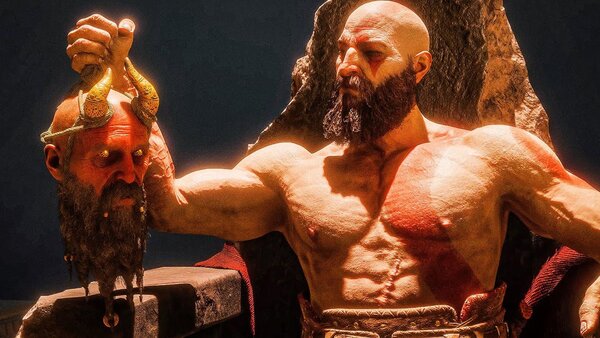
Kratos has done a lot of things that most would be right to label unforgivable. God knows he'd be first in line to do so. But the Norse duology on the PS4/5 helps him to come to terms with his guilt and try to move forward. But anyone who hates themselves to the extent that Kratos does knows that that's never the end of it. Kratos needed to have his past laid out so that he can truly come to grips with it.
Enter God of War: Valhalla.
This free DLC for Ragnarok picks up a bit after the events of the story, with Kratos and Mimir answering a summons to the Norse realm of Valhalla, which only those who have died in battle can typically enter. Valhalla has been brilliantly reimagined into a constantly shifting gauntlet, meant to wear away at the worldly regrets of those who enter so that they may pass into Valhalla unburdened. And Tyr has decided to use this system to help his friend work through his traumas.
Kratos was already the greatest performance of Christopher Judge's career, but his performance in Valhalla is his magnum opus. A man who desperately wants to do good and be better, but just needs to forgive himself enough to take the right steps. Valhalla isn't just the best ending for God of War: Ragnarok, it is the perfect final note for the character of Kratos.