7 TERRIBLE Video Games That Made The Industry Better
Why do we fall, gaming industry?

Of all the terms associated with the gaming industry - "blockbuster", "immersive", "high-octane" etc. - one that anyone on the consumer side will have a million stories to go alongside, is "failure".
Whilst it didn't used to be associated with gaming across the 90s and 2000s, the 2010s saw the proliferation of broadband connections, post-launch patches, games receiving updates months or years after hitting retail. It didn't take long for companies to exploit that.
Where in decades gone by, you had nail your final game build; had to make sure as many bugs and issues were quashed, now you can release a day one patch, or otherwise "get round to it" when it's more feasible.
As mentioned, this is an issue endemic to the current generation, and it lay the groundwork for some monumental failures to eventually take all the blame. Some were sticks that broke our collective backs; shouldering so many half-baked releases in a row, and others are straight-up dog piles of obviously unfinished assets being impossible to tolerate.
Thankfully, as we're on the cusp of seeing what the PS5 and Xbox Series X can do, you want to believe the industry has learned from all their mistakes so far.
Still, like Bruce Wayne at the bottom of that well, gaming had to take one hell of a fall first.
7. No Man's Sky - More Considerate Marketing From Triple-A Studios
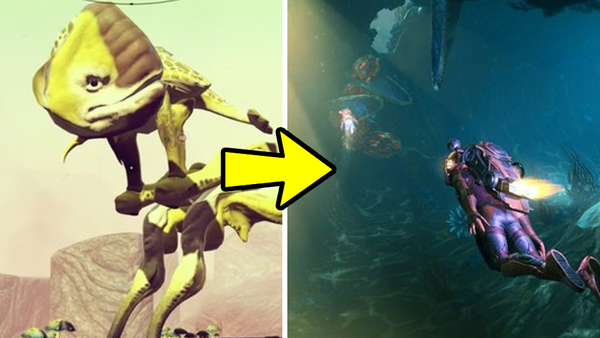
No Man's Sky represents the most carried away we all got with expectations and hype for a game, this generation.
The behind-closed-doors gameplay demos being reported as "mind-blowing" and "jaw-dropping". The faked talk show segments showing a build of the game clearly unrepresentative of what we'd play. The fact that even on the week of launch, not even Hello Games knew exactly what No Man's Sky was, or was supposed to be.
No Man's Sky had morphed from the wondrous, 13 person dev-team experiment it started out as, into an E3-dominating beast of unachievable expectations. Literally nothing could've lived up to what No Man's Sky had become in a pop culture sense, and that's the point in retrospect.
Sony quickly distanced themselves from the damage, essentially saying that the advertising and marketing deals they'd offered Hello Games weren't evidence of wrongdoing, because creative lead Sean Murray had agreed to them.
Sony personally vet everything they're going to sell on their storefronts, but regardless of where blame lay, we ALL had to learn from this.
Since No Man's Sky there's been a cap on expectation; a drilling down on "concept trailers", redefinitions of "gameplay" and a narrowing of the gap between pre-release footage and what you'll be buying.
The 2000s' worst example was Sony faking Killzone 2's gameplay, and all it took for truth to be desired even more, was one of the biggest lies in gaming history.
6. Battlefront 2 - The End Of Predatory Microtransactions

It took a LONG time for microtransactions to hit absolute rock bottom.
You had a practice where game makers of various roles realised they could insert microtransactions into almost any part of a game, and someone out there would pay.
Skins and cosmetics? For the most part, especially if they're in a free game, cool.
Blind boxes that may or may not have the item you need? Less cool. Annoying, in fact.
Straight-up grind-fests where the game is purposefully designed to waste your time until you "give in" and buy the solution instead? That was the tipping point.
Ubisoft's For Honor was one of the first titles with an insidious grind at heart, promptly taken to task by its fanbase. Middle-Earth: Shadow of War was another, as the endgame became entirely reliant on "orc loot boxes" to actually finish.
Then Battlefront 2 came along - all of these in 2017, by the way - and we'd had enough. Simply due to the predatory nature of paying to remove a game's grind, paired with none-other than the all-ages Star Wars branding, EA's latest was labelled, "a Star-Wars themed online casino designed to lure kids", according to Hawaiian politician Chris Lee.
From here things only blew up further, but everything finally changed.
Battlefront 2 overhauled its design, as did For Honor and Shadow of War. Various legal restrictions are now in place - dependant on country - to disclose things like drop rates for loot boxes, or to force on-box mentions of the microtransaction systems within.
MTX are obviously still in many titles, but consumers finally have the power to flag them on a public forum, gathering enough momentum for things to be amended immediately.
2017 was the worst of it, and thankfully, we haven't seen anything quite so bad since.
5. Sonic Boom - Forced "Modernisation" Of Old-School Heroes

If there's one thing the industry routinely struggles with, its modernisation of a character designed for a specific timely demographic, being retrofitted or overhauled for a new audience.
We had Crash: Mind Over Mutant, where the Orange Marsupial suddenly had some very late-2000s tribal tattoos over his arms. Skylanders snatched up Spyro and turned him into a weirdly angular goblin... dragon... thing. Bionic Commando reinvented Nathan "Rad" Spencer as a dreadlocked nu metal singer-looking fellow, and even Dante came back without his iconic red coat, white hair or even overall personality, in 2013's reboot of Devil May Cry.
The worst of it though, and the one that prompted an apology from Sega?
Sonic Boom.
Centring more on just how busted and half-baked Sonic Boom was as a game, Sega boss Haruki Satomi released various official statements, noting that the company had "lost trust" between themselves and fans, that they wanted to "win back customers' trust", and were "dedicated to bringing you quality gaming experiences" going forward.
Their next move was to ditch this redesigned Sonic altogether, releasing the immaculate fan team-developed Sonic Mania as a smooth-over. Activision released the Crash and Spyro trilogy collections alongside Crash Team Racing, Capcom went back to their roots with Resident Evil, losing the increasingly ridiculous direction of Resident Evil 5 and 6 for the confident re-imaginings of RE 2 and 3, and Devil May Cry re-embraced the Dante of old, for one of the best entries in the series.
4. Custer's Revenge - Forcing Rating Systems & Treating Games As Art

This applies to a bunch of titles that royally freaked America's top lawyers and government officials out at the time, but let's focus on the one that wasn't remotely good to play.
Because the formation of the ESRB was a fascinating thing.
With video games before its creation being categorised as "toys", and the American Software Publishing Association saying the government "didn't want to spend any time" regulating adult video games, it meant the likes of Mortal Kombat, DOOM, Wolfenstein, Night Trap etc. were "being made for kids".
Obviously one look at these things and you knew that wasn't the case, but clearly video games were in need of a regulation system.
Where all the aforementioned games were actually pretty good with solid mechanics and enjoyable pay-offs (yes, even Night Trap), 1982's Custer's Revenge had long been held up as a truly awful game that should never be given the same categorisation as, well, anything else.
Centring on the attempted rape of a Native American prisoner (yes, really), the ESRB's formation finally came in 1994, but it was after over a decade of certain companies just seeing what they could get away with.
There'd be envelope-pushers after 1994, but with codified age-gates and that inbuilt sense of consideration behind what the hell you were making, it elevated and matured the medium like nothing else.
3. E.T. - Tie-In Games No Longer A License To Print Money

This point has been made at varying times over the years, with the most recent being the initial slate of MCU tie-in games (Captain America: Super Soldier, Thor and The Incredible Hulk), putting Marvel off doing anything other than apps until Spider-Man came along in 2018.
LONG before that though, was E.T. - a game assembled in just five weeks. Why? Because there was money to be made, Atari were flying very high indeed, and a game licensed off an incredibly popular movie should've been an easy cheque to cash.
Instead... it almost killed the entire gaming industry.
You can do wider reading on the state of gaming at the time - how the medium was seen as something for children, and mostly a way to kill time - but the real takeaway comes from treating consumers like total fools. In this case E.T. fans, who'd blindly snap up anything with a recognisable logo.
E.T. the game sold like hell, its remaining copies were buried in the Nevada desert in an attempt to move on, and it would take Nintendo arriving on western shores with both Mario AND Zelda to get half the planet caring about video games all over again.
E.T. will forever be the biggest reminder, that just because you HAVE a "license to print money" in theory, it's never a foregone conclusion.
2. Mighty No.9 & Godus - The Perils Of Crowd-Funding

For a little while in the late 2010s, it felt like crowdfunding was the way to get a game off the ground, if the triple-A side of things wasn't working.
Thankfully over time we've seen the indie circuit become so much more advanced. Things like the Unreal 4 engine going free, initiatives like EA Play and Ubi Art all help break the perception that "indie games" equals "side-scrolling pixel platformer".
Back to crowdfunding though, and there are some horrendous cases of creatives not living up to their end of the bargain. Peter Molyneux's Godus amassed over $500k in funds, only for the final result to barely be worth a fraction of that.

Keiji Inafune's Mighty No.9 - aiming to be the "traditional Mega Man" that Capcom would no longer do, only fell flat on its face, misusing funds to add features the backers didn't need, resulting in a shabby final product.
There's also the complete travesty that was the Ouya, and other examples like Star Citizen, which whilst still in production, was supposed to release back in 2015. That game has gathered over 228 million dollars in funding, with nothing for anybody in return.
Triple-A devs have certainly tried our patience this generation; relying on the same formulae over and over, but crowd-funding is not a one-size-fits-all saving grace you should simply throw your money at.
1. Ghost Recon Breakpoint - No More Unfinished Triple-A Games

You wanted to believe Ubisoft learned their lesson with Assassin's Creed Unity, but after an entire generation of homogenised game design, Ghost Recon Breakpoint was one broken title too many.
The hyped and much-anticipated game sold next to nothing thanks to a terribly stilted demo, scores of microtransactions, off-feeling physics and an inclusion of Jon Bernthal that amounted to a glorified boss fight.
Ubisoft reported a 93% fall in operating income (yes, really), illuminating just how much relying on the same formulas - then churning them out faster and faster - had taken its toll.
Thankfully, this was a big enough blow to finally enact some change.
Ubi apologised to fans and promised that Breakpoint would be overhauled, before delaying Watch Dogs: Legion, Gods & Monsters and Rainbow Six: Quarantine, so they could be worked on with care.
It's not only Ubisoft who were reading the tea leaves, though. Nintendo, Sony, Bethesda and more all delayed major releases at the close of 2019, including The Last of Us 2, DOOM Eternal, Dreams, Animal Crossing and more, to allow for sorely needed development time.
At time of writing we've seen DOOM Eternal, Animal Crossing: New Horizons and Dreams all release to critical acclaim, and even Ghost Recon: Breakpoint has come back swinging, with its Splinter Cell-infused Deep State expansion, all showing it's better for all involved to give games their necessary time in the oven.
Watch Next
Can You Handle Our Insanely Hard Video Game Quiz?
