7 Ways Your Favourite Video Games Are TOTALLY Different Overseas
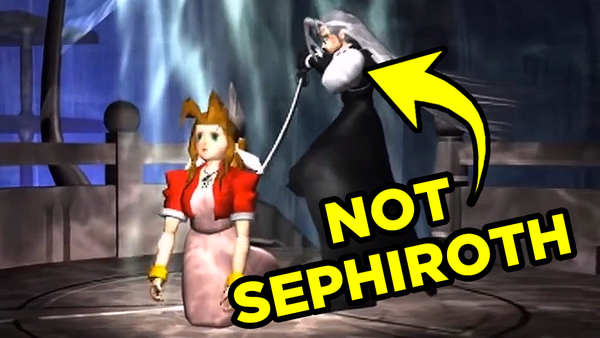
You've been blaming the wrong person for Aerith's death for over 20 years.
Part and parcel of being one of the most exciting and innovative entertainment artforms on the planet, is that gaming had to reach that planet in the first place.
It might seem supremely obvious that a given game is successful in one area, thus it should be ported across and language-swapped to work elsewhere, but the reality of localisation often hits a number of snags, and they're fascinating to pick apart.
Where key terms, weapons, items and even character catchphrases can immediately need a change if a certain region's nomenclature clashes with the artist's intent, sometimes entire plot points are modified or overhauled. The latter is the most integral thing to focus on, but over the years, various localisation teams have clearly struggled communicating the nuances of a particular script or scene, resulting in scores of major alterations that entire chunks of the globe aren't aware of.
Point being: Some childhood favourite you've held dear for years might also be a childhood favourite for another individual in another part of the world, but for entirely different reasons.
7. Colonel Campbell's Time Paradox - Metal Gear Solid 3: Snake Eater
Following Metal Gear Sold 2 showing everyone the power of the PS2's graphical capabilities (seriously, it still looks pretty astonishing to this day) and one hell of a plot twist-filled story, all eyes were on MGS 3, and the question of where Kojima would go next.
Being Konami didn't tell a soul that Raiden was secretly the majority main character of Sons of Liberty, this had fans and games journalists alike trying to predict the next "massive twist".
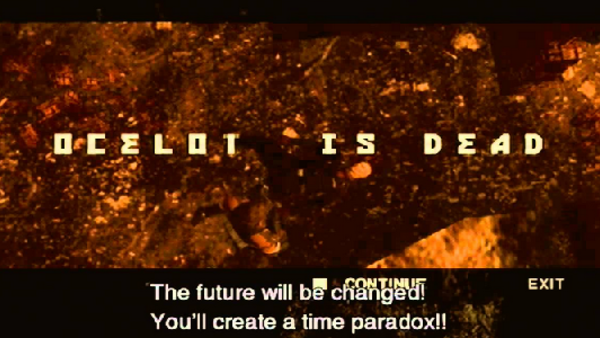
We knew that MGS 3 was going to focus on a young Big Boss, Naked Snake, and that it would be set in the 60s, but that was it. A breakthrough came then, when pre-release footage included a modern day-sounding Colonel Campbell stating Snake's death would change the future, and that it had "Caused a time paradox!"
"That's it!" we thought. "It's all a simulation!". Raiden or a new-age Snake is journeying back to investigate some past event, and there'll be some insane reveal at some point in the game, right?
Wrong.
Though this became known as a fourth wall-breaking joke, the reality was that Campbell's Japanese voice actor, Takeshi Aono, actually voices Doc Brown in the Japanese dubs of the Back to the Future movies.
The "time paradox" line was a reference to Doc's line from BttF 2, and the only reason we got it in the American one was as a straight translation into English, though it didn't carry the same meaning whatsoever.
All those years of speculation, and even in-game, the idea that Snake Eater was going to have a timeline-based reveal... came from a joke.
6. The Fate Of Ganon - Zelda: Breath Of The Wild

One of the reasons Breath of the Wild is so totemic, so outstanding and so ethereally beautiful, comes from its status as something of a "standalone" Zelda.
Almost feeling like a soft reboot of the franchise, Nintendo dodged all questions of where it sat in the canon, gave Link a nice blue tunic and set about naming half the locations in the world after characters, rather than including them as NPCs.
Ganon too, is still a powerful evil Link must wield the Master Sword to defeat, but in having his appearance not be a man, but a large demon, the Western and Eastern releases ultimately define him very differently.
In the Western release, before you fight the final form of Dark Beast Ganon, Zelda screams that he "has given up on reincarnation and assumed his pure, enraged form". This makes sense in the moment as the various parts of Ganon that were scattered across the realm have also been brought down, and all that's left is one final enemy to put in the ground.
It's the word "pure" that fans latched onto, and it's what makes this fight so powerful.
In the Eastern release though, Zelda's line references the entire Legend of Zelda mythos and Ganon's immortality, saying that Dark Beast is "born from his obsessive refusal to give up on revival" i.e. This is just another form of Ganon, and - like in the wider mythos - downing Breath of the Wild's Ganon is only a stopgap for a future fight.
5. Sonic's Planet "Mobius" Doesn't Exist, And Was Earth All Along

Remember how across the 2000s, Sonic's entire canon just switched, and suddenly Dr. Robotnik was Dr. Eggman, and even the levels were now set across places that looked a whole lot like Earth?
Yeah... it all started with a mistranslation from series creator Yuji Naka, who when speaking to Sega for an issue of Sega Visions magazine, made reference to Sonic running on "Mobius", resulting in the idea that the games were actually set on some random place called "Mobius", and not Earth.
Being set on another planet would explain the underground purple caverns and moss-caked ruins that looked like they belonged to a completely different species, so various western media and entertainment properties ran with this, resulting in even the absolutely f'ing awesome Sonic TV series and comics all being set on Mobius.
Sadly, it wasn't to be, and as the series was always supposed to be set on Earth (Sonic rescuing various critters from a cackling oil baron-looking dude was always an environmentalist message anyway), Sonic Adventure 2 finally called the planet Earth, and it's been like that ever since.
That "Mobius" line? It referred to the levels being modelled somewhat on "mobius strips" - a mathematical for a one-sided space that Sonic could then sprint across.
Westernised assumptions were also the case for Dr. Robotnik, too. Team Sonic's Takashi Iizuka stated in a later Game Informer interview that Eggman was always Ivan's real name, but it was the American localisation team who changed it, without consulting the developers.
Call me crazy, but Dr. Robotnik on planet Mobius is infinitely cooler than Dr. Eggman on Earth... but you can't have it all.
4. The Primordial Serpents' Role - Dark Souls
-- Major thanks to Dark Souls lore master VaatiVidya for this one --
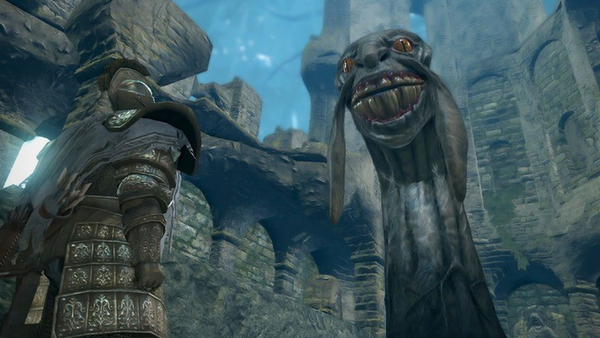
If you've played/survived the first Dark Souls, chances are you'll remember meeting one of the Primordial Serpents, Kingseeker Frampt. A giant, rabbit-with-teeth looking thing that gives you the ability to fast-travel between bonfires, Frampt opens the game up in a way you hadn't even thought of.
Still, Dark Souls lore is famously vague and interpretive up front, but even after delving into the item descriptions, you could be left with a head scratcher or two.
For the Primordial Serpents, a more apt translation for the West would've been "World Serpent", immediately drawing comparisons to Jörmungandr, Norse mythology's world serpent, whose body encircles the Earth, and whose mind understands all time, both past, present and future at once.
Knowing that this is what FromSoftware were trying to connote, both Kingseeker Frampt and Darkstalker Kaathe's dialogue and respective roles make a ton more sense. Frampt gives you the Lordvessel to move around more freely, letting you become powerful enough to stop Gwyn, and Kaathe reinforces this by stating that the Lord of Cinder "resisted the course of nature", ultimately hinting at the wider light vs. dark state of Dark Souls' world, and how balance must be restored.
Without this simple tweak, the Serpents' role in everything is all that more vague, and easily ignored.
3. Two Of Metal Gear Solid's Characters Are Drastically Different

This is less an "error" (depending on how much you want to define an artist's original text as gospel), and more a look into how different regions' entertainment will only "accept" certain affectations and characteristics.
Point being: Another massively, almost un-categorically influential video game whose defining instalment is beloved across both the East and West, is Metal Gear Solid, but it has a drastically different portrayal of Solid Snake and Revolver Ocelot, depending on where you're playing.
First up, Solid Snake. The gruff, militaristic "got this" mercenary us westerners fell in love with? He was originally a more playful individual, turning into Bashful the Dwarf around women, and being inspired - according to Hideo Kojima - by energetic anime character Lupin III.
In the translation/localisation process, as Snake was moulded even more into the Hollywood model he was initially taking influence from, he became an archetypal action hero with more rigid mannerisms.
In the roundly despised (by PlayStation owners) MGS: Twin Snakes, the vast majority of the western fandom lost their collective minds because Snake was back-flipping off missiles in mid-air and flipping about the place in slow motion, but this more overblown take on the character was more in-line with the original across the board.
It's also worth highlighting that Revolver Ocelot - one of the coolest villains in gaming history - was supposed to come across as a "wannabe". Noted by TvTropes, the Eastern release paints him as more of a "gun fanatic" who's "rude", and has "nerdy speech patterns and pitiful fixations".
As the localisation team didn't think this would work for a western audience, he was transformed into a "spaghetti western" gunslinger the eastern Ocelot could only dream of.
2. Kingdom Hearts' Nobodies Categorically DO NOT Have Hearts
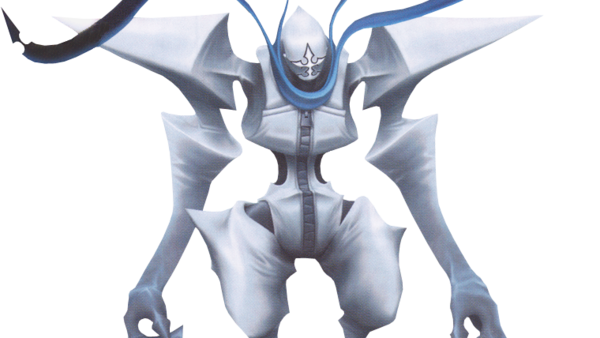
For as long as Kingdom Hearts has been a thing, I've been confused as to what a "heart" even was. Sometimes they're referred to as more of a "soul" i.e. not a physical thing, and others it'll feel more direct, as though the dialogue is referencing a sense of health and charisma within Sora and his companions. Other times a "heart" will be a vessel, and very much something that's being talked about as having a capacity, or other such specific purpose.
That's just the tip of the iceberg when it comes to the complex noodle pile of plot threads that is Kingdom Hearts, but it's worth pointing out that because "heart" is also an English word, and there are various heart-shaped entities within the KH lore, the "physicality" of a heart started to develop for westerners, even though in Japanese, heart means "What makes you, you".
This Japanese read allows for "having a heart" to equal "having a soul", which is all well and good, but after the franchise introduced "Nobodies" (beings without heart), the Western side of the fandom began to question just what Nobodies even were.
This is a conversation that's raged for many years now, but the reality is that a heart in Kingdom Hearts, was never a real, physical thing, and instead was always encapsulative of a person's soul, or will to carry on.
1. Sephiroth Was Controlled By Jenova, And Didn't Stab Aerith - Final Fantasy VII

Yeah... turns out the original Japanese text for Final Fantasy VII wrote Sephiroth in a completely different way, and it was down to a threadbare localisation team that a TON of FF7's descriptions and lore barely makes any sense.
Even Sephiroth has a markedly different role, with markedly different motivations. See, thanks to Redditor Ryias shedding light on the reality of the translation, they detail how Jenova was the real big bad; a parasite infecting and controlling Sephiroth, rather than unhinged, obsessed killer.
This is why Sephiroth finally sprouts additional limbs and a more alien form in the final battle, and how after defeating this form, you then face off with the remaining "human" version within. It was all about removing the Jenova parasite from the real Sephiroth, but this final version is the one who merges with Jenova after Cloud throws the pair of them into the Lifestream at Nibelheim.
The Sephiroth that does all the stuff we remember him for? The death of Aerith? That's all Jenova - an imposter trying to unite the various parts of itself at the Northern Crater. This massive, ludicrously seismic plot twist IS in the Western game, but you'd barely take it on board, because it's resigned to two sentences, and Cloud saying "I'll explain later", only to never do so.
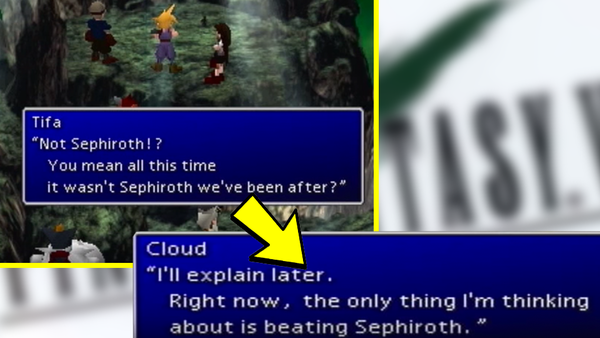
Back to Aerith, and the humble flower girl didn't die to Sephiroth, but Jenova - an alien wiping out the one Ancient who could weaponise Holy materia to bring it down.
Ryias describes how at the game's end Sephiroth's persona is "at the forefront", but it's "Jenova's instinct and will [that] lives on through him, driving him to destroy". We get a taste of this when the game takes all control away from you before Aerith's death, only leaving the commands to try and strike her down as Cloud. In the original Japanese script, all of this is spelt out way more.
As Jenova cells are injected into prospective soldiers, only to be regulated by Mako, Cloud's body never took to the treatment - hence the headaches and blackouts - but Jenova keeps trying to control him regardless, whilst also guiding "fake Sephiroth" north.
Knowing Jenova's true role as the main overarching villain; stringing both Sephiroth and Cloud along, makes for a far more satisfying ending in every respect when Aerith uses the power of the Lifestream to repel Meteor, and Cloud defeats both Jenova AND Sephiroth to protect the planet.
All of this is all but left out the western release.