8 Underrated Relationships In Assassin's Creed
Nothing is true, but everlasting endearment is permitted.

The Assassin's Creed franchise is nothing short of interesting lore and mythos, encapsulated in a narrative spanning virtually all of recorded history itself.
A bit of science fiction, compounded by a never-ending conflict between the Assassins and the Templars, has successfully resulted in one of the best-selling franchises of all time.
What started as a simple battle of ideologies in the Crusades, has developed into a morally-ambiguous discussion on which side is more right than the other. No matter if one plays as Desmond Miles or Layla Hassan, the player gets the opportunity to see various characters interact with one another, in their respective period of time.
This provides the opportunity to see not only how some figures of that era interacted with others, but also how the protagonists of the games formed bonds with them.
These relationships, intimate or otherwise, formed the basis of what made playing the Assassin's Creed game so gratifying, knowing that these characters were capable of more than just being a robotic NPC.
While iconic relationships like that between Ezio and Leonardo may have stood out to players, there are others that may have been overlooked. Upon closer inspection, the bonds between certain characters throughout the series offer players a glimpse into some truly compelling storytelling...
8. Ezio Auditore and Yusuf Tazim

The general consensus is that Ezio Auditore is Assassin's Creed most popular protagonist. He's had his fair share of interesting relationships over the course of three games. The one that individuals may sweep under the rug is the one shared with Yusuf Tazim, the leader of the Ottoman Assassins.
They both form an amicable bond over the course of Revelations, often sharing jokes and quick-witted banter with each other about the the differences in their respective societies. When things inevitably became serious, they followed the Creed they shared, in both fighting off the Byzantine Templars, and with defending the Assassin strongholds within Istanbul.
Though he was significantly younger than Ezio, Yusuf nevertheless possessed the same skills that made for a leader fit to defend the city he held so close to his heart.
He was able to trust Yusuf on such a level, that he tasked him with protecting Sofia Sartor, Ezio's eventual wife, from harm that may come her way because of their mounting success in the region. This came at the cost of his life, but Ezio and the Ottoman Assassins made sure that he was buried with dignity.
Ezio may have had memorable relationships throughout his trilogy with characters such as Leonardo da Vinci or with his uncle Mario Auditore. Yusuf, on the other hand, through his depiction, was almost a younger mirror of Ezio, effectively making their chemistry as natural as possible.
7. Jacob and Evie Frye

The Frye twins were one of the few bright spots in an otherwise uninspiring Assassin's Creed series entry. The brother's sharp wit and humour often complemented the sister's headstrong and determined composure, and their divergent paths helped to bolster the game's overall narrative in Victorian-era London.
Although they were bound by their Creed to dismantle Crawford Starrick's Templar influence in London, Jacob and Evie nevertheless tried their best to have some fun in some areas.
From Jacob poking fun at Evie's affection for fellow assassin Henry Green, to racing to a train at the end of the game, their bond was always as strong as their impulse to amuse one another.
Eventually, their mandates often clashed with each others. Evie would blame Jacob for being too reckless, while Jacob would question her effectiveness in the field, leading to a temporary drift between the two. Disagreements never lasted with the Frye twins, as they eventually reunited to eliminate Starrick and obtain the Shroud of Eden.
Evie even went the extra mile in latter years for her brother by both rescuing him from and assassinating Jack the Ripper, a former protégé of Jacob.
All siblings will have disputes as their relationship matures. When the time comes to put their differences aside for the greater good, most will, just as Jacob and Evie have done. It's a shame they haven't been mentioned much since.
6. Shay Cormac and Liam O'Brien

The great thing about Assassin's Creed Rogue was that it demonstrated that the franchise was not as black-and-white as it was initially developed.
Which is why the soured brotherhood shared between friends Shay Cormac and Liam O'Brien is so fascinating. Their ideologies and beliefs clashed with one another’s, showcasing that the Assassins weren't always as good as they claim to be.
Shay shared a brotherly bond with his counterpart in Liam, who was eager to help the Colonial sect of the Brotherhood in any way he could. Although Shay would often joke around during their initial conversations, Liam was never dismissive of him.
Liam, however, was so headstrong about his belief in the Assassin's motives, that he spared no effort in attempting to kill his childhood friend, when Shay was seen accusing Assassin mentor Achilles Davenport of sending him to voluntarily trigger an earthquake within a Precursor site. These events made Shay defect to the Templars, while Liam remained with the Assassins.
The assassin met his demise by the game's end, sarcastically questioning if Shay made the correct decision in helping the Templars create what he perceived to be their version of the new world.
Although Shay was remorseful for killing his former friend, it served as a reminder that, sometimes, beliefs can be strong enough to turn the closest of friends into the most distant of strangers.
5. Haytham Kenway And Kaniehtí:io

Complex, layered characters were in abundance if one looked closely at the narrative of Assassin's Creed III. Connor, a very complex protagonist, was conceived out of an even more complex partnership shared between his biological parents.
Haytham Kenway, one of the most memorable characters of the entire franchise, was tasked to locate a Precursor Grand Temple in the New World.
He eventually formed a partnership with Mohawk woman Ziio, as they both had a mutual desire to kill Edward Braddock, a former Templar and British Army general. In turn, after finding the Precursor Site, the two conceived a son, who would later grow into one of the Brotherhood's most revered members.
Although he remained dedicated to his Templar beliefs, with this also being the cause of his later drift with her, Haytham nevertheless wondered what a life with Ziio may have been like.
The two's relationship ended as soon as Ziio was made known of his Templar affiliations, and her eventual death was one of the main reasons for their son, to target Haytham.
Their love for each other was undeniable, even after many years have passed. As far as tragic ends to relationships go, the one shared between Connor's parents was melancholic, as they would never truly be able to continue their obvious affection for one another in a world filled with different hierarchal orders.
4. Altaïr Ibn-La'Ahad And Malik Al-Sayf

Sometimes, disagreements between best friends can be the cause for a significant rift to occur. However, if the bond is truly unbreakable, those friends will find a way back to trust each other again.
The relationship between Levantine Assassin's Altaïr and Malik was representative of this sentiment through and through.
Malik had great respect for Altaïr, but would subtly envy him, due to the Master Assassin's superior combat prowess, and their mentor's preferential treatment of him.
Their mission to retrieve the Apple of Eden proved to be the catalyst for Malik's envy transforming into animosity towards Altaïr, as not only did the former ignore all tenets of their Creed, but his recklessness resulted in both his younger brother's death, and him losing his arm.
Eventually, they mended their relationship with one another. Both admitted their faults to each other, with Altaïr apologizing for his devil-may-care behaviour, while Malik genuinely grew to respect him as a brother.
This sincerity grew from there, even after the Assassins retook Masyaf from their former mentor. Altaïr entrusted Malik so much, that he made him his right hand man, once he departed to face the threat of Genghis Khan.
Unfortunately, Malik fell at the hands of another disillusioned comrade in Abbas. Loyalty, however, was the link that bonded the two together, and it was certainly cause for Altaïr to avenge his death when he confronted Abbas for the last time.
3. Edward Kenway and Adéwalé

In a time where outcasts from various demographics had to band together to survive, brotherhood is usually found amongst those ranks. The bond shared between famed assassins in Edward Kenway and Adéwalé illustrated that sentiment.
The pair met each other, in shackles, aboard a ship that was headed for Seville. The two worked together to escape their captors, and eventually escaped. Since then, Edward and Adéwalé became the closest of friends, with the latter becoming the former's quartermaster and most trusted advisor.
Despite having periodic clashes over what they should be pursuing in their life of piracy, such as Edward aiming to pursue riches and Adéwalé wanting to work towards Assassin-based goals, they formed a brotherly bond that was without fault.
In fact, it was Adéwalé who managed to convince Edward to use the Assassin's ideals to amend for the latter's long list of past mistakes. Adéwalé always spoke highly of Edward even in death, such as when he battled his son Haytham, in which he said that his father would be disappointed in his chosen life as a Templar, just as he was.
Though their personalities differed greatly, the duo had a reverence for each other's consistent values and beliefs. The life of a pirate may have been the initial reasoning for their partnership, but committing to the greater good was what bolstered their devotion to each other.
2. Bayek and Aya

Intimacy can either be really well done in Assassin's Creed, or left with a lot to be desired. When it is the former, founding members of the Assassin's brotherhood, Bayek and Aya, illustrate both the high points of love, and the incredibly difficult sacrifices that relationships sometimes have to make.
Initially, the proto-Assassins would view each other with nothing short of adoration for one another. They shared a mutual goal, which was to avenge the murder of the son Khemu. Their missions may have eventually taken them in separate directions, but they were both consumed by love upon seeing each other again.
These bursts of happiness were not made to last. As each became more aware of their direction, with Bayek hunting down those directly responsible for Khemu's death and Aya cementing the foundations of the Brotherhood, their marriage was eroding.
It wasn't out of sorrow or remorse over their son's death, but rather of the realisation that their threat was much bigger than initially anticipated, thus requiring the need to build Assassin influence in separate regions.
The pain they both endured because of this was palpable by the game's end. What began as a simple tale of revenge, eventually evolved into Bayek and Aya discovering their true purpose. Marriage doesn't always result in a happy ending, but can, sometimes, manifest in an amicable split, for better or for worse.
1. Connor Kenway And Achilles Davenport
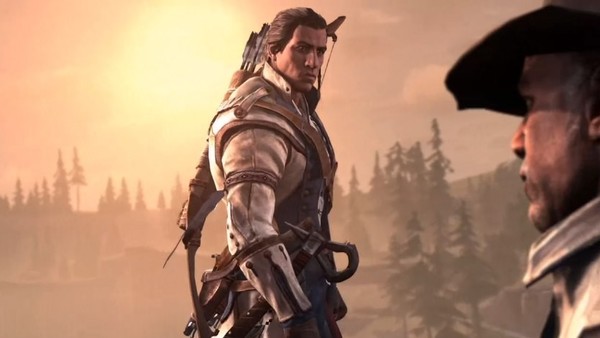
Assassin's Creed III often gets a bad rep, and, although some of the criticism is warranted, the relationships Connor has with some characters in the game are remarkable. His relationship with his biological father, Haytham, was tenuous, which is why the one he shares with his father figure and mentor Achilles was so gratifying.
By the time Connor meets Achilles, he was a broken man, isolating himself away in his Homestead. Achilles would eventually bestow upon him the history of the Assassins and Templars, his training and his missions.
Connor would gain valuable insight from Haytham in their periodic encounters, but it was Achilles who truly valued Connor's achievements, such as rebuilding the Homestead into a beacon of community in a young America.
Achilles would sometimes admonish Connor for being reckless, the way he had in his years as an Assassin and as Mentor. The two, however, were always able to put their minor differences aside, as they recognised there was a larger mission to accomplish, in eradicating Templar influence in the New World.
It's no surprise that, by the time Achilles peacefully passed away, Connor realised where his westernised name came from, which was from the former's own dead son.
Connor may have never been able to secure a relationship with his own father, but Assassin's Creed III demonstrates that, in some instances, one's parental figure can be found in someone else entirely.
Watch Next
How Well Do You Know Assassin's Creed's Characters?
