9 Controversial Things Rockstar Games Want You To Forget
Anyone for coffee?

Of all the video game developers in all the world, none court controversy quite like Rockstar.
Going from fairly humble beginnings with Thrasher: Skate & Destroy and Earthworm Jim, the studio blew a hole in the side of the public conscious with 1997's parent-terrifying GTA. It goes without saying that this more than made Rockstar a force to be reckoned with, but as for how the various teams making up their studios actually operate, that's mostly remained shrouded in secrecy.
Founders Sam and Dan Houser aren't ones for public appearances, and simply down to Rockstar having so much cultural pull, they tend not to allocate much money to advertising, either. Everybody and their granny will check out "the next Rockstar game" no matter what, and the team knows it.
As such, they've built up a solid reputation for quality video games and innovative mechanics (GTA III literally changed the face of the industry and invented a genre), but outside of that, maintaining a level of autonomy away from the public eye has resulted in a number of stories being quashed...
9. Niko Bellic's Voice Actor Feeling He Was Unfairly Paid

Imagine working on a Grand Theft Auto game post-GTA III, and not knowing it was going to be a big deal.
Such was the case for Niko Bellic's voice actor, Michael Hollick, who despite being paid $1050 per day for recording sessions across 2006-2007, once he noticed the game was soaring to heights of $600 million and beyond in revenue, he wanted more. Thus, he got in touch to "renegotiate" his contract with Rockstar, only to be completely ignored and cast aside.
In fairness, this qualm centres more on SAG (the Screen Actor's Guild) setting up contracts between actor and studio that don't benefit the long term, but that didn't stop Rockstar being blamed for not adequately paying their actors, despite legally not doing anything wrong.
It all cumulated when MTV Multiplayer asked for comment on whether Hollick would be in GTA IV's then-upcoming DLC packs, to which Rockstar responded with a rather blunt, "Hell no".
To somewhat add salt to the wound, Rockstar would use discarded clips from Michael's previous recording sessions to make a performance for Bellic whenever he appeared, moving forward and neglecting to address the complaint ever again.
8. There Was Almost An Internal "Mutiny" Over Manhunt

One of the most relentlessly brutal and gory video games of all time, 2003's Manhunt felt like Rockstar saying "If you want a monster, we'll give you one".
Following just how overblown the controversy surrounding GTA III and Vice City had become, what's more surprising is that a decision to make something so deliberately controversial and press-goading was not a decision the entire team were on board with.
Said now ex-employee, Jeff Williams,
"There was almost a mutiny at the company over that game. It just made us all feel icky. It was all about the violence, and it was realistic violence. We all knew there was no way we could explain away that game. There was no way to rationalize it. We were crossing a line."
The "line" Williams refers to is the sort of thing games like Postal or Hatred don't know how to walk, whereas with Rockstar at the helm, Manhunt became a tale of prey and predators - of slowly turning the tables on your oppressors, one shiv, plastic bag strangulation or shotgun blast at a time.
7. When They "Stole" Daz Dillinger's Music For GTA V

One of those under-reported stories that ultimately fizzled out due to the behemoth that is both GTA and Rockstar thundering on, rapper Daz Dillinger tried to kick up a stink over two of his songs ("C-Walk" and "Nothin' But the Cavi Hit") being used in GTA V.
He reported that Rockstar did approach him to use his music before launch, but offered the "offensively low" $4271 as a one-off - which he declined.
The kicker was that GTA V still went ahead with these songs intact, as Dillinger claimed various fans had got in touch to tell him. This resulted in a cease and desist letter being sent to Rockstar, with the clause that if Daz wasn't paid more than the aforementioned initial sum, Rockstar should "recall and destroy" all copies of the game.
That... was about as far as it went, as in a later interview Daz mentioned he was still waiting, letting his lawyers do the work. Assumedly the parties settled out of court as Dillinger never followed up on the allegations and the songs have been removed from the game's full playlist.
6. Target Refusing To Stock GTA V Because Of "Violence Against Women"

Nothing like a good ol' hyper-sensationalised media spin to whip everyone into a stupor.
Of course, by the time we got to GTA V it was somewhat expected that the game would be the centre of yet another, "Won't someone think of the children?!" outrage, but Australia's Target chains decided to get hung up on something else: An apparent "focus" on committing violent acts against women.
Started by a change.org petition that went all-in, pleading to Target that Rockstar's latest game "encourages players to commit sexual violence and kill women", almost 50,000 people signed on, resulting in the retail chain refusing to stock GTA V in the country.
Being that GTA is always a black mirror held up to society, outside of exclusively female prostitutes there's just as much propensity to commit violent acts against males, females and anything in between. Target remain selling R-rated content such as movies and other games, yet potentially because of this petition-backed outrage, GTA V is still a no-go.
5. Accidentally Leaving A Sex Minigame In GTA: San Andreas

2005 was the year when - after three years since GTA III - the whole world was debating the various moralities and "influences" GTA could have on the youth, seeing Rockstar in the firing line for everything from Manhunt's "murder porn" aesthetic to lawyer Jack Thompson making it his life's work to rid the world of their products.
"Hot Coffee" then, was the name given to Rockstar's coders leaving a sex minigame on the initial pressings of San Andreas' physical copies. PC modders dove into the code in 2005, uncovering lewd scenes of CJ getting it on with the game's array of females, thereby causing every major press outlet to compare San Andreas to pornography - despite many characters remaining clothed.
The cultural response was unprecedented as San Andreas was pulled from Australian store shelves under governmental mandate, and the U.S. granted it an "Adults Only" rating (again, the same as pornography).
Rockstar promptly started printing versions of the game without the "offensive" material, reverting the rating back to a solid 18 in the UK, and Mature in the US. Original copies are still out there, so chances are if you bought one in 2004, your game will still have the Hot Coffee scenes intact.
4. Bully's Controversy-Fuelled Name Change In The UK
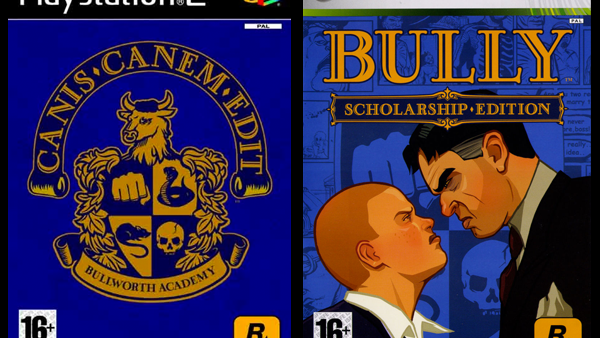
Speaking of the mid-2000s, every game Rockstar looked to put out was viewed by the media as Satan's own private reserve. Bully was no different, and as antagonistic lawyer Jack Thompson was appearing on as many talking heads news segments as possible, the game quickly became misrepresented as something that "encouraged" bullying children.
Naturally, the reality was that Jimmy Hopkins (your character) was not only the subject of bullying himself, but could save various other children from harm - a setup that saved Bully in the long run as it remains one of Rockstar's most well written and best games of all time. Still, the press chose the sensationalised route, leading to the UK release having a completely different name: Canis Canem Edit (latin for "Dog Eat Dog").
Over time the general furore would cool (mainly because all those who played Canis Canem Edit/Bully realised its playful representation of high school cliques was endearing and loveable), leading to the Scholarship Edition on Xbox 360 retaining the Bully name, even in the UK.
3. Lindsay Lohan Managing To Sue For Her "Likeness" In GTA V
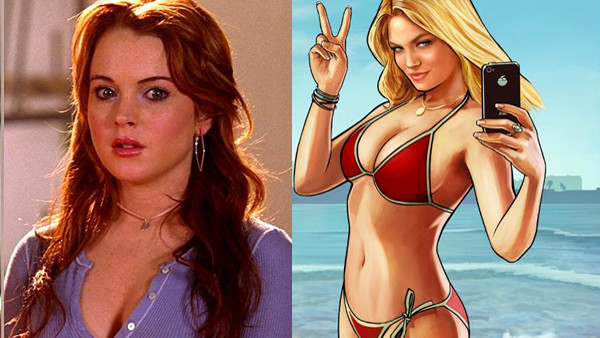
Completely out of left field considering the sorts of allegations usually levied at Rockstar, Lindsay Lohan claimed that the character of Lacey Jonas was directly inspired by her actions and image.
Though the "character" in question was nothing more than a random bikini-clad woman Rockstar had used in GTA V's advertising, Lohan claimed all sorts of similarities from the likeness clothing resembling Lohan's fashion line, to the beachside location being a dead wringer for the Chateau Marmont, a hotel where Lohan once stayed.
Weirdly, this sort of court case should've been immediately discarded as Jonas is - if anything - a perfectly legal parody of Lohan, leading Take Two (Rockstar's parent company) to label the case as "filed for publicity purposes".
Still, it went ahead... for a literal New York minute, as a court judge then stated that "works of fiction and satire do not fall within the narrow scope of the statutory phrases advertising and trade", adding "This video game's unique story, characters, dialogue, and environment, combined with the player's ability to choose how to proceed in the game, render it a work of fiction and satire."
Better luck next time, Lindsay.
2. Manhunt's Association With Real Life Murder
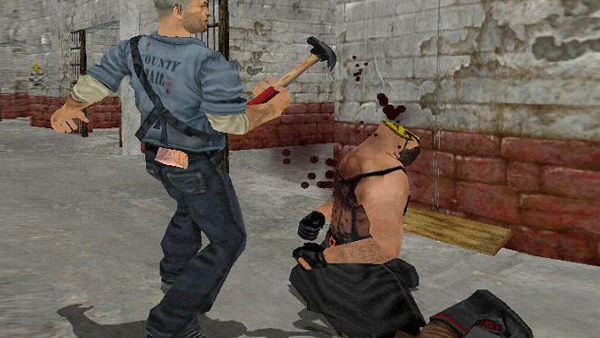
Possibly the culmination of mid-2000s "video games are killing the youth" horror clickbait, a copy of Manhunt was actually found in connection to the murder of Stefan Pakeerah, by the killer Warren LeBlanc.
This simple fact was all it took for Manhunt to be repeatedly blamed for the killing, only there was one key fact omitted from the initial, more reactionary reports: The copy of Manhunt belonged to the victim, and not the killer.
Not only that, but the motivation behind the killing was concluded to be related to "robbery" and Warren being under the influence of illegal substances, as the Leicestershire Constabulary ruled the investigation "did not uncover any connections to the video game".
Sadly, the full report came after Rockstar were forced to weather a storm of inaccuracy, and the victim's parents, Patrick and Giselle, had wasted time and money hiring the disbarred Jack Thompson to sue Sony and Rockstar for their supposed "culpability" in allowing Manhunt to be released.
A mess for all involved, but one that would repeat only a few years later...
1. Rockstar Vs. The World Over Manhunt 2

Knowing that doing anything with the word "Manhunt" would kick off a media storm of unknown proportions, Rockstar still steamed ahead, again showing off a game that prioritised horrifically brutal murder scenes, and rated your performance based on just how sadistic you could be.
At least, in theory. That version of the game would come up against a veritable storm of backlash and misrepresentation in the media.
First up, lawyer Jack Thompson was ready to leap into action again, proclaiming that despite Manhunt being thoroughly removed from all association with the LeBlanc/Pakeerah murder, Take Two were "lying" about how the crime went down.
Following this initial salvo, Manhunt 2 was denied classification from both the BBFC and IFCO ratings boards, banning it in the UK as the ESRB once again gave it an "A.O." rating in the US - meaning like the original, it could not be sold in the majority of high street retailers.
To actually get their work out the door, Rockstar altered many fundamental parts of Manhunt 2, removing the "more brutal kills = a higher score" rating system and various decapitations and kill animations, before adding black and white filters to obscure the bloodiest scenes.
This resulted in a 18/Mature rating, but Manhunt suffered critically as many of its newest features were now no more.