Dark Souls III: 8 Niggling Concerns No Fan Wants To Admit
Is Dark Souls III destined to be a complete catastrophe? Quite Possibly.

Praise whichever celestial body you please - Dark Souls III is real and it's coming next year. Queue the increased sales of every previous title and a spike in hours spent online in Lordran and Drangleic - training has begun in anticipation of a new world that will try it's damnedest to kill you in every which way possible.
But are we jumping the gun by assuming that the newest release in the series will be anything other than fantastic? On paper, at least, one would think that the prospect of Dark Souls III turning out be a disappointment would be impossible.
For starters, series creator Hidetaka Miyazaki is back at the helm this time around after taking a hands-off approach for the development of the middle child - and many consider his input to be what makes the games so popular. There's also fervent talk of the so-called 'Sword Arts' and a ramp up in speed for the combat system. Are such changes big enough to surprise Souls veterans, and are they even what anyone wants?
Changing the established formula too much is sure to get under the skin of all the purists out there, but not doing anything to mix things up is a surefire route to the words 'stale' and 'formulaic' being thrown around like hot potatoes.
That's just the starting line of potential problems that await Dark Souls III though, read on to see the other hurdles that stand in its way.
8. How Sustainable Is Difficulty As A Selling Point?

Dark Souls made its name through the championing of its self-proclaimed difficulty - something that has largely been lost in modern gaming. It was a throwback to the olden days of gaming, when checkpoints and hand-holding tutorials were abstract concepts that nobody had ever dreamed of using.
No, I'm not an idiot in suggesting that Dark Souls III needs to be easier, but I am a fan of the series who's concerned with how sustainable such a selling point is.
We're at a point in the life cycle of the Souls series where sequels are being designed specifically for gamers that have already familiarised themselves with the ins and outs of how not to die in the resolve-destroying worlds of Boletaria, Lordran and Drangleic.
The problem is over-familiarity. How exactly does one continually make a game like Dark Souls maintain its image of unforgiving difficulty when fans have already become accustomed to the challenges they're likely to face?
The rule of thumb is that whatever Souls game you played first is the hardest, due to not knowing what the hell you're doing or how to survive - each subsequent entry being easier.
I'm honestly not sure if its an issue that can be overcome without resorting to wiping the memory of anyone who's ever played a Souls game. Bloody muscle memory, it's all your fault.
7. We Live In A Post-Bloodborne World

Bloodborne and Dark Souls are very similar, trying to argue any differently would be a futile lesson in semantics. However, they are different in more ways than one - namely, their entirely different approaches to combat and movement. Put simply; one is fast and nimble, the other moat definitely is not.
Dark Souls III will be the first in the series to release after Bloodborne, and you can bet your bottom dollar that reviews on forums and professional publications alike are going to be awash with more than just a few utterances of Hidetaki Miyazaki's PlayStation 4 exclusive when it drops.
'The combat in Dark Souls III is too fast - why did From Software make it more like Bloodborne?'
Such comments are as inevitable as the end of the World, and they'll kind of be justified. There's already video evidence that Dark Souls III's combat is being sped up to satisfy fans of both play styles, but the only foreseeable result of such a change is dissatisfaction on both sides.
Fans that want faster combat will go back to Yharnam and those that prefer the more methodical, chess-like approach of before will exhaust the air from their lungs in an effort to let everyone know that Dark Souls' combat simply shouldn't be fast-paced at all.
6. It's Not New Anymore

If series' like Assassin's Creed, Call Of Duty and Halo have taught us anything over the past decade or so, it's that a good idea doesn't last forever.
Some game franchises just don't maintain their quality when the owners of said intellectual property decide that it's a good idea to run a once-glorious name into the ground so far that each new release is only met with tepid interest and hushed sighs in the tone of "Oh great, another one".
Such is the life of a renowned video game series, though. If you don't innovate enough with each sequel, then the cracks will start to show - just like they did with Dark Souls II. Ask any series fan that played the 2014 sequel what their opinion of that game was, and you're likely to get an answer akin to 'It wasn't as good as the first one'.
Dark Souls II had every feature that garnered its predecessor so much adoration, but they weren't combined into a satisfying whole, more glued together in a patchwork of distorted design.
Trying to emulate what came before with an inferior result is exactly what became such a turn-off for Dark Souls II. No, what we need are new features that complement a potentially unstable foundation.
5. How Do You Surpass A Universally-Loved Cast Of Characters?

Cast your mind back to the many, many times you fought against, died to and subsequently conquered your enemies in the first Dark Souls. Are those memories punctuated by the quieter moments in Lordran when you stumbled upon an NPC going about their business, seemingly oblivious to the perils around every corner?
The answer to that question will obviously be yes. Dark Souls' colourful cast of characters are undoubtedly part of the first game's charm. Even if you ignore the meme-spawning, Grossly Incandescent Solaire Of Astora, there's the jolly, onion-headed Siegmeyer Of Catarina, the aloof Shiva Of The East or the butt-ugly Kingseeker Frampt to get acquainted with - to name just a few.
If you try and reminisce in the same way about Dark Souls II, you're not likely to remember much. Whether the residents of Drangleic were better or worse than Lordran's borders on the subjective - but they were certainly nowhere near as memorable.
Dark Souls III has a mountain to climb in this regard, and they have almost everything working against it. Solaire's pop-culture status in particular is not something that can be made to happen, no matter how hard you try.
4. Dark Souls III Isn't The Last In The Series
The Souls series needs to have a definitive ending sooner or later, and the former is the more preferable option.
Dark Souls II was a misstep, but From Software have a very good opportunity now to make up for past mistakes and end the series on a resounding high. It's their chance to tie up all of the lose ends surrounding the Undead Curse and finally bring resolution to a world teetering between salvation and oblivion.
Except that isn't going to happen, because the series' creator, Hidetaka Miyazaki, has already stated in numerous interviews that Dark Souls III won't be the final entry in the series.
Great, we've got at least one more sequel after the third game to come, so look forward to having the once-excellent lore being stretched so thin a a blunt toothpick could cut right through it.
3. The Lore Will Never Trump The First Game

Despite the success of the first Dark Souls, nobody really expected a direct sequel. Rather, most assumed that From Software were going to keep the 'Souls' moniker and spin the series into a Final Fantasy-esque franchise that contained various running themes, but always had a different narrative and world for each title. There was, after all, a precedent for such a decision, à la Demon's Souls.
Alas, that wasn't to be, and we got Dark Souls II instead. Running in tandem with the criticism that the sequel's world didn't feel as well-crafted as its predecessor, fans also directed their ire towards a far inferior story.
Perhaps the reduction in quality is a result of Miyazaki's absence from the second game's development or simply because it never felt as grandiose. Whatever the reason, the player's journey to the Kiln Of The First Flame as the Chosen Undead to put a halt to Gwyn's reign felt infinitely better.
And therein lies the biggest problem; Dark Souls' story was so self-contained that trying to add anything else to it - directly or otherwise - feels unnecessary.
To make matters worse, there's even talk in the trailer of there being multiple 'Lords Of Cinder'. Please guys, don't ruin it.
2. The Camera Is Your Worst Enemy

Ornstein & Smough? Capra Demon? Ha, they have nothing on Dark Souls' most daunting challenge of all: the forever-finicky camera.
Despite the near-universal acceptance of the mantra that death in any Dark Souls game is inevitably a result of your own failings as an Undead, there are times - more than anyone would care to admit - when the game's camera will delight in giving you the proverbial finger as it causes your untimely death for the umpteenth time.
Cramped corridors, gigantic bosses and irritatingly narrow platforming ledges (do one, Sen's Fortress) are all the omnipresent camera's favourite hunting grounds, and it looks like it'll be making an unpredictable return in Dark Souls III.
Just a single viewing of the gameplay trailer proudly shown off at Gamescom will cement your fears that From Software still haven't managed to suss out a way to fix how the camera behaves in certain situations.
Indeed, there's even a sneak preview of a humongous, armour-clad boss that charges around the arena at terrifying speed. The camera struggles to keep up and, god forbid, when the creature inevitably charges at the player character, the poor thing has a seizure trying to correct itself by spinning around uncontrollably.
Not good.
1. Too Much Recycling
This is a biggie, and its an issue that's only become more prevalent as time has gone on.
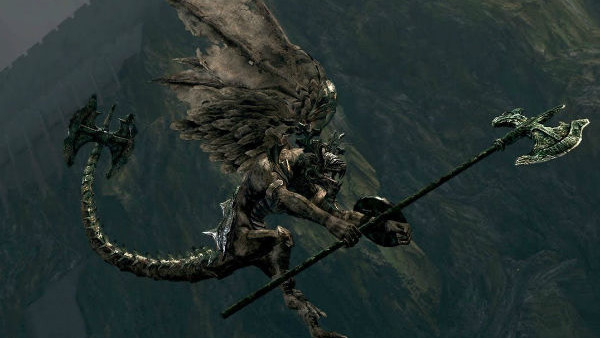
Firstly, Dark Souls had the infamous Asylum Demon trio - a boss that was essentially used for three different encounters with slight visual or mechanical nuance. Dark Souls II suffered from rehashed content syndrome on a far larger scale though, with the Belfry Gargoyles and Old Dragonslayer were assets lifted directly from the first game and ever-so-slightly adjusted to make them feel new. Most jarringly of all however, were the Alonne Knights found in Iron Keep who emitted the same shrill death cry as Gwyn's Black & Silver Knights.
We can all try to defend the reduce, reuse, recycle axiom by citing lore or fan service as the reasons for such inclusions, but it still feels lazy, nonetheless.
To make matters worse, there's already talk of behind-closed-doors screenings of Dark Souls III featuring the return of the Alonne Knights, and even the announcement trailer has a freaking Drakeblood Knight (Dark Souls II DLC) wailing on the player.
Please From, don't give us a third iteration of the Gargoyles - we've all had enough.