Fallout 4: 10 Essential Survival Tips For New Players

Making life in the wasteland that little bit more manageable.

As you read this, millions of Sole Survivors are traversing the Boston Wasteland. Many of these people may be experienced series veterans, who will have quickly settled into their new lives in the more colourful, blue-skied climes of Fallout 4. But there's a good chance that the vast majority of people are hopelessly scrambling around in the dead earth, running low on ammo, dying chronically, and questioning those all-important stat choices they made at the start of the game. This list of tips is for those struggling with life in the Boston Wasteland, or those who are yet to awaken from the Sole Survivor's 200-year slumber, and want to be well prepared when they finally venture out into the stark wilderness. It's a tough world out there in the Commonwealth - an area that, contrary to what its name suggests, is filled with hostile humans and mutants, itching to empty your pockets and feast on your relatively radiation-free flesh. So instead of wandering out into the wasteland and perishing like a mole rat in the dirt, read this essential guide for new wasteland wanderers, and equip yourself with the knowledge you need to survive (and have a hell of a lot of fun doing it).

10. Choose Your Starting Stats Wisely
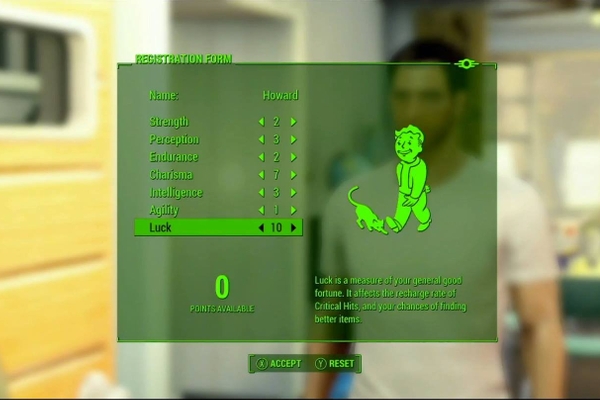
Starting stats aren't everything in the world of Fallout 4 - nurture over nature and all that. But while it'd be no fun to follow a prescriptive list of the exact stats you should choose when creating your character, there are certain guidelines you should follow. Don't worry, the following list of pointers won't set you off-course from creating that Fallout 4 character you've been fantasising about ever since the game was announced. If anything, these basic tips will help you gain XP quicker, accelerating your progress towards getting the skills that you really want: Don't over-invest points in any one skill. Be balanced about how you redistribute your points, then collect bobbleheads dotted around the world to improve them later. Charisma is worth investing a few more points in that you would've in previous Fallout games, because you can't spend specific points on persuasion and bartering any more. Charisma has a big effect on how NPCs respond to you, and the more of it you have the more dialogue options are available to you. For the most part, choose whichever perks suit your play style, but the V.A.N.S. level 1 Intelligence perk is extremely handy, showing a path to your closest objective when you're in V.A.T.S. mode.

9. Hone Your Basic Pistol Skills

As soon as any of us heard about Fallout 4, we started envisioning and planning what kind of a person our perfect wasteland wanderer would be. Maybe they'll be a highly charismatic settlement leader, resolving disputes through speech and only occasionally having to rely on their long-range rifle; or perhaps a blockheaded thug whose main means of communication is through firm swings of his baseball bat. But to create your ideal character, you'll need to level your way through the early stages of the game first. In order to help you do that, you should invest some skill points into pistols, because they're the most ubiquitous weaponry you'll find early on. At the very least, a pistol is likely to be your secondary weapon, so you may as well learn how to use it. To this end, one of the best early perks you can get is Gunslinger. Its function has changed in Fallout 4 from previous games, and it now improves the damage you do with non-automatic pistols, with each rank increasing the damage delivered.

8. Radiation Isn't Good For You

In previous Fallout games, getting radiation poisoning was akin to coming down with a cold. It was a bit of a nuisance, but not generally something lethal or particularly crippling. That's all changed in Fallout 4, as getting too much of the radioactive bad stuff into your bloodstream has a far more dramatic impact on your health. Specifically, the more exposure you have to radiation, the smaller your health capacity becomes, making it comparable to being hollowed in Dark Souls 2. One way in which radiation in Fallout 4 is like the common cold is the fact that you can catch it very easily. There are a lot of radioactive environments, nearly all mutated creatures can irradiate you when they punch, bite or slap you, and you should always cook your meat before eating it (an invaluable Fallout lesson that, believe it or not, can also be applied to the real world). To protect yourself from the nasty effects of radiation poisoning, use Rad X to build up your radiation resistance, and Rad Away or a doctor to get rid of it once you're poisoned.

7. Store All Your Junk At A Workshop

Even if you're not much of a craftsman, workshop areas are extremely important in Fallout 4. They not only let you mod your weapons and armour, but also act as storage lockers where you can keep all your junk. Why would anyone other than a pathological hoarder want to hang onto stuff specifically labelled as 'junk'? Because in Fallout 4, junk has more purpose than in previous games, letting you use it to build your home settlement, as well as crafting weapons, ammo, and more. When you pick up junk, always drop it off at a workshop as it'll most likely come in handy at some point, and you don't want it encumbering you while you're out exploring. Something worth noting is that the things you store in workshops don't magically teleport to whichever workshop you're using at a given moment, so it's best to choose a workshop and stick with it so you always remember where your stuff is. Early in the game, you'll stumble upon workshops at Sanctuary and the Red Rocket fuel station, so choose which one you want to use as your main storage depot, and stick with it.

6. Remember To Remove Mods Before Scrapping Weapons

If you've started dabbling with weapons customisation, you may have been working under the assumption that once you've modded a weapon, you can't disassemble it again. That's not the case, and if you're thinking of converting an old weapon into scrap so that it can later be turned into a shack in your settlement (up-cycling at its finest), then remember to take the mods off it first. Likewise, check unwanted weapons you find in the wasteland for mods, because there's a good chance you'll be able to add them to your own weapons. But keep an eye on your inventory when chopping and changing mods around. Mods are pretty weighty, and if you replace one with another, then the one you're not using goes into your inventory, using up precious space and weight capacity. To avoid this problem, store your old mods at a workshop you've designated as your main one.

5. Look The Part When Talking To NPCs

Pull your trousers up, tighten your braces up and trim your 'tache, because you need to be well presented in the Boston Wasteland if you want to get the most of of the people you come into contact with. Specifically, the higher your charisma, the more NPC dialogue options are opened up to you. You no longer have separate skills for persuasion and bartering, so it all rests on your charisma, which can be boosted by certain items and combinations of clothing. Sunglasses, for example, will give it a bump, as will certain hats and fancy suits. Something to be wary of is that if you're wearing a power armour or any other whole-head helmet, you won't get any of your other headgear charisma bonuses. Make sure to take off your helmet before speaking with the locals. Common courtesy goes a long way in Fallout 4.

4. Save Your Game Regularly

'Thanks a lot,' you're probably thinking. 'In the next tip he'll be suggesting that I need to switch on my console to play the game, and to take 15 minute breaks after every hour of gameplay'. But the old gaming adage of 'Save Often' particularly applies to Fallout 4, because it's already proving itself to be rife with bugginess and instability. People have reported getting stuck in elevators, weapons disappearing from peoples' hands, and all manner of technical nasty. Classic Bethesda. In what seems like a perfect cocktail to screw gamers over, Fallout 4's bugginess is combined with a sparse save system that doesn't have any checkpoints, and will only save when you ask it to. If your last save was five hours ago and you find yourself stuck in a piece of wall or something equally ridiculous, then that's five hours you're not getting back. Such is wasteland life. To better cover yourself, go into the game's options and set it to autosave every half an hour, or however much time you're willing to backtrack before throwing your controller against the wall and proclaiming you'll never play Fallout 4 again on principle... before sheepishly coming back to it an hour later.

3. Leave No Chems Behind

You'll come across a veritable assortment of classic Fallout drugs in the wasteland - old packs of pharmaceuticals that conveniently combat the effects of radiation, even though presumably most of them have been lying around since before the bombs dropped. As well as the usual assortment of RadXs, RadAways and stimpaks (which you're probably picking up anyway), you'll also find seemingly purposeless chemicals lying around the that you wouldn't normally give a second thought. But even if you don't plan on becoming the Walter White of the Wasteland and cooking up your own stuff, you should still pick up any of the chems that you find. Chems have a great weight/value ratio, and those lonesome merchants and traders hanging around the bars and settlements want to get their hands on them (presumably to make their lives - spent standing around waiting for your custom - that bit more exciting). Remember to wear your finest charisma-boosting clothing when selling your chems to merchants, and if you have the drug Day Tripper on you, have a dose of that before you trade to get +3 to your charisma and luck. If you're willing to be a bit more patient, you can also craft your chems together to make them more valuable, earning you even more caps.

2. Realise You Can Scrap Almost Everything In Sight

No, by that I don't mean throw all your unused goods into the nearest garbage can (not that they seem to exist in Fallout anyway). I mean that instead of selling any items that you don't see yourself ever using, break them down into scrap instead, because you'll be able to use this material for weapons and armour mods, as well as settlement-building. Learning the basics of crafting in Fallout 4 really pays dividends, because breaking items down into scrap to make your own weaponry is a far more effective method of acquiring items than buying them for extortionate amounts of caps off traders. Even if you don't end up using all the scrap-crafted bits, you can sell off your creations to traders for solid rates. Of course, once it's scrap, there's no turning back, so make sure you definitely want to do it before committing.

1. Look After Your Power Armour

Unlike in previous Fallout games, you can get the iconic power armour in Fallout 4 relatively quickly. Once you've put on the armour (which you satisfyingly step into as if it were a vehicle), you feel more or less like a demigod - a virtually indestructible behemoth that feels like the spiritual ancestor of Iron Man. But you need to maintain your precious armour. It runs on fusion cores, which aren't easy to come by early on in the game. As such, you should try to avoid sprinting when possible, because that expends your power armour energy really fast. Generally, to preserve your power armour's energy, you should leave it in a safe place then only pick it up when you know you're going to be in a hairy situation. Storage-wise, you can technically keep your power armour anywhere, and it'll always wait be right where you left it, but the best place for it is in your own settlement - where you know a raider isn't waiting around the corner to club your head in. Let us know your most essential tips in the comments, and sign up for an account if you'd like to write about video games and get paid!

Contributor
Contributor

Gamer, Researcher of strange things. I'm a writer-editor hybrid whose writings on video games, technology and movies can be found across the internet. I've even ventured into the realm of current affairs on occasion but, unable to face reality, have retreated into expatiating on things on screens instead.