How Kingdoms Of Amalur: Reckoning Nearly Bankrupted An Entire State
Rhode Island gave Curt Schilling $75 million to make a game. It didn't end well.
For those of you who’ve not played it, Kingdoms of Amalur: Reckoning is a single player action RPG made by 38 Studios and in short, it’s actually pretty great. What wasn't so great was its troubled development, which was not only filled with more issues than a Christmas re-run of Jim'll Fix It, but led to events that nearly put an entire local economy on the breadline.
That story, however, is amazing.
We begin with its conception. The game was the brainchild of Curt Schilling and his development company 38 Studios. Now if that name seems slightly familiar to some of you, that’s because that’s the same Curt Schilling that pitched for the Phillies, the Diamondbacks and the Red Sox. Keep this in mind as we continue our journey.
Schilling was a huge fan of gaming, both table top and video game, and would frequently attend conventions for both - even starting his own in some instances. However, one franchise that he became heavily involved with was World of Warcraft, to the extent that he even ended up being a regular guest on WoW-centric chat "The Instance".
His time with the game clearly had an influence on his next business decision, as in 2008 he announced that he would be working on his first video game title, one which went under many codenames - most notably Project Mercury. It'd eventually become known as Kingdoms of Amalur: Reckoning
[CON'T. P1/5]

Drawing from his pool of high-profile contacts, Schilling managed to net the outstanding talents of both Todd McFarlane and R.A Salvatore. To give a sense of just how big a coup this was for a start-up project, consider that McFarlane has breathed life into comic lines across the multiverse and gave us the terrifying and much loved Spawn character. Meanwhile, Salvatore is a writer with a pedigree in creating lore for the likes of Star Wars, as well as penning The Silent Blade, a fantasy novel that bagged him an Origins Award in the year of it’s release. Schilling had lofty ambitions for his game - and he was prepared to push to meet them.
Salvatore went on to write a full novel's worth of lore for the game during its production, something distinctly evident in every aspect of the game, from its weapons to its backstory, that hundreds of hours were poured into it.
But as you can imagine, such a level of depth didn't come cheap, and it was clear that despite putting a sizeable chunk of his personal fortune into the project, Schilling alone wasn't going to get as far as he'd have liked.
Enter the Rhode Island Board of Economic Development, a section of the local government working with the EDA to secure federal funding assistance for people looking to get businesses off the ground. If a project was deemed beneficial for Rhode Island in terms of boosting tourism, the local economy, or the job market, it would have a greater chance of securing funding. Schilling leaned on the latter, when he stated that if he were to receive a bursary he would be able to bring 450 jobs to the state by 2012 through the creation of 38 Studios.
[CON'T. P2/5]

They accepted his proposal. Oh boy did they accept. Rumors circulated that it was because the board was instantly impressed with the name value of having the Curt Schilling in Rhode Island, so greenlit an astonishing $75 million dollars to fund the project.
75 million dollars: that is some serious loose change, and it was all going to be sunk into Amalur. The game began development immediately - and most likely, with a big smile on the faces of those involved and the 160 employees they brought with them to their new studio in Empire Plaza, Rhode Island.
Those smiles however, were not likely to be shared with Rhode Island economists nor the taxpayers, had they known public funding was been wasted on a video game, of all things, in the middle of a recession.
Reports stated that for 38 Studios to even come close to clawing back this money, it would need to release hit after hit without any mistakes or missteps for years to come. Not even current triple A publishers can maintain that sort of consistency.
However, on they slugged, signing up with EA to publish the game and acquiring another developer Big Huge Games to help them flesh out the fantasy world. And gosh did it need fleshing out: Salvatore had reportedly created over ten thousand years or lore for the world. It was perfectly in line 38 Studios' business philosophy. They doled out money like they were in The Wolf of Wall Street, as everybody took home huge wages in the expectation they were about to change the industry. Everybody was wrong.
[CON'T. P3/5]
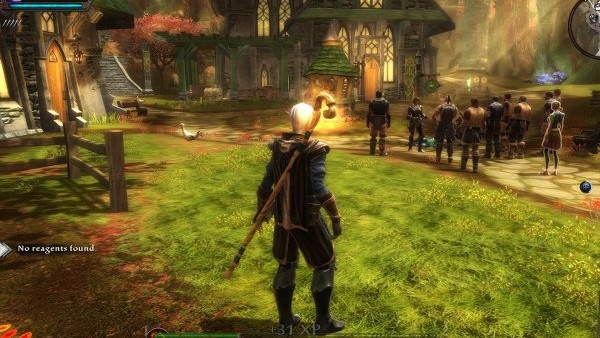
When the game was released in 2012, it was not met not with the rapturous praise that it had anticipated but a general vibe of “it’s good, very good even, just not amazing”.
A demo released prior to launch, while cleverly trying promotional item unlocks to Mass Effect 3, gathered a lot of attention - but only for how broken it was. Sponsorship and collaborations with the likes of IceT were yet more wasted investments, and while the game managed to shift over 1.5 million units in 90 days after launch, it was nowhere near the project 3 million it needed just to break even. For any other new IP, those would still have been phenomenal numbers. But Kingdoms of Amalur needed so much more.
Then it came time to pay the piper: after all, that $75 million was a loan, not hand-out. On 1 May 2012, the bill arrived at 38 Studios' door for $1.125 million, the first of many intended repayments. Their response? "Nope."
Panic quickly surged through the Economic Development Board; after all, they wanted to make a video game industry in their state and their first project was bombing hard. It was, as the (surprise) new head of the Rhode Island Board of Economic Development put it, one of the worst investments they had made.
Numerous back and forths occurred between 38 studios and the Rhode Island reps, as cheques were hand delivered only to bounce, payroll for the employees were missed, and all the way throughout the board went on smiling and assuring that things were going well. It was like seeing a couple arguing over who was going to pay the food bill, only to find out the building was on fire. The writing was on the wall, and late in 2012, 38 Studios declared bankruptcy. An email sent out by Schilling informed his employees that they were all terminated and dreams of a sequel went up in smoke.
[CON'T. P4/5]
However the fire still had some embers left, and in November 2012 Schilling was sued by Rhode Island itself for squandering its money and setting the state back a long way on their road to economic recovery. They'd only managed to claw back around $4.5 million, meaning that the biggest fantasy tale the Kingdoms of Amalur: Reckoning managed to weave was that of the disappearing coin purse.
It was a real shame, because there was no doubting Schilling's good intentions, and the two subsequent DLCs for the game were labours of love. The real issue lied with the fact that the Economic Development Board should have never signed such a huge chunk of money away without a better means of claiming it back in the first place. It wasn’t just a wad of cash they had laying around, but taxpayer money that could have been used to improve the lives of citizens in far more substantial ways. It was simply the wrong move, which ultimately even cost the jobs of those it was designed to help.
Despite its troubled history, Kingdoms of Amalur emerged a fine game, packed with content and a brilliant arcade fighting system that doesn’t feel stale even after hours of playtime. It didn’t set the world on fire like it was aiming to, but it wasn’t a technical failure - and the passion for the project shines through brightly. But it probably wasn't worth nearly sinking Rhode Island for the pleasure.