Mass Effect 4: 12 Mistakes Bioware's Next Gen Sequel Must Avoid

Yes, one of them is the ending!

possible-mass-effect-4-story-hints-in-me3 In 2007, Bioware started one of the biggest new game franchises of the last console generation with Mass Effect, a science fiction game that combined RPG and third person shooter gameplay. While gamers and critics liked it, everyone admitted there was a lot of room for improvement. 2010's Mass Effect 2 was a huge hit, although there were people who felt it was less of an RPG than a shooter. 2012's Mass Effect 3 promised to add more RPG elements and wrap up the story in a bittersweet, but satisfactory bow. Then we played the game and got to the ending. At this point, it's safe to say that you've at least heard of the controversy the game's original ending caused. While the details aren't really essential, what is important is that it tarnished Bioware's reputation in the eyes of the fans and general gamers. And with Bioware already committed to making Mass Effect a cash-cow franchise, that means there's another game in the works. Since the new Mass Effect is still in early production, it's hard to say what the game will be like. Unlike the first three Mass Effects, it is being developed at Bioware's Montreal studio, which made ME3's multiplayer component. While some developers who worked on the single-player campaigns of the Mass Effect trilogy are working on the game, Casey Hudson (the man who came up with Mass Effect) and most of the writers have moved on. That means the game is a blank slate in a lot of ways, but it still has to overcome the sour after-taste of ME3's ending. Because of that, ME4 can't afford to make too many mistakes €“ here are 12 that it has to avoid.

12. No Controller Support On PC

Thanks to Microsoft, the Xbox 360's controller has become the default controller for PC gamers who don't want to use a keyboard and mouse or complicated button mapping software for other console controllers. But in one of the most bizarre development decisions ever, none of the PC versions of Mass Effect allow you to play with gamepad instead of a keyboard and mouse. Even PC ports of Japanese games and indie games have the ability to use gamepads, although it might not work properly. In all fairness to Bioware, they do a great job with creating user interfaces that are optimized for keyboard and mouse players. But one of the PC's greatest strengths is that you can configure your setup however you want, and Bioware has inadvertently removed options for the gamer. And with plenty of last gen console gamers jumping ship to PC and a strong push from PC hardware manufacturers for systems that fit in the living room, now is the time to bring proper controller support to PC Mass Effect games. Not only that, but since all the new consoles have PC architecture and their controllers will have PC drivers, not a lot of time and effort needs to be spent on setting up the controller interface on PC. There's little downside to something that makes it easier for people to jump and play with no hassles, even if it has to be an optional download.

11. Terrible Vehicle Sections

When it comes to space opera, exploring planets is a staple of the genre. And one of the strengths of video games is the ability to create huge areas relatively cheaply compared to TV or movies. So it made sense to create big planet levels to explore in Mass Effect 1, and to use a vehicle to get around quickly. The problem was that it was pretty terrible to play through on consoles. There are two equally important parts of vehicle section design: the geography of the level and the vehicle itself. In Mass Effect 1, planets generally were flat plains or valley areas with huge, almost impossibly steep mountains, with items and locations of interest scattered around. That often forced players to climb the impossibly steep mountains to get to those items or locations, which was made even more difficult by the vehicle. In Mass Effect 1, players had to use the Mako, a six-wheeled rover with jump jets, a cannon, shields, and high health. Unfortunately, the jump jets meant that you could flip the entire Mako over and get stuck for a while or fall off of mountains while trying to avoid obstacles. While it worked wonderfully on level terrain or story mission maps that didn't require insane climbing, Bioware decided to remove vehicles from ME2 until the Firewalker and Overlord DLC. While the Hammerhead, a hovertank with a missile launcher and booster jets, was a lot easier to handle in combat than the Mako, it also had the durability of a paper bag. Its levels were also a lot more reasonable in terms of geography, although there was only one DLC that really used the Hammerhead in a large map (Overlord). Sadly, it didn't get a chance to return in ME3, where the only vehicle section involved a turret on the back of a hover-truck. Since the developers of ME4 seem interested in bringing back vehicle based exploration, merging the best of the Hammerhead and Mako into a new vehicle and pairing it Overlord's map design seems like the way to go. It avoids the mobility and durability problems of the old vehicles, while keeping the game from torturing the player with geography and making them loathe having to use a vehicle.

10. Pay To Win Multiplayer

2014 has not been a good year for game companies involved in microtransactions and free to play games. First, there was Microsoft taking a beating for making people pay tons of money to get good cars in Forza Motorsport 5, then EA was excoriated for making people pay to get things to happen in Dungeon Keeper in reasonable amounts of time. One of the more successful parts of ME3 was its multiplayer component. Unlike many other attempts to add multiplayer to single-player only games, ME3's multiplayer was well executed, received constant balance tweaks, and didn't create a frustrating gulf between rookies and veteran players. One key part in that success was that it was a cooperative multiplayer game instead of a completive one, but another was the random rewards system. Unlike most multiplayer games, players didn't get powerful weapons dumped in their laps as they leveled up. Instead, players would buy packs of consumables, weapon mods, weapons, and new character classes with in-game currency or actual money. Each pack was a random set, so players were never sure whether they'd get what they want, especially since there were several tiers of packs with different probabilities for getting certain character classes and weapons. The packs even updated as free multiplayer DLC was added, meaning the only thing standing between you and new content was a download. Unfortunately, EA's need for money could endanger an ME3 style system for the next Mass Effect. For cynics, it's all too easy to imagine a scenario where EA "encourages" Bioware to make the default game currency prices for anything beyond the basic pack absurdly high, but rather low in real money cost. Or even worse schemes to bilk people out of money, after they've already paid $60+ for it. It's up to Bioware Montreal to convince people that EA hasn't ruined their game.

9. Promising Things It Can't Deliver

One of the biggest problems for gamers is that the developers' reach often exceeds their grasp. The list of games that have failed to meet benchmarks set by their creators, in games press or elsewhere, is probably long enough to cover some or all of the planet. And when people have to spend around $60 to get the base game, on day one, it's not hard to see why people flip out whenever there's a sign a game they want to buy might suck, which is happening to Watch_Dogs thanks to its newest trailer. For Mass Effect 4 (or whatever its official title will be), managing expectations is even more critical because of blunders made in ME3's pre-launch hype build up. Casey Hudson saying there would be tons of variations on the ending because of your in-game changes was probably the biggest mistake. Once people saw that the endings didn't really change no matter what you did (and most wiped out galactic civilization in the original version), they felt ripped off. Now ME4 not only has to avoid being crushed for not meeting expectations, but it also has to rebuild consumer trust in Bioware after a public snafu. With the franchise's reputation, already tarnished by ME3's ending, on the line, Bioware Montreal and EA need to honest with gamers. If some hyped feature or mechanic doesn't end up working and needs to be removed, admitting that earns more credit with potential consumers than dodging questions about it and avoids the perception that you suckered people into buying something with false promises.

8. Not Building Off Of ME3's Gameplay Mechanics

Whenever someone makes things, especially something as complex as video game, it's important to learn from what you or others have done before. That way, you can avoid making the same mistakes and improve on what works. Admittedly, it's why video games (and most entertainment media) feel so similar and not innovative €“ a lot of times, it's easier to make incremental improvements than something entirely new and unproven. Unless Bioware Montreal decides to do something totally unexpected for ME4, like an XCOM style turn-based strategy game, the game is probably going to be an action RPG. And if ME4 is going to an evolution of the previous games mechanically, then it should build on the foundation set by ME3, which had the best mechanics of the trilogy. ME1 had massive problems balancing old school RPG skills and inventory systems with shooter combat. In fact, things were so bad that Bioware had to build ME2's gameplay mechanics from scratch because it was impossible to make satisfying combat in ME1's system. While ME2 was a massive step up from ME1, there was plenty of room for improvement, especially since there was almost no gear customization. With ME3, it finally felt like the franchise was where it should've been at the start mechanically. There was a lot of ways to move in combat, a large selection of guns with different attributes, a variety of melee attacks, and more freedom to choose between guns, powers, or a mix of the two. On the RPG side, gun customization was brought back with the addition of visual changes to the guns and more diverse skill trees that offered two choices for every skill level past the third level. For ME4, Bioware Montreal's challenge is take those great ME3 mechanics and figure out how to make them even better. And given what they accomplished with ME3's multiplayer, it shouldn't be too hard.

7. Having A Useless Ship

In space based games with lots of exploration, having a cool ship is par for the course. But for an RPG, the ship is a particularly important part of the overall puzzle. It's a mini-hub, where you get to interact with NPCs and party-members, fly around to visit planets, and possibly have space battles in it. So getting the player invested in the spaceship is a good idea, and for that to happen, it needs to be useful beyond going from point A to B. One way of doing that is having a lot of interaction on the ship. One thing that Bioware succeeded at was making the Normandy a major conversation hub. But there usually wasn't a lot beyond that€“maybe a few items that would do something or trigger conversations, plus team and equipment management stuff. Even the ship minigames in ME2 or 3 didn't really add that much value to the games after the first playthrough €“ all the tech savvy players modded their saves to avoid having to mine minerals and search for war assets. Another way is doing something that the previous Mass Effects never allowed: customizing the ship. While Mass Effect 2 did allow players to upgrade the Normandy, everything was mostly internal (except for the pop-out Thanix cannons), so Bioware could pre-render all the ship fighting scenes. But customization takes the ship and makes it your (the player's) ship through the part choices you make. While losing the slick spaceship visuals does suck, it more than made up for by the fact that you can do more with the ship and potentially get better minigames out of it. Even a basic procedurally generated space race scenario would be better than flying around scanning planets or searching for random items in solar systems.

6. ME3's Fetch Quest To Story Ratio

One of the biggest problems with ME3, even ignoring the ending, was the fact that it felt like "Fetch Quest: The Game." Because of the war assets minigame, just about every background NPC on the Citadel had a line of dialogue that would trigger a quest to find some item. That resulted in Commander Shepard flying the Normandy around solar systems, scanning for or retrieving items on or around planets, then flying back to the Citadel to give people stuff. It felt like 70% of the game on day one, thanks to the fact that there were barely any multi-map missions anywhere besides Tuchanka or the Citadel. Another complication was the fact that ME3's journal was inexplicably merged with the Codex and had crucial features removed. First of all, every mission wound up on the same list, which only served to disguise the fact that there were so few story missions. Second, there were no details reminding you what to do or of your progress, so you had no idea if you'd done any parts of the quest or where to even go. And third, there weren't any journal mission reminders on the galaxy map, so you'd constantly have to exit the map to figure out where to go to find the items. For ME4, Bioware Montreal needs to do two things to fix this mess. First, roll the journal back to ME2's system, which was the best one of the trilogy. Second, make more planets with missions on them. Even if most of them are procedurally generated vehicle sandboxes, it's better than flying around trying to deliver things for numerical rewards.

5. ME3's Dialogue System

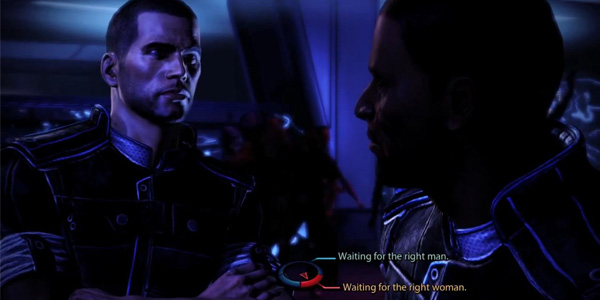
The dialogue wheel in Mass Effect 1 was a slick solution to clunky conversation interfaces in RPGs. Three response options would be on the right side: a polite/good one on the top (Paragon), a neutral one in the middle, and a pragmatic/jerk/space racist one on the bottom (Renegade). On the other side was an option to pump characters for more info, which would remove the regular options and put a bunch of topics all around the wheel, or special dialogue reserved for people who maxed out Shepard's Paragon or Renegade reputation. While ME2 toned down the Renegade option and added interrupts as a way to do Paragon or Renegade actions in certain situations, ME3's conversation wheel felt like a step backward. There were only two options, Paragon and Renegade, in most situations. Bioware tried to justify this by saying the Reaper War plot demanded definitive choices in dialogue, which didn't seem true when so many conversations took place outside of hectic situations. It also wasted the new Paragon/Renegade reputation tracking system, which allowed players to pick dialogue selections they wanted without locking them out of dialogue. Bringing back the dialogue wheel's neutral option would help make the conversation choices feel less artificial and forced. Adding some better context clues, like a Deus Ex: Human Revolution style text preview of what the player character will actually say, would also help ME4's dialogue wheel standout against the lackluster one from ME3.

4. A DLC Unfriendly Design

The Mass Effect games have had a mixed history when it comes to DLC. Setting aside the quality and quantity debate, only Mass Effect 2 feels like it was designed with DLC in mind. Unlike Mass Effect 1 or 3, ME2 allowed players to continue playing after the ending without using New Game+. This meant that you didn't have to replay the entire game or part of it to enjoy the new content, and it felt like the game universe was moving forward in time and expanding. While ME1's inability to play DLC after the main campaign was a technical issue, ME3's was a deliberate design and narrative decision. And given the fact that ME3 is intended to end Shepard's story, it's understandable. It just doesn't stop the whole thing from feeling like the game is pressuring the player to endure the ending again after they get through the DLC. If anything, ME3's DLC time warp probably got in the way of people moving on from the ending controversy because there was no sense of time progressing. Having something you hate looming in the future of your playthrough does dampen the enthusiasm of playing new content. For ME4, gamers pretty much know that DLC is going to be coming down the pipeline, especially if there's a multiplayer mode. So Bioware Montreal should keep in mind that with DLC, the ideal is to keep playing after the game's main plot ends. We want the new material to feel new, not like a missing chapter of the game.

3. Lackluster Main Villains

Reaper Fleet Like many good scifi franchises, Mass Effect has an incredible variety of antagonists, from minor ones like mercenary companies to major ones like Cerberus. So it's a bit surprising that the entire trilogy's plot revolved around some of the most boring major villains imaginable. And yes, that means the Reapers. The one of biggest problems with the Reapers was that they were too similar to past villains. Their shape, age, and some of their abilities are meant to evoke Lovecraft. They manipulate younger races like Babylon 5's Shadows. They run a cycle of killing everything in the galaxy like the Inhibitors in Revelation Space and tons of other scifi villains. It feels like someone went to TVTropes, looked around for a few hours, and mashed together the ones they thought were cool to form the Reapers. They even have a numerical and technological advantage that requires an epic final battle while a Deus Ex Machina is prepared. But the biggest problem was that until Mass Effect 3, we had no motivation for the Reapers. In Mass Effect 1, you get to pump Sovereign for information about everything the Reapers are doing, except why they're doing it. And this is a problem, because not knowing why the villain does things feels like you're jerking the audience around, which sets higher expectations for the motive than there would be if it was simply revealed. As seen with shows like Lost, Battlestar Galactica, and others, the more you delay that revelation, the higher the minimum bar is for a satisfying motive. Why? Because the audience expects the writers to come up with something that at least justifies keeping them in the dark for so long. And when the reveal is poorly thought out and poorly executed, it makes the audience feel ripped off, especially when they had to pay $60+ dollars to get it. What Bioware Montreal needs to do is simple: make a villain with a clear motivation that is explained up front, preferably not the Leviathans. There's no need for another ancient evil awakens plot in the first post-Reaper game ever when Mass Effect already has tons of interesting antagonists in the forms of mercenary companies, terrorists, criminals, and so much more. And even better, not using an ancient evil would mean the villain could be beaten without messing up the entire galaxy... again.

2. Saving The Galaxy... Again

Another thing Bioware Montreal should avoid is a "save the galaxy" plot. If the intent is to avoid comparisons with the Shepard trilogy, as they seem to be doing by not calling the game ME4, then redoing the same plot is a step in the wrong direction. Not only that, but it's a bad move for a game that has to rebuild interest in the Mass Effect franchise after ME3 literally blew up the setting that attracted people to it in the first place. And to be honest, everyone wants to forget as much of ME3 as possible. Another save the galaxy plot would just rip that scab off and make everyone paranoid about whether these new games will wind up ending as poorly as the Shepard trilogy did. Not only that, but these days, it feels like too many games are "save the world as we know it" deals. Mass Effect 1 stood out because, like Star Trek, it had a fairly bright and optimistic future, which was a big part of its appeal. Returning to a save the galaxy plot would make the game feel a lot more generic, especially when new games like Watch_Dogs are going for more personal stories with smaller stakes. A combination of brighter tone and a story with smaller stakes would make ME4 feel like a step forward for the franchise and a deeper exploration of the ME universe.

1. Not Outlining Things Ahead of Time

Bioware's biggest failure of the Mass Effect trilogy was the writers' and producers' inability to plan ahead. We first got inklings of this between Mass Effect 1 and 2, but it's been pretty much confirmed thanks to post-ME3 interviews with Mac Walters and Geoff Keighley's The Final Hours of Mass Effect 3. Despite being planned as a trilogy from the start, Mass Effect was written much like Lost and Battlestar Galactica €“ on the fly €“ and shares those shows' inability end in a coherent and logical manner. To be fair to the writers at Bioware, until ME1 was released and did well, having everything planned out would've been an insane risk. If the game had flopped as hard as Advent Rising did, an Xbox game that aspired to do some of the same things Mass Effect did, all that work would've been for nothing. But it's fairly obvious from some of the plot points in ME2 and 3 that there wasn't a lot of foresight when it came to story. For instance, while the Suicide Mission ending ME2's regular story is great, it came about because no one on the writing staff remembered that they would have to import the saves into ME3 until too late. If they had remembered, they probably wouldn't have designed the whole Suicide Mission with potentially killing everyone in mind and avoided having to have surrogate characters for all the dead ME2 ones. Many people's problems with ME3's ending came from the suddenly introduced and unforeshadowed organic/synthetic cyclical conflict that was at the heart of the Reapers' motivations. Essentially, we'd been given clues to unravel a mystery, only to be told at the end that everything we knew was wrong. A lot of this criticism is harsh, but it's because Bioware themselves set higher expectations for the fans by saying the Mass Effect games were designed to be a trilogy from the start. Indeed, all the problems related to the Reapers seem like they could've been solved if all the writers got together between ME1 and 2, simply hashed out a paragraph or two on their motivation, and stuck to it. While it is true that lots of things change during the development and production of media, the villain's seems like one of the things that wouldn't. Of all the mistakes Bioware Montreal has to avoid for ME4, this is the most important, especially if there's another trilogy planned. Even if there isn't a new trilogy and the new Mass Effects are loosely connected stories, outlining things like who the villains are, their motivations, and the state of the setting during the game is still a good idea, because it gets some of the hard work out of the way early. And if ME4 is the start to a new trilogy, having those basic bits of information locked down early means time and effort can be spent on fleshing other things out and making sure the overarcing story is coherent and satisfying. And that is ultimately what fans want. What do you think Bioware should avoid doing in ME4? Let us know in the comments below.

Contributor
Contributor

Living in Florida, enjoying the weather when its good, writing for a living. TV, Film, Animation, and Games are my life blood. Follow me on Twitter @xbsaint. Just try not to get too mad when I live tweet during Toonami.