Mass Effect: 8 Weirdest Enemies (And What They Represent)
H.P. Lovecraft and electron photographs lie beyond the Omega 4 Relay.

Mass Effect has long been one of the lynchpins of science fiction gaming, with the original trilogy being one of the most beloved - and hotly debated - in video game history.
Long have fans looked back fondly on the first entry for its groundbreaking introduction to galaxy defender Shepard, and celebrated the series high and one of the best games of all time in Mass Effect 2. Whilst the third instalment and Andromeda still invoke the wrath of fans the world over, they still go some way to crafting a believable extension of this rich, alien universe, regardless of their issues.
It's undeniable that Bioware made a lasting impression on both the industry and our imaginations with their space-faring adventures beyond the stars. And really, a large part of that is from their innovative approach to character, including some absolutely stellar enemies.
Bioware have created terrifying and strange species to populate their landscapes and meet the business end of Shepard's omni-blade for years on end, but where did they draw their inspiration from? And what real-life influences can we read through their concept design?
Let's take a theoretical stab look at the world of Mass Effect's bad guys. They're only as strange as they look...
8. Citadel & Nexus Species

Whether it's Asari commandos, Turian bodyguards, or Krogan mercenaries, you'll come across plenty that rival your cause over the four mainline games Mass Effect has to offer - so it seems only fair to have a cursory glance over their own inspiration.
Asari, interestingly enough, were allegedly incorporated as a spin on the Orion race of Star Trek.
A nice crayola green and a part of a female-dominated society, the Asari took their iconic role in the Star Trek series and made it into something of their own in Mass Effect, instead opting for a blue hue. Orion are also particularly seductive in the TV show, which the Asari's aesthetically pleasing appearance and stints as dancers early in life also reflect upon.
The Drell were also inspired by pop culture, with Thane Krios seemingly crafted from a template of Abe Sapien in Hellboy - the sexy fish-man answer to the Asari's sexy tentacle-lady creation.
Krogans began life as concept drawings from bats, and Salarians were the classic 'grey alien' brought to life in Mass Effect style, taking the big eyes, spindly limbs, and propensity for science and making it their own.
Turians were inspired by eagles, a military race that plays upon America's own patriotic animal in their appearance.
7. Cerberus

Though Cerberus might seem like a weirdest choices for this list considering they're a human-fronted task force, their name is notable, as it's one with origins way back in the past.
Cerberus is the name of the three-headed dog that guards the gates of Hades in Greek mythology, and considering he spends most of his time in the underworld, we've instantly got a parallel to the game organisation's own shifty heritage. The whole three-head deal is also a nice nod to Cerberus's own evolution as three distinct entities to deal with in each game in the trilogy, too.
Cerberus's primary job in-game (as detailed in a manifesto) is to protect humanity from entities beyond the Charon Relay, the device being a metaphor for the gates of hell that the hellhound stops undead creatures from escaping from, and living souls breaking into.
Much in the same way, Mass Effect's Cerberus utilises any horrific means at their disposal to make sure they defend humanity regardless of cost. In another interesting parallel, Charon is the name of the Ferryman that delivers souls to Hades in other Greek mythology, too.
With this in mind, their increased role in Mass Effect 2 makes way more sense, as your Shepard continues to walk the line between paragon and renegade; their own soul not being truly evil or redeemed until the climax.
6. Architect

Appearing in Mass Effect Andromeda, the Architects crop up across various golden planets in boss-level battles.
Much of Andromeda mirrors the earlier games in the series - like the Kett being stand ins for Collectors, the NOMAD being the new Mako, and the Remnant themselves another spin on the old Reapers - it feels like the Architects are the upgraded version of Thresher Maws.
Thresher Maws are a gigantic nod to the sand worms of Dune and the Sarlacc of Star Wars, which the Architect mirrors as a synthetic that burrows through the sky instead of the ground.
On a more debatable level, the Architects could be argued to be inspired by yet another sci-fi work - The Little Shop of Horrors.
Rearing up as massive mechanical interpretation of the flesh-eating flower at the centre of the musical, both with tendril-like arms surrounding a deadly 'face'. Architects bear terraforming wishes that are akin to the plant Audrey II, with hers revealed at the end of the theatre production as being intent on Earth's domination by destruction and growth through other plants. Of course, the Architect can create other Remnant.
Audrey II is from outer space, which of course the Remnant is as an alien life form too. That it's shot into orbit once Ryder hacks into it just reinforces its otherworldly capabilities.
5. Adjutant

Adjutants, as found in the Mass Effect 3 Omega DLC, are Bioware's take on Lovecraftian horror; an enemy defined by their spooky appearance and tentacle-clad faces.
Whilst many games riff on Lovecraft's work as a base point for their enemies - take Hermaeus Mora and the Seekers of Skyrim, for example - Bioware's version is especially gruesome, playing into the writer's own science-fiction based roots with a proper alien species.
Of course, the tentacled appearance is one directly taken from the Cthulu mythos, where Lovecraft's affinity for all things squid-like has long since ruled in writing. Elsewhere in his work, the Adjutant bears some similarity to individual creatures, like the lesser mentioned Ythth Ghuggl’ing - a once-human priest that has been transformed into a vampiric creature that bears glowing eyes and a tentacled face.
The straddling of two species is close to the Adjutant's own mishmashed genealogy, turned from one alien into another at the hands of the Reaper invasion.
Adjutant is also the word for a military official that serves under the commanding officer, an assistant and helping hand to the higher-ups. And considering these creatures are used as infectious devices for Reapers that turn hosts into their own kind, the name makes sense, really.
4. Reaper

It would be remiss to mention Lovecraft without a nod to the Reapers, since their lurking presence in the universe is directly lifted from Lovecraft's own special brand of cosmic horror.
In the series, there are cycles of creation, the impossible expanse of time; imperceivable to the tiny organisms inhabiting it, and of course, there are giant, hulking entities deemed gods in their own right, out in the vast expanses that no-one has yet reached.
This is all crystallised in one Cerberus Researcher stating "even a dead god can dream", in relation to the derelict Reaper ship that forms the bulk of the IFF mission - a direct play on one of Lovecraft's most famous lines:
"In his house at R'lyeh, dead Cthulhu waits dreaming."
On the other hand, the Reapers embody our own fear of technological advancement in its plainest terms, showing the threat and fall of organic life under the rule of sentient machines.
How warped and pained most of the Reaper's own creations look further reinforces this, with the species forcibly combined with technology in abstract and abject ways. Their indoctrination is a worrying reflection on our own integration with technology as the years go on.
3. Rachni

The Rachni crop up a few times throughout Mass Effect's original trilogy, with the choice to wipe out the entire species laid at Shepard's feet not once, but twice as the series plays out.
The creatures themselves are insect-like by nature, appearing as hard and chitinous with many legs and eyes in some sort of amalgamation of all the most repulsive parts of creepy crawlies. Whilst grotesque, their history is even scarier, revealing long years of battle between the Rachni and other species as they instantly started hostilities and multiplied to an insane degree.
And whilst it's easy enough to call them 'bugs', there's clearly some other sci-fi influences that make their home with the Rachni. The Formics of Ender's Game share an eerily similar arc and questionable decision as to whether to commit genocide on their species or not, despite having intelligent, communicative queen leaders that have simply been misunderstood for as long as they've existed.
The Rachni also are most closely represented by the Arachnids in Starship Troopers, with the Rachni name even being derivative of the movie's own enemies since they've just taken the first and last letters off.
Scientist Flores that works on the Rachni project in game also seems like a nod to Dizzy, or Private Flores, from the film, too.
2. Banshee

Appearing in Mass Effect 3 as the result of synthetic-organic hybridisation, the Reapers create Banshees from Asari, corrupting those with predispositions to becoming Ardat-Yakshi for maximum biotic potential. Banshees have all the semblance of their original Asari form but are warped by machinery, with skeletal, horrifying faces and a gaunt frames that hide just how formidable a foe they are.
When looking at Mass Effect's Banshee then, it's easy enough to draw parallels to its namesake from folklore. The original banshee is a female spirit that brings dark omens, notable for her shrieking that signals a death is imminent.
Most banshees are described as cloaked women, veiled from the world to hide ghastly, ghostly forms - which Mass Effect's version extrapolates on by turning its own Asari into a demonic vision of the original species. Of course, the game version is replete with its own horrifying wail too, another play on the original legend.
Banshees from world folklore are also often associated with grief, literal figures of mourning who's cries are forewarning of those that has passed. Considering the banshee's deadly potential, and the original Ardat-Yakshi's fatal abilities that kill all those they copulate with, the Banshee's close relationship with death is even more poignant.
1. Collector
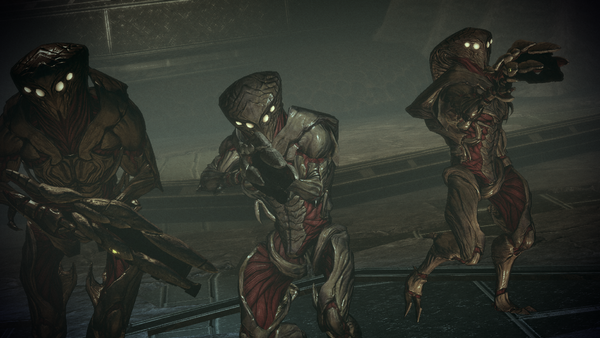
Collectors crop up all throughout the original Mass Effect trilogy, situated as legendary enemies that have long been considered nothing more than myth. Many have heard of strange dealings that go on with the Collectors and agents from other species, of which the Collectors trade advanced technology for living persons that are then never seen again.
Of course, Collectors are largely connected to the Reaper invasion, harvesting humans in an attempt to make the giant Human-Reaper at the end of Mass Effect 2. The species as a whole, however, are far more insectoid than their looming, mechanical, cephalopod-looking bosses however, tying into their massive numbers and hive mind controlled by the Harbinger.
The Collector's design was inspired by electron microscope pictures of insect heads - playing into their bug-like qualities and building around that concept with their wasp-hive of a home world.
As Mordin explains in-gam, Collectors are husks and drones, rather than particularly forward-thinking sentient life, and this emptiness of culture is reflected in their practical, rudimentary design.
At the very least, this is a comment on the fear of what happens when we lose culture and art - turning into working drones controlled by an exploitative force higher-up.
Politics, baby, they're always the enemy.