The Outer Worlds - 10 Reasons It's Better Than Fallout 4
The sort of RPG you wish Bethesda still made.

When a new game comes into a well-established genre, it's inevitable that comparisons between it and the long-standing greats are on their way.
The Outer Worlds has launched to rave reviews from the critics thanks to its involved role-playing mechanics, amazing writing and fun combat. Thanks to this success, people are starting to side-eye the current king of the first-person RPG, Fallout 4.
Back when Fallout 4 released in 2015, it garnered good reviews and amazing sales, but several concerns were raised about how much of an RPG the game actually was. The years since haven't been kind to Fallout or Bethesda, but Fallout 4 still stands as a great game in the genre.
There hasn't been a game in the genre so notable since Fallout 4, but it's pretty shocking how many ways there are that The Outer Worlds beats Fallout 4.
If The Outer Worlds has had this much success with just one title, who can imagine what it might do in the future?
10. It's Not A Buggy Mess

Bethesda bugs aren't as cute as you think.
Thankfully, Obsidian's focus on a smaller experience means that The Outer Worlds very rarely has any bugs in it at all. There's occasional clipping and UI issues, but there's nothing that makes turning the game off necessary.
When you compare this level of polish to how Fallout 4 launched, and indeed how every single Bethesda RPG launches, it's pretty laughable.
Just because a game is big doesn't mean that it can be unpolished. Texture issues, crashes, saves being deleted and much much more plagued Fallout 4 upon release and none of the issues seemed to be actively worked on.
It's not like either game is particularly graphically intense either, so it really doesn't make sense why consumers keep supporting Bethesda's lack of quality control.
This is a long-standing problem with all of Bethesda's games, and it's got to the point where something needs to change.
9. More Varied Locations

With more than just one planet at its disposal, it's no surprise that The Outer Worlds have more varied locations.
Although there are technically only two planets in the game, there are a range of different areas as well, such as a docked ship and a moon. The range of locations helps to keep things fresh, even if they're kept a fairly compact size.
It also helps that this is all completely brand new content. We've never seen anything from the world of Halcyon and even the space theme is fairly unexplored territory for a first person RPG.
Vaults and wastelands are awesome, but you have to wonder when they'll lose their luster.
If a sequel to The Outer Worlds could build on these worlds and make them that little bit more detailed, Halcyon could easily become a standout gaming location.
Fallout may be bigger, but that doesn't mean that it's better.
8. Reliable Companions Change Everything

Companions are a staple of role-playing games, but they're done so well in The Outer Worlds that they really feel like a standout.
Not only do companions have their own unique combat abilities for you to use, but they're also very active in the game world. They'll constantly tell you bits of lore regarding the world and themselves, and they'll also get involved during quest conversations.
These combat abilities are actually pretty helpful too, and they're one of the elements that help spice up what is otherwise a fairly standard system.
You'll genuinely want to finish Parvati, Felix and Vicar Max's quests before the game ends, and that's quite the thing for what are essentially just side-quests.
Fallout does have some memorable companions too don't get us wrong, but the way The Outer Worlds implements them in both gameplay and story makes them feel like a breath of fresh air.
It's just a shame we can't romance any of them.
7. Perks And Flaws

Not only are almost all of the perks in The Outer Worlds actually useful, but Flaws introduce a new level of depth to the experience.
The Outer Worlds gives you three different tiers of perks across your adventure, and although there are a few stat adjustments along the way, a lot of them are actually genuinely useful.
Flaws help mix things up as well. Dying or taking damage from a specific element will give you the ability to take a flaw, which will permanently give you disadvantages but will also reward you with a perk.
This risk-reward system is a pretty fun way of role-playing your character even deeper. Fallout has taken a stab at it in the past with addictions, but these could be removed at any point.
Leveling up was a bit of a mess in general in Fallout 4. Rather than the old skill and perk system of old, Fallout 4 decided to try something new. This system wasn't positively looked upon, and ended up alienating a lot the fanbase.
6. Snappier Combat

Combat isn't a focus of either experience, but shooting definitely feels snappier in The Outer Worlds.
This is good because no matter how you choose to play, you're bound to be getting into some fights. Although shooting is fairly standard, the ability to use Tactical Time Dilation lifts combat above other games in the genre.
Importantly, The Outer Worlds also features the ability to dodge. This midair shift makes combat much faster and more involved, as well as finally making melee seem like a viable option against gun-wielding enemies.
Overall the combat is fun enough that it doesn't drag during the game's 20 hour campaign, even in the firefight-heavy later sections of the adventure.
To be completely fair to Fallout 4, it did make some significant improvements from the older games in the series, but it almost took this focus too far. Don't focus on your combat if your role-playing isn't up to snuff.
5. Tactical Time Dilation Keeps Combat Involved

Although the inspiration is pretty clear, Tactical Time Dilation is one of the best aspects of The Outer Worlds's combat.
Nobody is fooled- Tactical Time Dilation is almost laughably similar to Fallout's own V.A.T.S. Slowing down gameplay is hardly specific to Fallout, but considering how close the two are already, it's
Saying that, Tactical Time Dilation is unarguably better than what we've seen before.
Rather than just letting you pause time and get near guaranteed hits, Tactical Time Dilation lets you keep actively involved in combat. There's no pause and win here, even if some of the damage you can do with the meter and targeted shots is obscene.
It also feels a lot more balanced because it isn't directly linked to an AP meter. You don't have to choose between it and sprinting.
Although it was always satisfying to land a headshot in V.A.T.S., it just doesn't compare to what is essentially a first person bullet time.
Don't even get us started on how Fallout 76 handled V.A.T.S...
4. It's Not Overstuffed

In a gaming landscape full of 100 hour adventures and endless side-quests, The Outer Worlds is thankfully compact.
If you want to see and do everything in Halcyon, you're looking at around 30-40 hours of gameplay. Just going through the story can be as fast as 15 hours, but the times vary depending on how much side content you want to do.
Although this may sound a little lacklustre, none of the content here feels pointless. Every character has a point and every quest has a beginning and end. You won't be finding any random quests to kill a certain number of enemies for no reason.
This lends itself well to another goal of The Outer Worlds- replayability. With such a brief overall game completion time, it's much more tempting to give it another go as a completely different character and see what happens.
Fallout 4 definitely felt like it was given more content than it needed. Rather than telling good stories, Fallout 4 decided to try and fill the mini-map up as much as possible.
This isn't a problem limited to Fallout 4, but it's definitely an apt comparison.
3. Sharp & Funny Writing You'll Remember

Even if you're not trying to play as stupidly as possible, the writing in The Outer Worlds is rapier-sharp and legitimately funny.
In a game all about corporations essentially ruling the world, having a good sense of humour is incredibly important. Luckily that's definitely the case here.
Whether it be Parvati's small-town girl reactions to the evils of mega-corporations or your ability to shut down basically any living person on Halcyon, all of the dialogue in the game is incredibly charming, whether it's spoken or not.
A lot of encounters feel extra special because you're essentially setting them up yourself. One particularly funny moment can be found in the Groundbreaker. Go up to the Spacer's Choice vendor and nag him about his hat, and you'll see exactly what we mean.
Fallout 4's wit hasn't run dry per say, but it's definitely doesn't feel as strong as it once was. Most of the humour there comes from your character being sarcastic, but that never feels like it gets a reaction.
2. Characters Are Better Written
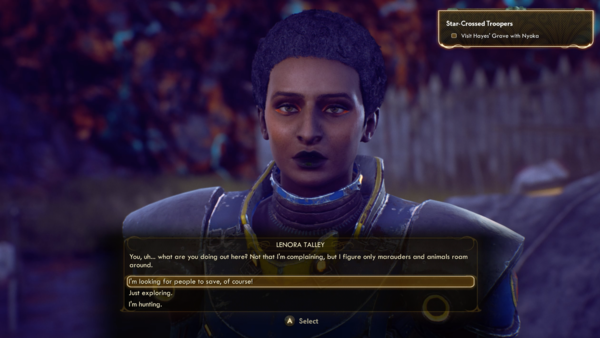
Much has been made of Obsidian’s ability to write interesting characters in the past and thankfully it makes a hell of a return in The Outer Worlds.
Every single character in The Outer Worlds is written to the point where even when they're trying to sell you something, they feel real. This even applies to how your own character is written. No matter which type of response you go for, all of them are incredibly sharp. There’s a level of wit in The Outer Worlds that just wasn’t there in Fallout 4.
This is exactly one of the things that made Fallout New Vegas so memorable, and it's good to know that its because of Obsidian's involvement. They don't need an established IP to have good characters.
Besides a few of the more interesting companions, who can you actually remember from Fallout 4? The most memorable characters are a dog that never speaks and a company logo that never actually makes an appearance.
Team Vicar Max all the way.
1. Endless Choice

Obsidian made the bold promise that you can play however you want in The Outer Worlds, and thankfully they lived up to that claim.
Want to go about Halcyon killing every NPC you come across? That's a (slightly demented) option. Want to play it as safe as possible and try and unite the colonies together? That ambitious goal is entirely possible if you go about questing the right way.
Everyone's adventure will be different in The Outer Worlds, and that's massively helped by the incredible dialogue system. The game doesn't limit you in any regard, and if you want to role-play a character who acts dumb one minute and kills everyone the next that's entirely up to you.
Fallout 4 felt extremely limited in the choices it allowed you to make. Role-playing didn't really feel like a part of the game at all, and it instead felt like a open-world first person shooter with light RPG elements.
The Outer Worlds has made other RPG's look rigid by comparison.