Why WWE SHOULDN’T Re-Sign Brock Lesnar
If Lesnar guaranteed something next-level amazing - which his salary and disproportionate role should - that may excuse the extent to which the full-time roster are overshadowed. He doesn’t. Since erecting Suplex City - an in-ring strategy he cannot deviate from, demolishing as it would established psychology - the man’s record is almost exactly 50/50 in terms of in-ring quality. In terms of elevating talent to his level and compelling fans to care about those he defeats after the fact, the Conqueror is no company Ace.
In 2015, he fully justified the investment. The Royal Rumble Triple Threat bout versus John Cena and Seth Rollins saw Lesnar underscore his position as a leviathan. The sprint match-within-a-match was lent massive urgency, as the killer lurked under the commentary table. His last jump scare manifested as a superb melee of destruction. At WrestleMania 31, he played the sadist brilliantly. In comprehensively proving himself more Phenom than Phenom, in a series with the Undertaker blinding in content and rich in pathos, Lesnar even atoned for his most polarising night in the company.
Even within that annus mirabilis, a lurching sense of unease encroached. His singles match with Seth Rollins at Battleground confirmed his incompatibility with so much of the roster. The contrast of physiques, styles and presence was too stark to suspend disbelief. It was much too implausible. This was not a problem for AJ Styles, who sold those Germans like near-death experiences to inspire hope for an equally implausible comeback - but not every wrestler is AJ Styles.
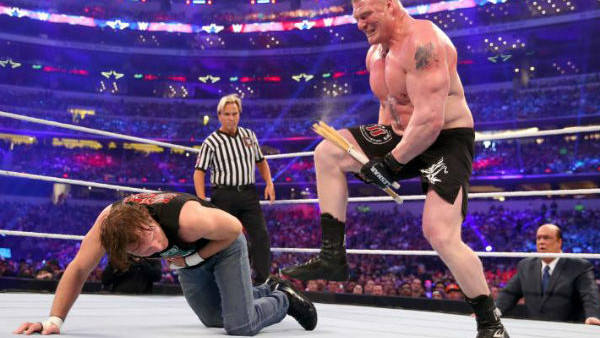
The on-paper pairing of Lesnar and Dean Ambrose promised much - the latter’s Terry Funk never-say-die tribute act represented the best means of elevating a Lesnar opponent in defeat - but Lesnar, with one eye cast in the direction of real paper, another UFC payday, entered an indifferent performance at WrestleMania 32. This, ostensibly, was the stage on which to maximise the investment - and very few bought into it. This selective motivation was a borderline insult to fans - and Ambrose.
Following that, WWE upped the ante of his killer persona, and instructed him to risk concussing Randy Orton at SummerSlam. The subsequent Goldberg programme was an eventual triumph - but 2017 saw as many triumphs as travesties. 2015 saw Lesnar in brilliant form. 2016 was a complete waste of time. It all averages out to an average return.
The full-time roster is subject to the Wellness Policy. Brock Lesnar is not. This visually symbolises the problem. Lesnar is a God wrestling mere mortals. The discrepancy stretches suspension of disbelief - and, since Lesnar is billed as the legitimate fighter in a land of sports entertainers, it undermines also his entire character.
CONT'D...