How Good Was Triple H Actually?
Was Triple H really that damn good?
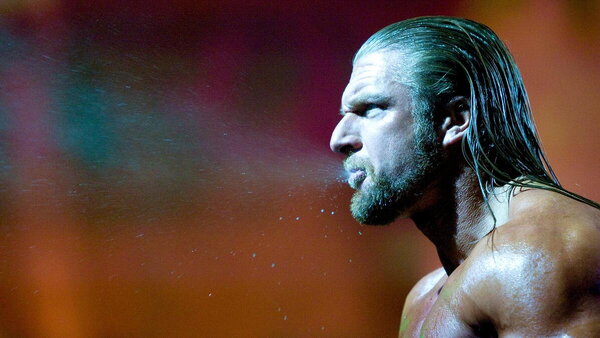
Paul Levesque runs the world. The Chief Content Officer of WWE did what he set out to do when he wasn’t even over: on the creative end of things at least, Triple H won. His corporate career mirrors his in-ring days, in that the man is presented as a demigod.
By the man himself.
The King of Kings, the Cerebral Assassin, The Game: Triple H has always loved presenting himself as at the absolute pinnacle of the sport. His main event persona was built on reaching the top. This has always meant more to him than anything, and he spared no opportunities, ever, to remind you how successful he was.
Now, overseeing the ‘Paul Levesque Era’, Triple H casts himself as the gigantic brain powering the machine on WWE Unreal. He points at the wrestlers he was clever enough to sign and gracious enough to promote for you. He soaks up pops by introducing the biggest WWE shows. (Vince McMahon, even under the guise of his egomaniacal Mr. McMahon character, never opened WrestleMania to tell you how great he was.)
Triple H was - as a result of factors not necessarily related to his talent - pushed at the top of WWE for longer than everybody not named the Undertaker. He is a 14-time World champion in WWE.
You’d think, then, that Triple H was nothing less than an all-time great. Triple H, to justify those decades spent in the main event picture, would have had to have maintained his glittering in-ring standards at an absolute minimum, or raised his level year-on-year. It’s highly unusual for any wrestler to have starred for as long as him.
How good was he actually…?
10. Presence/Look/Presentation
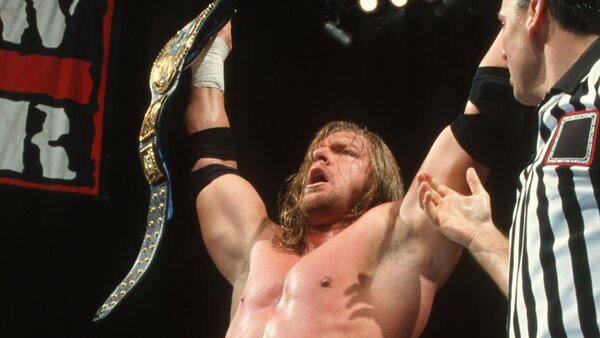
Triple H passed the silhouette test, especially if he was standing sideways.
He reached his final form in 2000, when he rocked one of the very best physiques in wrestling history. A hulking powerhouse, Triple H had oak tree trunks for thighs. His ab definition was immaculate. His waist was slim, which, next to his latissimus dorsi, made his torso look like a deadly cobra. He had wrecking ball biceps, stupidly big shoulders. Triple H’s main event body was both enormous and somehow lean enough, at the same time, to make him not look like a stereotypical 1980s muscle monster. There was still an athletic dimension to his look. He mostly maintained the outline as the years passed by, with one glaring and unsettling exception. When he made that MSG return, his shoulders looked weird, like he was wearing a pair of 2x4s for earrings. He was in fact so blocky that it inhibited his movement. It took a while for him to get back to normal and back up to speed in the ring.
His presentation was iconic, even if his preferred iconography was highly questionable. He was allowed the advantage of multiple licensed entrance themes, where hardly any other WWE wrestlers past or present were permitted one. Triple H at various stages of his career entered the ring to no fewer than three Motorhead songs. Three!
If this was “cheating”, it worked, but it wasn’t essential. Triple H didn’t need Motorhead to be a star; he was at his most over when using Jim Johnston’s ‘My Time’.
He owed much of his outside of the ring look to Shane Douglas. Many times, Triple H looked the part, but his leather and denim jacket was inadvertently funny. He took the two materials associated with tough guy jackets because he thought he was twice as tough as everybody else.
Triple H did have presence, and a lot of it. As negative as many older cynics are about Triple H, they can’t in good faith deny that the guy changed the atmosphere in a room. He was able to elicit a big reaction - even if he often hushed it the longer he performed…
8.5/10 (might've been a 9, were it not for various hilarious WrestleMania entrances).
9. Promos
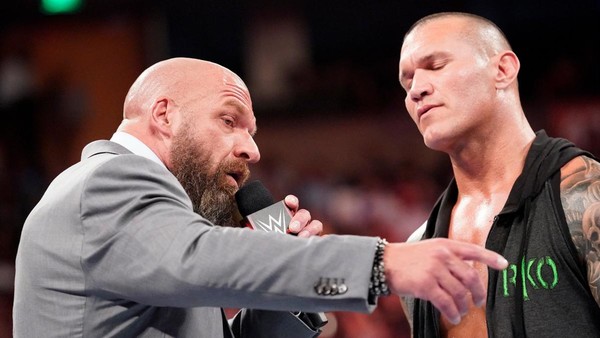
Triple H’s delivery was good-to-great, if you ignore the content of his words and how many of them he said and repeated across a single televised promo.
His composure was excellent. He was practically unflappable. He was good at emphasis; as a student of the game who sought to learn every single aspect of the WWE system, Triple H more than most grasped the “art” of a soundbite for a video package.
Some of his best work was weirdly fascinating, which is a phrase one rarely associates with Triple H. He was so utterly self-assured in disposition and secure in his role that he’d often test his storyline rivals, either to show them up or see what they had in them.
Even then, it was maddening to watch, since Triple H was playing the game on easy difficulty. What were these guys (like Kofi Kingston) meant to say back to him? They knew of his reputation as a shovel-happy political shark. It was magic, then, when CM Punk embarrassed him throughout 2011. If Triple H wouldn’t show ass, Punk pulled his pants down for him.
As a heel, Triple H struck a very effective tone of smug, above-it-all disdain. Shame that he often refused to deliver the catharsis, i.e. the most important bit.
This is an attempt at balance, to say some halfway positive things about Triple H because he couldn’t have been that bad, could he? He sold various big matches that drew money. Definitionally, he could not have been “bad” - so why did it feel so often like he was absolutely awful?
Probably because Triple H, unlikeable as a babyface and too sensitive to show himself up as a heel, spent an eternity prattling on and repeating himself. Notorious for his Triple H-isms, which he’d use to gather his thoughts - “the fact of the matter is”, “but here’s the thing” - Hunter would drone on forever. It’s just as well the build to his WrestleMania 27 match against the Undertaker is remembered for the silent taunt-off challenge, because Triple H’s promo the following week was diabolical. Repeating every point with at least three slightly rephrased sentences, he also made sure to bury the entire locker room. “Everybody else sucks, we have to fight each other” was the thrust.
A great promo can get their point across succinctly and make you beg to see the big PPV match. Triple H spoke for so long that the match was over by the time he’d finished promoting it. Triple H could not cut a “hard times”-calibre promo if his life depended on it. If he was tested, and told to cut a promo in under two minutes, he’d struggle badly.
Triple H spoke well. Many politicians do.
5/10
8. In-Ring Ability

If you view some of his best traits in isolation, Triple H was a magnificent professional wrestler.
His flat-back bump was incredible; he could throw himself down to the mat with lightswitch quickness, putting over a fiery babyface comeback brilliantly. His footwork and timing was great. He could blow a babyface away with his high knee, making it seem as though they’d never see it coming. When he was in the mood to do it, Triple H was fantastic at flailing in the pain of a submission hold. The mood did not strike him nearly enough.
The best of his big match catalogue is excellent. Vs. Cactus Jack (Royal Rumble 2000, No Way Out 2000); Vs. Shawn Michaels (SummerSlam 2002), Vs. Undertaker (WrestleMania 28); Vs. Daniel Bryan (WrestleMania 30), Vs. Batista (Vengeance 2005), Vs. Chris Jericho (Fully Loaded 2000), Vs. Ric Flair (Survivor Series 2005), Vs. Steve Austin (No Way Out 2001). That’s an impressive (and incomplete) record.
He might have wrestled the very best match in WWE Raw history alongside Steve Austin against Chris Jericho and Chris Benoit, and he knew his way around a TV match generally. Older fans still rave about that Taka Michinoku match from Raw in 2000.
But here’s the thing: is there a single wrestler who is either considered great, or was pushed to the main event level for as long, who has entered so many dud performances? Who has wrestled countless bad, boring, or counterproductive matches?
The Undertaker is competitive in this particular field, but ‘Taker, burdened with more terrible opponents and stipulations, was never explicitly marketed as a ring general.
Vs. Randy Orton (WrestleMania 25), Vs. Brock Lesnar (WrestleMania 29), Vs. Booker T (WrestleMania 19), Vs. the Undertaker (King Of The Ring 2002), Vs. Shawn Michaels (Armageddon 2002, Bad Blood 2004), Vs. Goldberg (Unforgiven 2003): these matches were disasters. Triple H’s attempts to engage a crowd over a sizeable length of time were often dreary in the extreme.
Even his more acclaimed matches weren’t even that special for such a pushed, supposedly legendary wrestler. Some of them while not undeniably great were very good - but this is the longest-tenured WWE wrestler who’s meant to be great we’re talking about here. Beyond the two extremes, Triple H racked up several matches that were strong without being close to Match of the Year contenders (Vs. Dean Ambrose, Roadblock 2016, Vs. Jeff Hardy, No Mercy 2008).
Then, there’s the tier of matches that could and should have been a lot better - matches where you can’t be sure whether chemistry issues or an unwillingness to truly make it work explain the muted crowd reaction and sense of missed opportunity (Vs. Kurt Angle, Unforgiven 2000, Vs. Rob Van Dam, Unforgiven 2002). It wasn’t as if Triple H was in there with two duds. Also, as good as Triple H’s best work is, is it up there with the very best of WWE?
Is the Cactus Jack match at Rumble 2000 a better brawl than Bret Hart Vs. Steve Austin at WrestleMania 13? Is the Batista Hell In A Cell match better than Undertaker Vs. Shawn Michaels at In Your House: Badd Blood? Is his technical chess match with Daniel Bryan better than Randy Savage Vs. Ricky Steamboat at WrestleMania 3, or even Bryan’s wars against CM Punk (Over The Limit 2012) or AJ Styles (TLC 2018)? Has Triple H wrestled a match that you could argue is the very best in WWE history? Even in the top 5?
Wrestling psychology is hard to define, particularly since a lot of people are so tribal about it, but broadly, it’s about making people make noise. Wrestling psychology is the successful manipulation of a paying audience. How else to measure that, other than by volume/atmosphere?
At WrestleMania (and beyond), Triple H was a specialist in silencing a crowd. It’s truly staggering, given how much time he was allocated, over and over again, how often Triple H failed to deliver on the grandest stage. Who else gets that many chances without being connected?
Chris Jericho (18), Booker T (19), Randy Orton (25), Brock Lesnar (29), Seth Rollins (33), Batista (35): Triple H might as well have wrestled them all at a funeral. This list doesn’t even factor in Triple H’s disaster against Roman Reigns (32), because the vocal rejection of it was not exactly silent.
Again: even when he was great, has Triple H ever wrestled a match you could put up there with the loudest in WWE history? He never generated an atmosphere as special as the Rock Vs. Hollywood Hogan, or any prime Steve Austin match.
Ultimately, Triple H was an almost defiantly uninteresting pro wrestler even when he was actively trying to produce something worthy, and if you believe the more cynical wrestling fans, he sometimes wasn’t.
He slowed it down against Goldberg, who Triple H knew relied on a shorter, intense rush. He made suspicious babyface choices against Roman Reigns. In matches against Edge and Kurt Angle and the like, he rarely thrust into a higher gear. He knew how to build a match to peak at the finish, and yet, those matches and certain others seemed to feel flat - as if he was trying not to create something blow-away great with guys he might have felt threatened by. That was the old message board accusation, anyway.
More often than not, Triple H did the right things in the right order. For a wrestler so divisive and discussed, many of his matches lacked emotion.
6.5/10
7. Time’s Test
Because Triple H is a very faithful devotee of the business, his work holds up (the matches in which he isn’t so much slowing it down but crawling, at least).
He was very adept at the shine/cut-off/heat/hope/comeback/finish formula that has endured in the U.S. mainstream for decades and decades. It’s a very simplistic structure, but it’s evidently very effective, enough to feel timeless.
Great execution will never fall out of style either. Triple H’s best work really is enthralling, frustratingly so. Why couldn’t Triple H make the ring shake with those 10/10 flat back bumps more often?
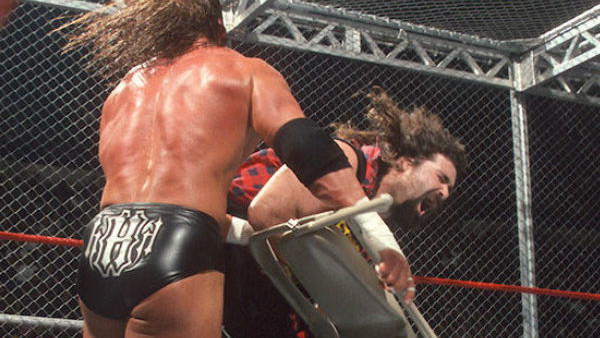
Some people mock Triple H and his tough guy fantasies, but to his credit, he could make a brawl feel sickeningly, awesomely violent. The more bloodthirsty fans among us could watch Royal Rumble 2000 forever.
Ironically, since Triple H constantly drones on about the importance of storytelling, downplaying the importance of the wrestling action itself, it’s his work outside of the ring that dates very, very badly.
He was even more racist than you remember in the Attitude Era. You’ll recall the Nation of Domination blackface parody, since it was one of the most memorable segments in an unforgettable time period, but you might have forgotten the time he aimed a monkey gesture in the direction of Mark Henry. You might have glossed over the time Triple H played a grotesquely stereotypical Asian doctor named ‘Dr. Hung Lo’. Or the time Triple H adopted a Pakistani accent to ridicule shopowners in an on-location shoot in New York. Also, that time Triple H made this stuff the key thread of a World title match at WrestleMania. He did this stuff a lot, and since he didn’t always do it as a heel, he can’t use “heat” as an excuse. It almost bordered on a hobby.
When he wasn’t allowed to do his bad taste material - let’s also not forget the homophobia, particularly intense in 2006 - he was so repetitive that it wasn’t even worth watching in full at the time. You already had the gist 10 minutes before he stopped saying anything.
7/10 (outside of the ring is 0)
6. Cultural Significance

As big as he is, nobody really knows who Triple H is outside of wrestling circles.
He’s not in the El Santo or Rikidozan tier, but then again, nobody else is, even the Rock or Hulk Hogan. Triple H isn’t in the Rock’s league as a household name, either: the Rock was the highest-paid and biggest Hollywood attraction in 2018. The Rock has generated at least $3 billion dollars in box office revenue as a leading man. ‘The Chaperone’, Triple H’s 2011 crime comedy vehicle, made less than $300,000. Triple H is no John Cena in terms of substantial mainstream renown/appeal. Or Dave Bautista.
Everybody knows what WWE is, in that it’s a synonym of wrestling, and everybody is at least somewhat aware of it. Triple H’s name is probably quite well known, if only because he’s been such a major part of WWE for so long that the long-suffering partners and mates and family members have learned it through no choice of their own. Triple H is probably in the Undertaker-tier of name value, in that he hasn’t done a f*cking thing outside of the business, but is synonymous with it, and everybody knows what it is, even if they laugh at the idea of its very existence.
Hunter is trying to correct this, by reinvewhnting himself as a “brains behind the operation” Dana White-style figure, but he still isn’t as well-known as Vince McMahon was before his cowardly retreat away from the limelight. Hunter, frankly, is boring. He’s not going to come agonisingly close to making a headline by blowing up in some poor guy’s face like Vince was. He doesn’t draw on (nor get used by) the media circuit as a result.
3/10
5. Rivalries

Triple H’s feud with the Rock was both fascinating behind the curtain and compelling onscreen.
Iron sharpened iron. The Rock was priceless when he ripped the piss out of Triple H and his growling, pretentious vocal tics, but he wasn’t so cocky when they shared the ring. They tried to eat each other alive. They were intertwined throughout the entire Attitude Era, and they always worked together like the other was capable of taking the top spot for good. The fierce spirit of competition underpinned every big match, even if the content was hardly groundbreaking.
Triple H had great chemistry with Steve Austin (when Austin started taking him seriously). Hunter’s big match series with the Undertaker was wildly uneven. They approached the five star, categorical classic a couple of times. They also sh*t the bed to dull or hilarious results. Conversely, Triple H and Mick Foley created magic together every single time. Foley was more giving than any wrestler ever, and smarter than most, so he knew how to go about it. He cast Hunter as a killer, and it suited him. The Batista feud was nothing less than one of the best WWE storylines ever.
Hunter and Shawn Michaels had it once, but since they always thought they were the greatest and coolest guys to ever do it, their series was mostly an excessive, masturbatory mess after SummerSlam 2002. The Triple H Vs. Randy Orton programme might be remembered as the most interminable, uninspiring long-term story WWE ever told, were it not for the fact that Orton’s feud with John Cena lasted even longer. Given how long the storyline lasted, and how quiet the one match was, Triple H Vs. Seth Rollins was a monumental waste of time.
In what is becoming a theme, this category is mixed, which is probably bound to happen when you’re as pushed as Triple H was over the years. There’s a solution in that sentence if you look for it.
7/10
4. Moments
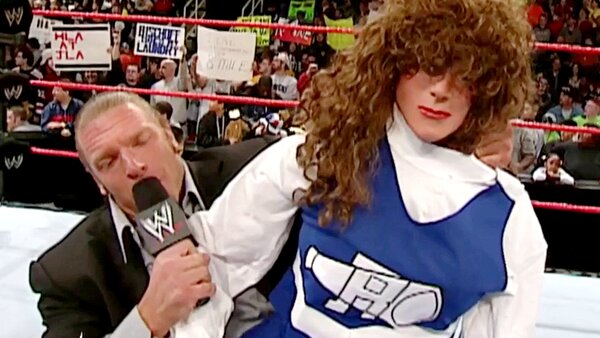
It’s difficult not to compare Triple H to some maverick athlete in real sports. This is an admittedly weird analogy for a man who never got in trouble and a performer lacking in true flair and creativity - but when he actually applied himself and did what was expected of him, Triple H really did get it.
A heel is meant to feign bravado, rub your face in how great he is, and sell fear and cowardice when, confronted by the babyface, the mask slips. Triple H is responsible for one of the greatest ever such moments, when Mick Foley promised to unleash his Cactus Jack persona at Royal Rumble 2000.
The problem is that Triple H seemed to go out of his way to do the opposite of this at almost all times. He said John Cena happened to not be a very good wrestler. He told Daniel Bryan, for months on end, that he was a B+ player. He said Booker T was only good for dancing. Amongst the set of fans who hate-watched WWE and drifted away from it altogether - Triple H’s long run being a factor there - the man is infamous for burying his opponents in key chapters of his most memorable storylines. When Cena beat Triple H at ‘Mania 22, it didn’t achieve much. Even his big breakthrough heel promo, beloved in some circles, was very try-hard. Who else got to say the cool, sacred F-word to help them get over?
Little People’s Court. The thumbs-down to Batista. Katie Vick. The fake 2005 babyface reunion with Ric Flair. As ever, it’s mixed. One extreme is worse than the other, in that Triple H is responsible for some of the dirt worst wrestling moments ever.
You could bring up the moment of Triple H’s MSG return as a positive, and as cool as it was in and of itself, how much did it matter…?
4/10
3. Range
Very poor.
Triple H was very over as a babyface in 1998. As on the pulse as any wrestler ever, he knew what was in, and he was credible, because he found that stuff amusing too. His relentless dick jokes were “f*cking over”.
It never happened for him as a babyface beyond that. Yes, he drew a ridiculous pop at Madison Square Garden on January 7, 2002: the date of his heavily publicised return. This pop and its importance is one of the most overstated moments in modern wrestling history, and that’s not a negative “hater” to take. There was no lasting significance to the moment at all. Triple H was famously and completely outclassed at WrestleMania 18; his main event against Chris Jericho was stolen by the Rock and Hulk Hogan. ‘Mania 18 took place on March 17, 2002 - just 69 days after the return pop. ‘Mania 18 was no aberration, either. Triple H had turned heel by July. Everybody knew he wasn’t working as a babyface.
Triple H played face for several more years in the mid-to-late 2000s and early 2010s - to mixed success. His 2008 SmackDown run was well-reviewed, but either side of that, the D-Generation X reunions are generally considered excruciatingly unfunny, lame, and unproductive. Hardcore WWE fans will tell you that Triple H is a legendary heel - but even they never seemed to adore him as a babyface. Triple H teased retiring at SummerSlam 2012 with tears in his eyes. This garnered no sympathy or even noise whatsoever from real, ticket-buying WWE fans.
Condescending and narcissistic to an almost impressive level, Triple H was a natural heel. He was the main antagonist in 2000, arguably WWE’s creative peak. In the 2010s, though, he was more overbearing than effective as the head of the Authority stable. And, since this is an assessment of his range, it should be mentioned that HHH played a tyrannical power-hungry authority figure in 2000 and in 2018.
In the ring, he always seemed to wrestle the same match, although he could go full slapstick comedy on occasion.
4/10
2. Drawing Power

Triple H headlined multiple PPVs throughout the Attitude Era, when the product was red hot and the numbers defined the fates of entire companies. You don’t get to do that purely as a result of who you’re close with.
In the July 15, 2024 edition of the Wrestling Observer Newsletter, Dave Meltzer compiled a list of the 15 top live draws in wrestling history. Meltzer calculated this by deducing which headlining wrestlers had drawn the most ticket sales over the longest time span. Meltzer admits that the system was flawed, in that it is not a true reflection of popularity. Steve Austin isn’t included, even though he was significantly more popular than Triple H was at any single point in Triple H’s career, but Triple H’s longevity is favoured by the methodology.
It’s a very Dave way of looking at it, strict and pedantic to an extent that you could argue misses the point, but nonetheless, it’s a somewhat flattering to Triple H, who places #14. But then the Rock doesn’t feature at all, and yet Roman Reigns does, at #11, so what’s going on there?
What this ultimately tells you is that Roman Reigns and Triple H drew smaller crowds than the Rock and Steve Austin for a higher amount of years. Triple H was the best draw in 2004 and scored highly throughout the monopoly era, but is that actually impressive? Is it even the bare minimum? Triple H drew smaller arena crowds with no competition.
TV ratings plummeted across the infamous Reign of Terror. When Triple H dominated the show as its nigh-on invincible top heel, the average Monday Night Raw coverage rating dropped from 2.43 in 2002 to 1.96 in 2004; interestingly, the average increased to 2.10 (2005) and 2.14 (2006) when John Cena replaced Hunter as the face of the brand. Triple H was drafted to SmackDown in 2008; the absolute best you can say about his run is that he didn’t crater the numbers.
He was a different animal on pay-per-view when - and here’s that refrain again - he wasn’t fuelled by his defensive, fragile ego. When fans sensed that HHH was on the cusp of losing his World title, they actually really wanted to see it. Backlash 2000 (Vs. The Rock) was the second most successful non-’Big 4’ pay-per-view ever, behind only InVasion, drawing a monster 650,000 buys. WrestleMania 21 (Vs. Batista) broke the all-time record with 1,090,000 buys. This was a staggering achievement, given WWE was not in a boom period.
Triple H wasn’t as strong a draw as you’d expect, given the scope of his push, but he justified it when he wasn’t so petty and paranoid.
7/10
1. Conclusion
A lot of people say that Triple H was only truly, consistently great for one (1) calendar year - 2000 - which would drastically undermine his G.O.A.T. case. Is that true?
Let’s break those years down:
1995 - You can’t reasonably expect much from Paul Levesque’s first few months as Hunter Hearst Helmsley; the performer was still green, the character he was asked to portray terrible.
1996 - He still wasn’t over, nor particularly good. No standout matches, no redeeming televised segments. Despite this, perhaps since roster depth was so poor, he was earmarked to win the King of the Ring tournament before his office “burial” - which lasted three months and culminated in him winning the Intercontinental title. Scores of boring, plodding matches.
1997 - He still wasn’t over, which is wild, since if you believe Bret Hart, this was the year in which Hunter started to make his political moves. 1997 is the year Hunter started to get there - very slowly, in his trademark style. His MSG Raw match against Cactus Jack was genuinely great, totally wild, and as the mate of Shawn Michaels in D-Generation X, Hunter displayed glimpses of an obnoxious personality. He knew how to draw heat.
1998 - He was over! At last. Triple H was a douchey cool guy not beloved but enjoyed by the new college-age bros in the stands. They thought he was a stitch. He was still really quite boring between the ropes, requiring a ladder to land his one truly great match. He excelled, if that’s the right word, on the new, edgy, lowbrow Monday Night Raw. Convincing the crowd that you were going to get your knob out after the commercial break was a barometer of success in a very weird time.
1999 - There was still a leaden quality to Triple H’s matches. Many people, including Steve Austin, didn’t take Triple H’s new serious heel persona seriously - no matter how much he swore.
2000 - His best year ever. One of the best years of any WWE wrestler ever. Triple H, with his rebuilt, hulking physique, was incredible. A warlord on offence, a great stooge when he met his match. Dynamic. Exuded a true main event presence. 2000 was the year in which a man with such a tryhard quality was effortlessly great.
2001 - His excellent form continued until he was cut down by a major injury - with some bad omens. He stopped showing ass. In the ‘Two Man Power Trip’ alongside Steve Austin, Hunter indulged his dour hard man fantasies. The results ranged from boring to cringeworthy before and after the bell rang.
2002 - Very uneven at best. He was slower, having returned in better cosmetic shape than anything else. SummerSlam was outstanding, emotive. Almost everything else he did with Shawn Michaels was overlong, histrionic. Triple H either tried to undermine Chris Jericho at WrestleMania, or was incapable of performing as a main-event level babyface. Not good either way.
2003 - His worst year ever. One of the worst years of any WWE wrestler ever. Interminable dud upon interminable dud. Irredeemable. Tedious. Unacceptable. Seemed to go out of his way to make his peers look worthless, which was massively ironic, since he was cosplaying as Ric Flair. The Scott Steiner debacle can be explained, but the Booker T and Goldberg matches were vile.
2004 - More of the unacceptable same outside of the WrestleMania 20 main event (and to a lesser extent Backlash). Again: if an earnest attempt was made to put Randy Orton over, Triple H was useless. If no attempt was made, that’s far worse. Outside of the ring, synonymous with the opening 20 minute promo, Triple H was unbearable.
2005 - The lead in his ass was surgically removed in 2005: Hunter’s second best year ever. In a subversion of 2000, it was Triple H’s turn to elevate somebody else to the main event scene: Batista. Triple H should not have bled at WrestleMania 21, but was otherwise immaculate in their series. Why didn’t he attempt this more often? He was demonstrably capable.
2006 - The year of the first post-Attitude Era DX reunion was, in a word, excruciating. A terrible case for Triple H as a babyface star, his comedy was obnoxious and unfunny. Smug and insufferable, Triple H was also one of Mr. McMahon’s worst opponents. The best Mr. McMahon matches played with black comedy and genuinely unhinged action set pieces; Triple H played it broad and juvenile.
2007 - Missed a sizeable chunk through injury, and didn’t return in amazing form. Peaked at “very competent if uninspiring”. This becomes a trend.
2008 - Very competent if uninspiring matches with questionable results. Got his win back over John Cena. Miracle match with Great Khali. Seemed threatened by Edge and Jeff Hardy. And this was one of his better years!
2009 - Another DX reunion. It was only slightly less offensive. It followed an interminable disaster of a series with Randy Orton. It was overcooked, bland, embarrassing. Triple H dominated a stale main event scene.
2010 - Ended the year away from the ring as he prioritised becoming even more influential outside of it. This was the formal beginning of his corporate career (emphasis on formal). Triple H did strong work against Sheamus before his long hiatus.
2011 - Which was subsequently undone so that Triple H could build himself up for WrestleMania. 2011 was indefensible even by his standards: he buried the entire locker room to justify getting the Undertaker match, scored a visual pin over CM Punk before putting him in his place at Night of Champions, and ended the year doing something boring even by his standards with Kevin Nash.
2012 - A part-timer at this point, the song remains the same. Uneven at best, again. Was part of the best false finish in WWE history at WrestleMania 28 before entering a performance so slow and emotionless against Brock Lesnar at SummerSlam that he elicited no reaction whatsoever when he teased retiring with tears in his eyes.
2013 - Triple H didn’t do much, but everything he did was awful. Defeated Brock Lesnar at WrestleMania before doing the job at the smaller Extreme Rules show in yet another political play. The first match was quieter than some pandemic Raws. Not that anybody else could have done much better, but his efforts in putting Curtis Axel over were hilariously ineffective.
2014 - An incredible return to form. Was finally bullied into doing the job to Daniel Bryan, and he did it brilliantly. He also did back-to-back jobs for the Shield alongside Batista and Randy Orton. Both matches were awesome.
2015 - Wrestled one match all year, against Sting, whom he defeated because WCW had the temerity to counter-programme WWE 20 years prior. Match was dumb and bad.
2016 - Classic Trips: he didn’t make Roman Reigns look particularly good, at all, but did everything possible to tear the house down with Dean Ambrose a month earlier so it looked like he wasn’t the problem.
2017 - Classic Trips: he silenced an entire stadium against Seth Rollins at WrestleMania.
2018 - Entered a potential career-best individual performance against Ronda Rousey at WrestleMania 34, selling her barrage of punches like he was staring down a firing squad. Ended the year with his dignity and pectoral muscle in tatters as one quarter of the hilariously bad DX Vs. Brothers of Destruction match at Crown Jewel.
2019 - While he did a couple of matches at house shows and worked Randy Orton in Saudi Arabia, his match against Batista at WrestleMania 35 was a fitting end: it stunk the joint out and went on far too long.
So that’s two great full years as a full-time wrestler (2000, 2005), one excellent six-month period (first half of 2001), another very good year in spite of some self-serving nonsense (2008), and a great quarter as a part-timer (2014).
That’s…that’s it?
Overall: a 6.5/10 who sometimes felt like an 8, more often felt like worse than nothing.