10 Most Hilarious Legal Battles In Comics History

When common sense was usually the super-villain.
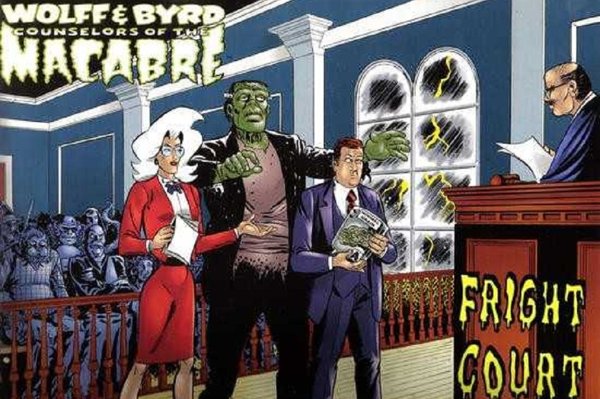
For a business that usually puts a lot of focus on simple battles between right and wrong, comics spend a lot of time in the murky world of the courtroom, where justice doesn't always prevail but might doesn't always make right, either. Here, a mere technicality, or even the threat of a lawsuit, can do what the most diabolical villains can't: end a popular superhero's existence, locking him away even from memory. Or they can just remove a hero from her home universe and put her in one where her entire existence stops making sense. They can control our language, justify intellectual property theft... make foolish causes noble and noble causes foolish, even change the very definition of right and wrong. So sometimes it's important to step back a bit from a case that a lot of serious lawyers have spent serious time being serious about, and reflect for a minute before saying, "You know what? This whole legal case is CRAZYTOWN KOOKOO BANANAPANTS." Here are the ten craziest legal matters we found-- some of them full-fledged court cases with judgments rendered, some unresolved courtroom wrestling and some the mere threat of a lawsuit or a cease and desist order. It was a close race.

10. Superman Sues Other Heroes For Copyright Infringement
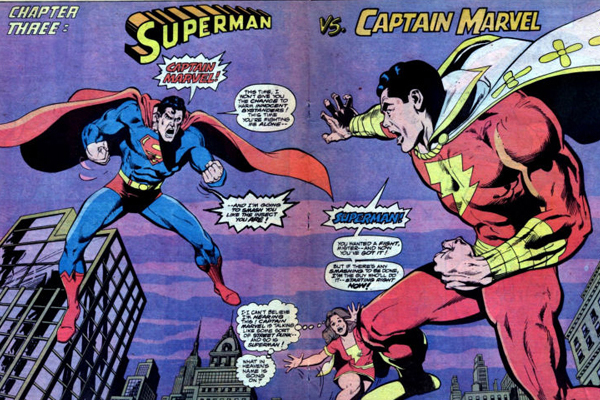
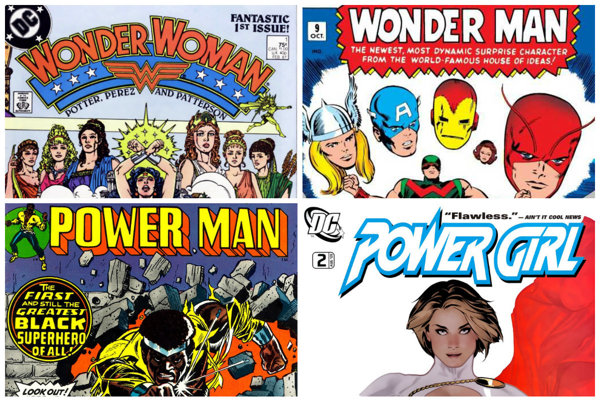
It seems hard to believe now, but seventy years ago, the character then known as Captain Marvel and later as Shazam was a serious sales rival to Superman. Fawcett Publications was also better at spinning off the Captain Marvel property than DC Comics was: there was a Captain Marvel Jr. and Mary Marvel well before there was a Superboy or Supergirl. Unable to beat the Captain in a fair fight, DC cheated, taking Fawcett to court on charges of being a mere copy of Superman. They had used the law well against other characters, like 1939's Wonder Man, commissioned by Victor Fox and written and drawn by Will Eisner, and Fawcett's own 1940 Master Man. Were Wonder Man, Master Man or Captain Marvel aliens? No. Were any of them newspapermen? No. Did any of them have a "Lois Lane" type foil? Of course not. Did they imitate Superman's earliest super-powers of strength, speed and sometimes super-jumping or flight? Yes... and so did dozens of other characters, many of them published by DC Comics. Only the Wonder Man case was actually resolved. Master Man never went to trial and the Captain Marvel case was settled out of court in 1953, but legal fees and threats had still gotten DC what it wanted. Today, other companies use far more blatant Superman ripoffs like Supreme, Hyperion and the Plutonian and nobody blinks.

9. Angela Adopted

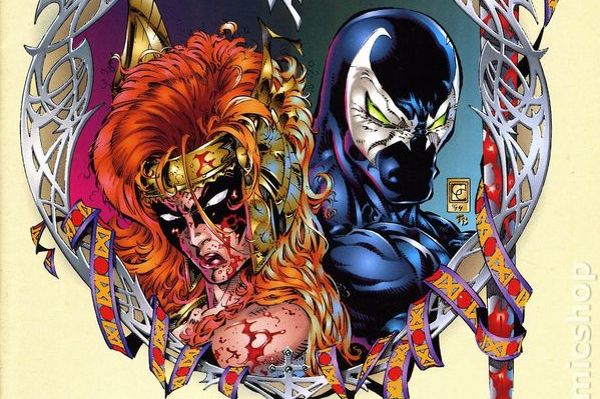
When Todd McFarlane broke with Marvel in the early 1990s to publish Spawn at Image Comics, he was loudly defiant of the work-for-hire system that DC and Marvel offered, where creators never owned their creations. He has often called it "the plantation." But when he started hiring big-name writers to work on Spawn, he found it difficult not to become a bit of a plantation owner himself. In a single issue Neil Gaiman wrote (Spawn #9), he co-created Angela and a couple of other characters with McFarlane. McFarlane at first claimed that Gaiman retained creator rights to them, but later described them as his property entirely and treated Gaiman's work as for hire. In 2002, Gaiman sued McFarlane and won co-ownership; in 2012, McFarlane gave Gaiman full ownership of Angela. Gaiman, not especially attached to the creation, sold her to Marvel in 2013. Lots of superheroes have "immigrated" to other universes after being sold to new publishers. What makes Angela's move so bizarre is that almost everything about her was designed to play off Spawn. She was a Spawn-hunter, then his frenemy and romantic foil, and the unforgiving Heaven she served, almost as bad as Hell, had direct implications for Spawn's own story. Forced to develop a new context for her in the Marvel Universe, Jason Aaron, Al Ewing, Lee Garbett and Simone Bianchi recast her version of Heaven, or "Heven," as the undiscovered tenth realm out of Thor's nine realms. Angela was also suddenly Thor's sister that he'd never known about. Her entire original reason for being was gone, as if Buffy The Vampire Slayer was now Buffy The Girl Still Picking A Career. They might as well have revealed she was secretly Aunt May, while they were at it.

8. Superhero(TM)

Marvel and DC have made legal claims on the term "super hero" and its variants since the 1960s. Realizing they could only succeed in acquiring a trademark if they applied together, they filed for a joint trademark and received it in 1979, even though there were certainly other companies publishing superheroes at that time. This trademark applies to comic books, magazines, cardboard stand-up figures, playing cards, paper iron-on transfers, erasers, pencil sharpeners, pencils, notebooks, stamp albums and costumes. This means they have the exclusive right to make and market, say, a product called "Superhero Trading Cards," though not one called "Costumed Hero Trading Cards." Notably not included in the trademark are books, movies, websites, video games and TV shows, AKA where the real money is, but that's cold comfort if you're in the Halloween costume-making business. "Superhero" is a dictionary term. Cory Doctorow, a prolific sci-fi writer and essayist on intellectual property, condemned the trademark as an attempt to steal its use from the public. As retaliation, he suggested borrowing a phrase from Warren Ellis and referring to DC and Marvel characters as "underwear perverts." "Let's reserve the term 'super-hero' exclusively to describe the heroes of comics published by companies that aren't crooked word-thieves."

7. Robyn vs. Robin

Speaking of trademarks, pop star Rihanna is running afoul of DC Comics right now for trying to trademark her given first name, "Robyn," for use in online non-downloadable general feature magazines. DC is apparently concerned that this will cause confusion in the marketplace, because Rihanna looks and behaves so similarly to Robin, the "Boy Wonder" introduced in 1941 as Batman's crimefighting partner. After all, Robin is known for expressions beginning with "Holy," and Rihanna collaborated with Beyonce and Nicki Minaj on "Holy Trinity." To clarify, Rihanna sometimes works with Kanye West, whereas Robin sometimes works with Adam West. Also, while Batman is known for saying "criminals are a superstitious and cowardly lot," a philosophy Robin agrees with, Rihanna is known for singing "B*tch Better Have My Money."

6. The Other Wonder Man

We've already been over DC's somewhat spurious lawsuit against Wonder Man as a copy of Superman, but not its legal action against Wonder Man as a copy of Wonder Woman. This Wonder Man was an early Avengers villain, featured in 1964. DC Comics made its displeasure felt at the use of "Wonder" in the character's name, feeling it would take something away from the brand identity of Wonder Woman. (Because if there's one thing people are always forgetting about Wonder Woman, it's the fact that she's a woman. When comics were sold in the supermarket, people used to buy her stories instead of Wonderbread all the time.) Stan Lee backed down from this particular fight with DC, declining to bring the character back from his apparent death, and he languished in obscurity for years before other writers brought him back as an on-again, off-again Avenger. Lee was somewhat put out when DC Comics introduced Power Girl in the mid-1970s... a couple of years after Marvel had introduced its title character, Power Man.

5. Stan Lee Media vs. Stan Lee... And Marvel
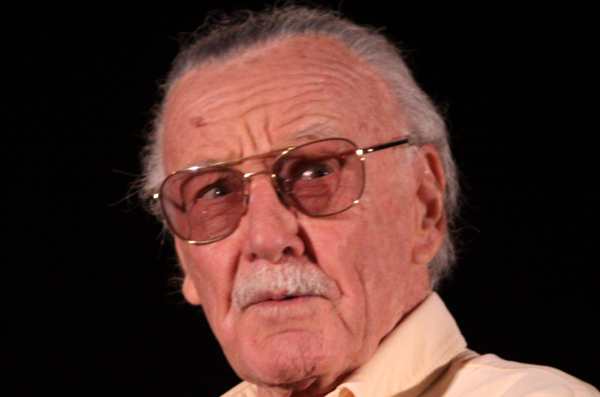
If Stan thought the Power Girl thing was hypocritical, he hadn't seen anything yet. There has never been a sadder, shallower, more ignominious attempt to cash in on a famous name in comics than Stan Lee Media. And that is saying something. The company seemed like a reasonable prospect at first. It generated superhero franchises under the Stan Lee brand, with Lee's exact degree of creative involvement nebulous as per usual. A staff of 165 created a Web portal that beat out Warner and Disney to win a Best of Show Web Award in 2000. Then the dot-com bubble burst. And then things got ugly. The bankrupt shell of the company, long after it dismissed its staff and stopped creating anything of value, filed lawsuit after lawsuit against Lee, Lee's other ventures and Marvel, essentially arguing that Lee co-created Marvel's characters and they were his by right, but also that he'd signed a deal with SLM which meant anything he created was theirs by right. The people involved really seemed to believe they could out-lawyer Disney in cases where they were clearly in the wrong. That worked out about as well as you'd expect.

4. The Oatmeal vs. FunnyJunk

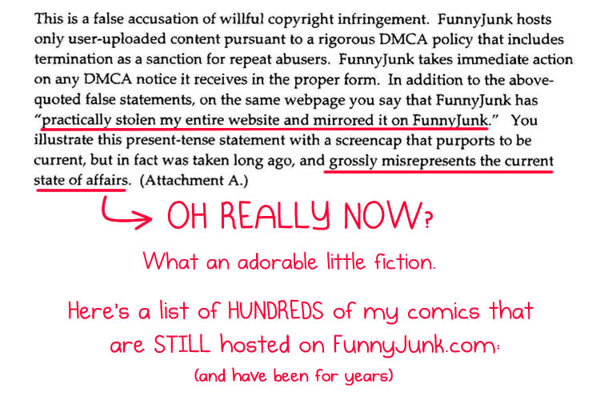
In 2011, popular online cartoonist Matthew Inman had a simple question for his readers, "What should I do about FunnyJunk.com?" FunnyJunk was and is a "content aggregator," which means that it re-presents pictures, videos and "other funny stuff" found and shared by users, often with little consideration to the wishes of the creators and sometimes without attribution. Inman reported FunnyJunk doing this with hundreds of his own comics. FunnyJunk responded by retaining the services of Charles Carreon, a lawyer whosenext actions would completely immolate his own already questionable reputation. Carreon demanded $20,000 in damages and threatened a federal lawsuit if Inman didn't retract his "false statements." Inman instead published Carreon's letter with replies, including enough hyperlinks to completely verify his claims, and raised $20,000 just so he could donate it to two charities instead of giving it to Carreon. Those charities were the National Wildlife Federation, and the American Cancer Society. Carreon promptly sued them as well as Inman. By the time that lawsuit was dismissed, Carreon had attracted a site devoted to parodying him and his actions-- which, of course, he also sued. This led to a countersuit in which Carreon paid $40,115 in damages. Since then, FunnyJunk and Inman have carried on much as before, though FunnyJunk now has an "original content" section. Carreon now maintains his own site where he talks about Internet culture and how it can destroy reputations, especially his. Its name? Rapeputation.com.

3. Archie Comics CEOs Suing Each Other
Archie Comics has commanded the attention of a growing fan base, but the company's management has had issues. Serious issues. Due to a complicated past management structure, it now has two co-CEOs, Jon Goldwater and Nancy Selberkeit (shown here with Editor-In-Chief Victor Gorelick, left). They hate each other. A past court decision means they can only speak through intermediaries, but really, they don't seem capable of civil conversation anyway. But this means Archie employees have gotten caught in the crossfire. Goldwater has sued repeatedly to have Selberkeit declared unstable. Her reported erratic behavior includes referring to male employees with shouts of "PENIS!", stalking employees and their families and failing to change clothes for several days. Five male employees have sued Selberkeit for damages and to bar her from the property. Three female ex-employees, former intermediaries between Selberkeit and Goldwater, claim "Archie Comics is a male-dominated and male-run workplace that disrespects females" and that executives think Selberkeit should go back to shopping and buying shoes, implicitly because she's female. Selberkeit has acted as an effective goodwill ambassador for the company, here and there. Both sides of this story are pretty weird, and it can be hard to pick one. But the tide seems to be running against Selberkeit. She was recently ordered to submit to a psychiatric investigation and was removed from the 2014 San Diego Comic-Con by police, barred from future Comic-Con events.

2. Iron Man's True Creators

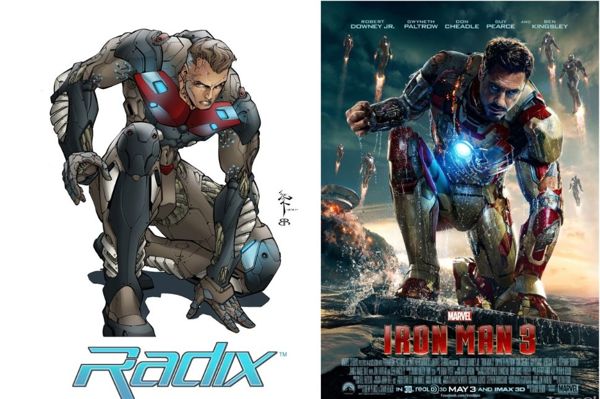
There are lots of past and present lawsuits that pertain to creator's rights, but most of them don't deserve ridicule. It's a serious question how much credit certain people deserve for creating long-lived characters and what is owed to them and their heirs. Bob Kane took almost all the credit for creating Batman's world when most of it should go to Bill Finger. Readers are sharply divided on how much credit to give Stan Lee and how much to give his collaborators like Jack Kirby. In that spirit, we must consider the claim made by Iron Man's original creators, Ben and Ray Lai. Wait, what? The Lai brothers filed suit, contending that the designs of Iron Man's suits as seen in the movies were based on their own comics series, Radix, created in 2001, and not a design widely known to have originated in the first year of Iron Man stories, in 1963. They also sued because an Iron Man 3 poster showed Iron Man rising from one knee, just like one of their Radix characters did once. Rising from one knee is not a copyrightable concept. Also, the Lais worked for Marvel for a bit themselves, in a standard work-for-hire contract that gave Marvel full rights to use any new suit they chose to give Tony Stark. In any case, the Lai brothers filed this suit seven years after the first Iron Man film, meaning the statute of limitations has expired. Such a shame. They had such a strong case otherwise.

1. Batman vs. Batman

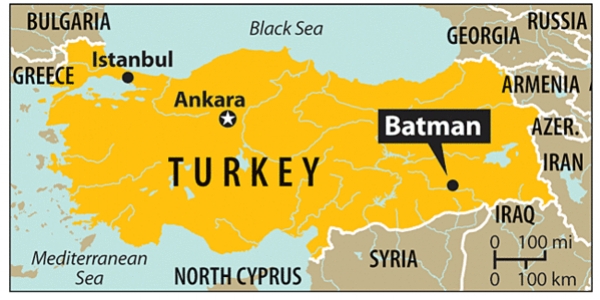
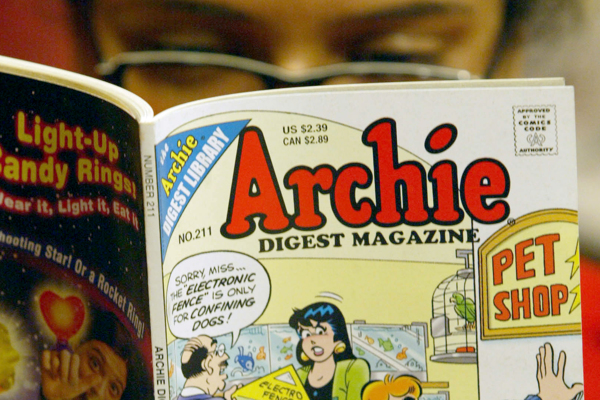
There just aren't enough hours in the day to talk about all the times DC, Marvel and other companies have pursued outrageous claims like the Robin vs. Robyn case. Not long ago, DC filed a complaint about soccer organization Valencia for using a Bat-logo it found too similar to Batman's, even though Valencia has been using bat-logos since 1919, twenty years before Batman's creation. Then there was the time in the 1990s when Archie Comics almost (accidentally) bullied a little girl named Veronica out of the domain name Veronica.org. Every once in a while, though, a big comics publisher finds itself on the receiving end. Such was the curious case of DC Comics, publishers of Batman, being sued by the city of Batman, in the Batman Province near the Batman River, in Turkey. The mayor of Batman, Huseyin Kalkan, said quite plainly that "There is only one Batman in the world," ignoring the Batman city in Iran. He also blamed the psychological stress caused by association with the Dark Knight films for his society's high rate of female suicide... sorry, that should be tendency to shame young girls into suicide. Nothing more was heard about this lawsuit after it was announced, so Kalkan may have realized he was walking into a no-win situation, PR-wise. Frankly, just reading that previous paragraph is enough to make someone want to visualize Batman swinging over there to punch a few people in the face. There are plenty more ludicrous lawsuits percolating through the comics world. Know one we missed? Nominate it in the comments!

Contributor
Contributor

T Campbell has written quite a few online comics series and selected work for Marvel, Archie and Tokyopop. His longest-running works are Fans, Penny and Aggie-- and his current project with co-writer Phil Kahn, Guilded Age.