The Call Of Duty Sequel Activision Needs To Make (But Never Will)
Come on, Activision. Right the ship.

Call of Duty is like a hydra. Though it has a core that defines all the games, the thing that allows to continue being at the top of the industry every single year is the separate sub-series that make up the brand. The longest running (and most successful) has been Black Ops, followed swiftly by Modern Warfare, but not every single attempt to get a new name off the ground has ended up being a $1billion win for publisher Activision.
From Advanced Warfare never getting a sequel to World At War being continued via spiritual successor Black Ops, there have been plenty of false starts, but it was studio Infinity Ward in particular which struggled to catch a break after originally wrapping up the Modern Warfare trilogy in 2011.
While the team initially occupied the role of lead CoD developer, an incredibly public controversy following Modern Warfare 2 saw the company haemorrhaging key staff, and needing help from support studios within Activision to rebuild. Their games suffered as a result, with Modern Warfare 3 being the weak link of the trilogy and Ghosts arguably being the worst modern Call of Duty title.
They've bounced back now with 2019's Modern Warfare reboot, which has even allowed them to leapfrog the other COD developers to the top of the pack yet again. Packed with content and completely overhauling a dated engine, MW is the groundwork all future instalments will be built off, and for good reason.
However, the studio's real comeback game actually happened three years prior to this, with 2016's Infinite Warfare...
2016's Public Enemy No.1

Now, that statement might come as a shock to some, because IW is one of the most hated COD games in the fandom. Its legacy, ultimately, is one of ruin, controversy, and disaster. The launch trailer for the title is one of the most downvoted in history, boasting a whopping 3.8million dislikes compared to only 614k likes.
However, its reception isn't entirely down to the game itself, but more about where Call of Duty as a whole was in 2016, and the terrible way Activision marketed the title.
Back then, fans were yearning for a return to the classic boots-on-the-ground gameplay the series made its name on. Years of sci-fi leaning releases, double-jumps invading the multiplayer and lack of innovation made Call of Duty look like a sheep for the first time in its history, copying competitors like Titanfall rather than leading the industry.
Consequently, when Infinite Warfare's first trailer dropped, showing actual space battles and zero-g firefights, fans let Activision know about their displeasure with the series' overall trajectory. Infinite Warfare was proof, to them, they hadn't been taking their criticisms seriously.
Adding to the negative press before anyone actually had a chance to play the game was perhaps the biggest misstep Activision has ever made as well. And that's saying a lot considering the company we're dealing with here...
The Modern Warfare Remastered Debacle

It wasn't just that Infinite Warfare was yet another big step in a direction fans didn't want, but that it was holding a game they actually did want to ransom. At the same time as IW was announced, the publisher revealed that it was also working on a remaster of Call of Duty 4: Modern Warfare, a next-gen retooling of the classic title's multiplayer and single-player suites.
That should have been a reason to celebrate: if people didn't fancy picking up a sci-fi COD, they could revel in a nostalgia hit. Sadly, Activision weaponised the desire people had for this remaster, and announced that it wouldn't be selling it separately. Instead, the only way you could buy it was to pick up Infinite Warfare. And not just the regular edition, but the far pricier Collector's Edition. 80 bones for a 10-year-old game.
That sealed the deal: it didn't matter whether or not Infinite Warfare was actually good or not, fans had made up their minds. Activision had pushed its luck too far, and Infinity Ward's game became the poster child for every gripe they had with the whole franchise.
But Was The Game Actually That Bad?

Of course, the worst part of this whole process was that Infinity Ward's game was actually... pretty good. At times amazing even. Drafting in top-tier talent, with writers from Naughty Dog penning the story and a team that had fully recovered from the loss of personnel almost a decade prior, this was a confident new beginning for the Call of Duty makers.
Also, Kit Harrington was involved. And Connor McGreggor. I mean, that means nothing to me but for a lot of people, that was awesome.
Even better, though, the team wasn't simply repeating what had come before. While, as mentioned, the series had been edging towards sci-fi for years, this was the first game to properly embrace that theme, giving the player a starfighter home base and even allowing them to pilot a fighter ship in unique, great-feeling vehicle levels.
The foundations were there, packed with the kind of exciting set-pieces IW made its name on, and it sucks to see Activision give up on the sub-series entirely after one attempt. Especially when it was mostly their fault and not Infinity Ward's for the mess of its launch.
Why Infinite Warfare 2 Now?
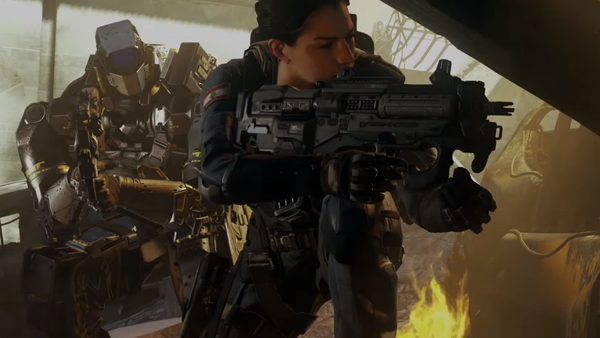
But why, in 2020, does this poisoned well need to be drank from? Why should Activision put in the effort and give the game a second chance when it can just cut ties and continue bathing in tubs of money?
Well, for one, while Infinite Warfare was ridiculed for being derivative with its sci-fi setting in 2016, it would be a breath of fresh air now. Activision's biggest failing with the whole series this generation has been a lack of diversity in its different COD brands. The whole appeal of having three developers working on three-year cycles should be that they each get to create their own unique universes, and offer a different flavour of COD every year to stop things getting stale.
Instead, there was a clear mandate that they all needed to fit into a certain focus-tested ballpark, in both gameplay and setting.
From arguably Black Ops 2 onwards, the series had an increased sci-fi focus, and from Advanced Warfare each game featured the double-jump dash mechanic. They all had different names, but each game played same, while even familiar narrative tropes - such as casting a big name actor as the villain (Kevin Spacey in Advanced Warfare and Kit Harrington in Infinite Warfare) - cropped up repeatedly in a way that allowed franchise fatigue to creep in and make the whole series feel as though it was out of ideas.
Thankfully, that's no longer the case. With Call of Duty: WW2 jumping into the past, Black Ops 4 staying in the near-future and Modern Warfare re-centring the franchise with a contemporary focus, Activision is seemingly edging towards far more variety when it comes to the setting of each brand.
Consequently, there's now space (pun intended) for a full sci-fi Call of Duty. As long as it's not something we get every year, there's the ability for Infinite Warfare 2 to single-handedly lead the pack of futuristic shooters. Instead of being another sci-fi COD, it could be the sci-fi COD.
Fans might be more open to embracing this side of the franchise if it's not the only thing getting stuffed down their throats.
A Unique Set Of Mechanics

Fundamentally as well, Infinite Warfare had a lot of cool ideas, especially in the single-player, that made the most of this theme that wouldn't be possible in the Modern Warfare series. The zero-g assaults were genuinely inspired, and could be improved even more with more freedom in how the player navigates these firefights. I don't care if they were daft, they were awesome. Throw in great weapons, unique gadgets and attachments, and there was so much here to play with outside of the same old gizmos that repeatedly show up in the titles.
Though the broad strokes and villain weren't that original, the writing was always on point, giving us some of the most memorable COD characters in a long time. Likewise, the story took us to some genuinely emotional places, and wasn't afraid to shock players with surprising deaths and twists. It's essentially the Rogue One of the modern CODs, and I still can't believe how much I cared about the plight of these soldiers. Especially that damn robot.
The openness of the campaign could be fleshed out even more as well. Being able to choose side missions and wander around your ship added an RPG element COD has mostly shied away from, giving you more reason to care about the world and invest into it. There was a freedom that sadly the developers went back on with Modern Warfare's campaign, which is a shame. Infinite Warfare showed you could maintain the signature explosive set-pieces while making players more in control.
What About Modern Warfare 2?

Now, I hear you saying: but Josh, if Infinity Ward makes another Infinite Warfare, that means there won't be a Modern Warfare 2 (another one) for years yet. To that I say, though, does Modern Warfare even need a sequel this quickly?
Part of the appeal of the reboot was that it was the first game in the franchise for years, and Activision surely doesn't want to drive it into the ground for a second time. Even better, for the first time in years the publisher and developers have been able to build a genuinely good platform for content. It's not riddled with toxic microtransactions or pay-to-win weapons like Black Ops has been, and has more content than ever. From gunfight, to regular multiplayer, ground war to spec ops, Warzone to tournaments, there's so many different ways to play that could be supported for a long time to come.
The battle pass system has provided a drip feed of mostly good content in a way that hasn't nickelled and dimed players, while a constant stream of reimagined maps from older MWs alongside brand new ones gives the developers so many options for keeping the multiplayer landscape fresh.
Warzone in particular is supposed to be carrying forward across the games also, meaning players are going to be engaging with a version of MW for years to come anyway.
Why It'll Never Happen

As a result, why rush out a sequel in a few years time? Why not let this reboot breathe and expand for a few years to come, while the team works on something completely different? Give Infinite Warfare a second chance and then return with a proper sequel to MW when there's a real taste for it.
Of course, that's not going to happen. For one, Activision loves money way too much, and Modern Warfare was the fastest selling COD of the generation so they're absolutely going to fast track a sequel. Similarly, some people involved in the project have gone on the record to say that fans will never get a follow up to Infinite Warfare. At least not any time soon.
Consequently, the game will continue to be remembered not for the qualities of its gameplay or story, but because of what it represented at the time, and the terrible way it was sold to players. And, if you haven't guessed already, that sucks. Because at its core, Infinite Warfare is an absolutely stellar Call of Duty game, and more than worthy of your time.
Watch Next
The IMPOSSIBLE Call Of Duty Quiz: How Will You Do?
