Brock Lesnar vs. Kurt Angle | Tales From Backstage
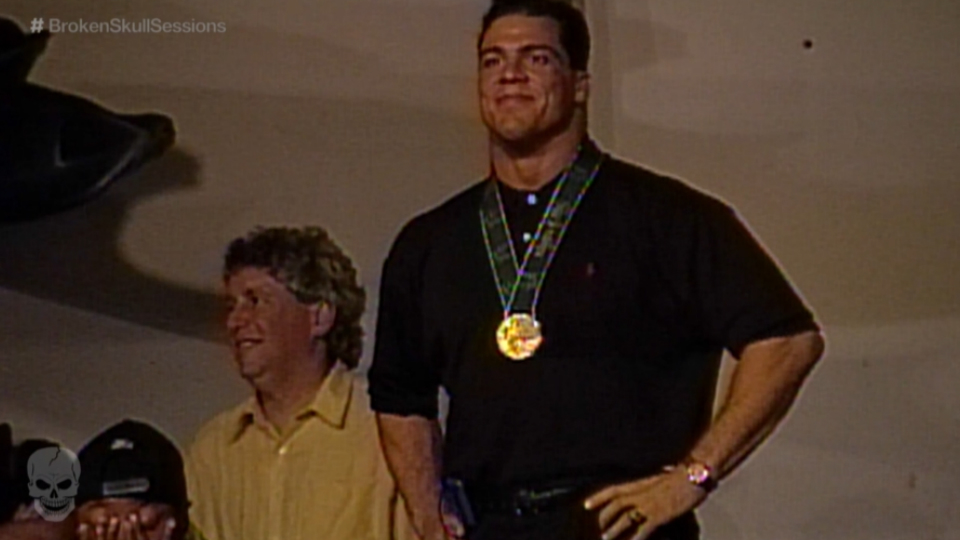
Kurt Angle’s rise from amateur standout to Olympic gold medalist to WWE Superstar was a journey marked by immense dedication, unmatched skill, and a willingness to sacrifice everything for success. Born in 1968, Angle was outstanding at amateur level, rising to prominence during his time at Clarion University of Pennsylvania.
His impressive wrestling accomplishments paved the way for his eventual success on the world stage in front of the brightest lights the level affords - the Olympic Games. He won gold in freestyle wrestling in Atlanta in 1996, despite suffering a serious neck injury - or "broken freakin' neck" - just days before the event.
His tenacity in the face of adversity became the defining characteristic of his career, and it resonated with fans across the world. Winning gold in Atlanta made Angle a household name, but it also introduced him to a new world when faced with the difficult next step career-wise - professional wrestling.
The transition wasn’t easy nor immediate, and away from his own trepidations, his first experience almost scared him away for good.
Looking to explore any potential post-Olympic career paths, Angle accepted the invitation of Paul Heyman, ECW’s mastermind promoter and booker to attend a taping at the fabled ECW Arena in October 1996. It was an earnest attempt to lure him there before the big boys got a look, not least because Extreme Championship Wrestling was far more forward-looking than both majors when it came to in-ring action.
That wasn't Angle's takeaway by the end of the night. One of the segments on that show became one of the most controversial moments in ECW history - the “crucifixion" angle that played out as part of the intense storyline involving Raven and The Sandman. Raven and his flock ambushed Sandman after a match, beat him down and proceeded to tie him to a large wooden cross using barbed wire, arms outstretched in a posture unmistakably resembling Jesus Christ on the cross. To make the religious symbolism even more overt, a crown of barbed wire was placed on Sandman’s head.
Even the raucous live crowd - known for embracing ECW’s wildest antics - fell eerily silent, unsure how to react. Backstage, Angle was furious. A devout Christian, he was deeply offended by the imagery and the blatant use of religious iconography for shock value.
Reports from the time say that Angle confronted Paul Heyman and others behind the scenes to make it crystal clear that he did not want to be associated with what had just transpired. He demanded that ECW never air the footage of his smile-and-wave appearance from the same night, fearing the blowback of an association with such an angle damaging his reputation, particularly given his wholesome image as an Olympic hero in the aftermath of Atlanta.
As it turned out, the newcomer had accurately gauged the temperature - in response to the backlash, Raven later issued an apology to the audience in the building, and the angle was removed from general circulation too.
The cold reality of something getting out-of-hand and being infinitely more fascinating than anything that actually took place on camera was nothing new to pro wrestling, but it was brand new to an amateur that already didn't exactly have the requisite respect for what the business could be when it wasn't accidentally eating itself from the inside.
Ironically, in real life, Sandman constructed the cross himself, highlighting how important cooperation and teamwork was for any endeavour to work in the industry. What might have been something of a PR disaster with the cameras rolling was just another collaborative production behind-the-scenes. On more than one occasion in the future, Angle would have to fight for real to prove his credentials in the worked world, but in the preparation stages, this had been anything but an internal battle. In multiple respects, it couldn't have been a worse glimpse into the world the Olympian would one day go on to excel in.
It was a weird first step, but if nothing else revealed that he had decent instincts for what made sense for him in the pro-wrestling space. He'd be brought back into Heyman's orbit in a way neither man could have imagined - by then, he'd shocked and delighted the world in a manner even more spectacular and unexpected than during his Olympic peak.
(CONT'D...)