Brock Lesnar vs. Kurt Angle | Tales From Backstage
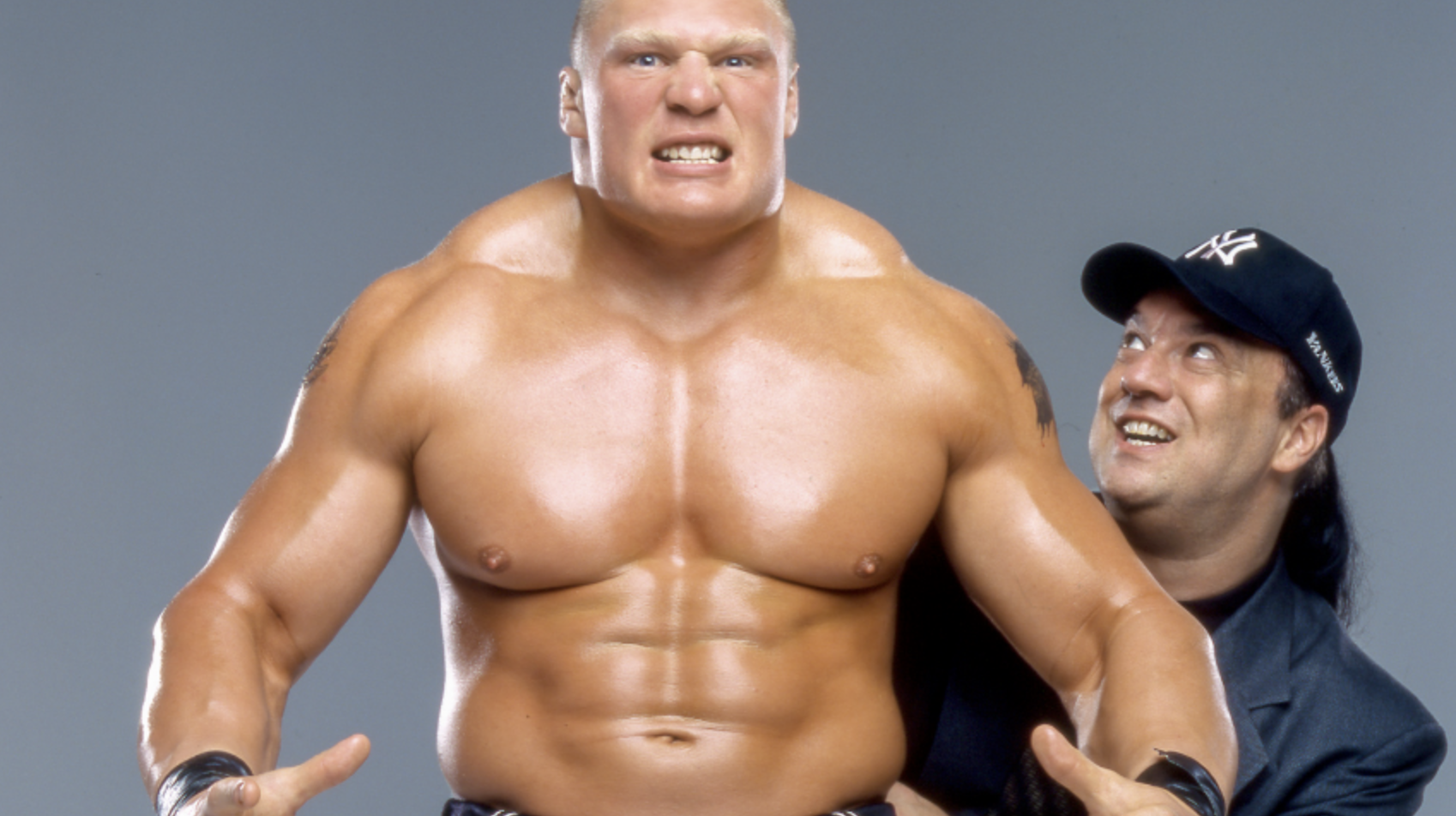
A glimmer of hope for WWE to break out of a barren creative period could be found being carried across the broad shoulders of an ex-amateur that had been on Jim Ross' radar for years. Still the Executive Vice President Of Talent Relations and with mountains of respect from being the uncredited architect of the company's second boom period thanks to the crucial signings of Mick Foley, Steve Austin and Dwayne Johnson, Ross had tenure, universal respect and a keen eye for the next wave to come through. Lesnar was that wave.
'The Next Big Thing' was the talk long before it was made canon by his nickname. Ross had despatched Gerald Brisco to watch him long before Sports Entertainment would have even appealed as a career move for 'The Beast'. It was more shrewd business from JR, who understood that not everybody was going to be taken simply with the allure of a shiny gold belt. As he put it on the Wrestling Reality with Justin LaBar podcast at the time;
"Gerald Brisco had scouted Brock Lesnar for two years and recruited him so that Brock Lesnar would know that we were waiting for him, and we could have signed him a year earlier, but we made an agreement with his Head Coach in Minnesota that we would leave him alone because he wanted to come back to win a National Championship, which I thought was great. So we saved our money for that year, but we ponied it up because we knew we were going to get him the following year. He was motivated by the dollar, he wasn’t a wrestling fan but he kind of thought that the lifestyle - guys like me and you may not have the benefits that Brock Lesnar gets, but if I could be Brock Lesnar, I’m in. I’ll take that deal, but the roster was big and we looked at it, and I always said that the key element, or trait for any talent that I ever signed was reliability."
Born in 1977 in South Dakota, Lesnar had always been an exceptional athlete, excelling in multiple sports, including football and wrestling thanks to his natural aptitude and exceptional and obvious strength. His standout achievement came in college wrestling, where he dominated at the University of Minnesota, winning the NCAA Division I Heavyweight Championship in 2000.
A multi-tool player, Lesnar’s size, power, and speed made him a formidable competitor, but experts in the field all noted that it was was his raw athleticism that set him apart from other amateur wrestlers. Thanks to the hard work of Ross and Brisco, when both sides could agree on the timing, Lesnar was ready to go pro via what was by then the company's chief feeder league - Ohio Valley Wrestling.
In OVW, Brock quickly became known as a once-in-a-generation pro wrestling athlete too. He was a physical specimen, standing at 6'3", weighing 280lbs of granite muscle, yet he moved with the speed and agility of someone far lighter. His shooting star press beggared belief, earning the turn-of-the-century version of virality amongst wrestling fans when it became globally accessible from Napster-adjacent places alongside clips of the first ever Van Terminator and Sid's horrific WCW Sin leg break.
The comparison with the latter would one day cut a little too close to the bone, but more on that later. In the heady early days, it was just another case of prodigious talent making the impossible probably. It was impossible as a fan not to immediately recognise his potential, and in March 2002 one night removed from WrestleMania, Brock made his debut on WWE television.
From the moment he arrived, it was clear that WWE had big plans for the prodigious powerhouse. Midway through a Hardcore Title melee featuring Al Snow, Maven and Spike Dudley, Lesnar stepped into the ring as if from nowhere, and - without a word - easily brutalised all three. Lesnar picked Snow up effortlessly and delivered a brutal spinebuster onto a trash can, sending a clear message that he was a force to be reckoned with with his very first move.
Lesnar unleashed a move that would soon be known as the F5 onto Maven, sending him Maven crashing to the mat. The rampage didn't end there. Spike Dudley, uniquely emboldened by the sight of his fellow opponents being destroyed, tried to make a move against Lesnar, but it was futile. 'The runt of the litter' snapped a broom handle across Lesnar’s head and chest, but it had no effect whatsoever on the powerhouse. Instead, Brock trucked him a video game-like lariat before launching Spike into the air with a jaw-dropping triple powerbomb.
Each impact sent shockwaves through the ring, leaving Spike incapacitated. On commentary, Jim Ross and Jerry Lawler noted with disgust and shock respectively that Paul Heyman was by Lesnar's side, barking instructions and very much in the ear of Raw's new clear and present danger. This was as key to the early success of the push as anything else Lesnar had in his arsenal - few managers had Heyman's credibility by 2002, so much so that the former ECW boss branded himself as an "agent" (before he was an "advocate" or "Wiseman", keeping a running theme of avoiding the M-word WWE seemed to want to move away from) to further distance himself from the chasing pack.
Within months, Lesnar became a central figure in WWE’s programming, and by SummerSlam 2002, he was King Of The Ring winner fresh off of bloodying Hulk Hogan out of the door and believably pitched as new WWE Champion following a win over The Rock. The victory was a testament to the newcomers's extraordinary (and extraordinarily believable) abilities.
At just 25, he was already one of the most dominant forces in the industry. What made Brock’s rise even more impressive and eye-catching was how quickly he adapted to the entertainment side of professional wrestling, blending his real-life toughness with WWE’s increasingly warped version of reality on-screen. He was one of the few remaining cases in the company of the "real self with the volume turned up" mentality actually working, and the 'Next Big Thing' moniker wasn’t just a marketing gimmick - it reflected the genuine belief in Brock’s potential to carry WWE out of its glum present and into a brighter, fresher future. By the end of the calendar year, he'd achieved more in his short time on WWE's main roster than many wrestlers do with an entire career.
His once-in-a-generation/lifetime skillset trumped everything else, and audiences were becoming as enamoured with his energy, his dominance, and his undeniable potential as his bosses. Brock’s rise created a much-needed narrative of there being some new blood coming in to challenge the status quo too. Great if it meant booting Triple H and The Undertaker out of their spots, but all eyes turned to a pairing that should have been more obvious from the off.
Somebody else had brought with him a similar CV, a similar skillset, and a similar meteoric rise. And he was, by this time, one of the few pillars staying firm around crumbling foundations.
(CONT'D...)