How Good Was Kurt Angle Actually?
In-Ring Ability
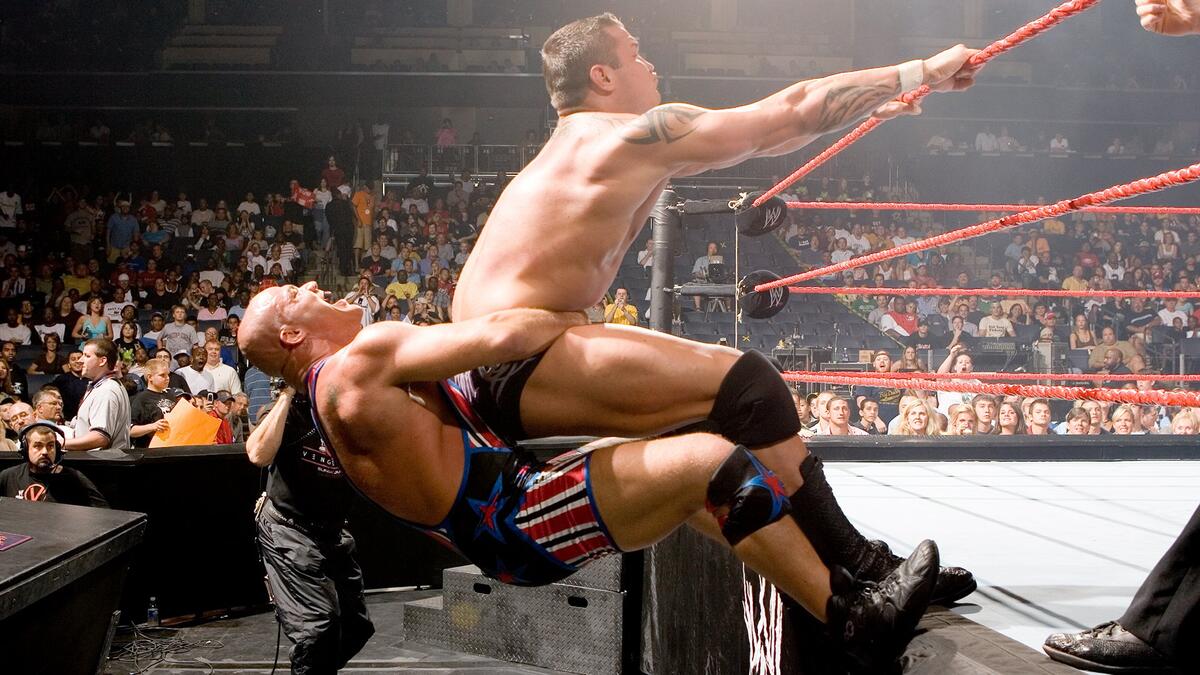
Kurt Angle was evidently a brilliant pro wrestler bell-to-bell. Capable of frenzied big-bumping main event epics and, when matched with the right opponent (e.g. Desmond Wolfe), a more understated chess match, Angle also excelled at the ultra-violent sprint. This is a major strength of his ‘G.O.A.T.’ case. A lot of wrestlers can and have put on lengthy, back-and-forth clinics. Few have convincingly attempted murder in a short, sickening burst like the resourceful Angle did to Roderick Strong on SmackDown in January 2005. Angle combined perfect mechanical form with gruesome violence and intensity. His best matches fuelled fans with pure bloodlust. His facial expressions were so powerful that you genuinely believed he wanted to injure his opponents. Angle was one of the most believable wrestlers ever.
Some of the more suspicious hardcore fans of the day weren’t quite so high on Angle’s work. They reckoned Angle’s matches were poor in psychology, that they lacked cause-and-effect, that he indulged in near-fall spam to a repetitive, numbing extent.
Angle’s work did not always make sense, even in the context of a medium where so little does. Do you fall down and pop right back up after getting punched in the face? Do you refuse to put your hands up so that the fans can enjoy you getting hit?
No - but there’s an internal logic to the illogical, and Angle did not always adhere to it.
The most obvious example here is Angle’s constant, failed attempts to execute a German suplex from the apron to the outside. He never did hit it, but spent years and years trying. The tension and purpose of this spot was nonexistent. Angle looked like a fool and a carny doing (or rather not doing) this signature spot. It was a transparent attempt to generate a few frightened gasps with zero intention of a payoff. It was a deflating experience and nonsensical thing to keep going back to. None of his opponents looked especially spirited for getting out of it, when all of them managed.
Angle’s famous missed moonsault spot was similarly flawed. It generated a reaction, particularly when he was crazed enough to do it off a cage, but he really could have done with landing it more often. That way, the miss might have enhanced the drama of the momentum shift. Instead, for a supposed technical genius, it just scanned as poor decision-making - a painful and dumb way of grabbing a cheap pop.
These criticisms extended to the structure of his matches. Some fans bemoaned that Angle did not build towards his ankle lock in the same manner as Bret Hart would, when weakening his opponent before applying the Sharpshooter. The 2000s message board critics also pointed out that Angle would burst too quickly into life as he sprinted up the turnbuckles to deliver his avalanche belly-to-belly suplex.
The counterargument here is that it was almost in-character for Angle to wrestle the way he did. Angle was both a great wrestler and an utter buffoon. ‘Intelligence’ was one of his three ‘I’s - but he was a blowhard.
He applied his character to the ring. He was prone to wild shifts in mood and embarrassed outbursts. He was never portrayed as a calculated, sly technician - he was just very much capable of executing his stuff flawlessly.
Angle was a deluded, hot-headed maniac. That was the thrust of his comedic approach. Doesn’t it make sense, then, that he would make stupid decisions and insist that he could do things - like the apron German suplex - even though he couldn’t? This is a different way of looking at it - but one that doesn’t explain his TNA run, in which his buffoonery was scaled back. But on the ankle lock: Angle was, in character, a volatile guy. It isn’t too much of a reach to suggest that a sudden attempt to break his opponent’s ankle without first working it over was something he’d logically do. Angle was pure instinct - you can’t plan strategy in your head if you lose it as often as he did.
Angle made poor decisions in the ring, some of which were galling and predictable the more often he did them - but perhaps the idea that he was bad or unintelligent fails to factor in the fictional character he was portraying. Angle very famously won a gold medal with a broken freakin’ neck. He was more fit and athletic than anybody else with an unparalleled tolerance for pain. His character justified those intense bursts of adrenaline.
Circling back to the question mentioned in the intro: does Kurt Angle have a legitimate claim to a “five star match”?
This, obviously, is subjective - but his match against Shawn Michaels at WrestleMania 21 was a bonafide classic.
Angle was incredible on the night, a lunatic in his pursuit to prove himself better than Shawn Michaels. This match best captured the idea of Kurt Angle as a wild animal. In one incredible story beat, Michaels dropped Angle with a desperation Sweet Chin Music. Shawn, who had been utterly annihilated after initially out-wrestling and pissing Angle off, was almost afraid to make the cover in case Angle noticed. Shawn draped his arm gently over Angle’s shoulder as if he were a tiger capable of ripping him to shreds with one last wounded, vulnerable attack.
The wall of noise during the famous climactic stretch, where it felt in the moment like Shawn’s ankle ligaments were about to snap, was deafening. It’s funny: Shawn Michaels spent his entire second chapter trying to convince the fans that his back was about to give out, but he never looked closer to being retired than on April 3, 2005.
Beyond that, Angle has the apparently unfortunate distinction of wrestling countless incredible matches that weren’t quite the very best of all-time.
No Dave fivers, but there aren’t many who have wrestled more fours. Before his system got out of control, Meltzer was just about fair.