The Secret History Of WWE’s Ruthless Aggression Era | Wrestling Timelines
July 22, 2008 - The End
Drawing to a close to the so-called Ruthless Aggression Era, a new era begins when WWE formally reclassifies itself. WWE is now “PG”. Again, there is no formal change to the format of WWE television. Authority figures still preside over the narrative; long promo segments continue to open the show; the matches, many of which are booked on an impromptu basis, are still worked in an increasingly generic style. The tone is very different, in an enforced way. WWE is no longer seeking to titillate the audience and distract them with vile, grabby material. Sponsors don’t like it, and that’s where the money is. WWE is about to enter an actual new era on the business side of things; through this new initiative of procuring big money sponsors, in a few years, corporate-driven revenue streams will outdraw the money generated by the fans. The tone of WWE television is pathetic, childish. You can scarcely believe even children find it amusing.
July 22, 2008 is a Tuesday. What is the state of play in WWE as ‘Ruthless Aggression’ comes to an end?
On July 20, WWE presents the Great American Bash from Uniondale, New York. As a show, it’s decent at best - elevated massively by another chapter of the superb Chris Jericho Vs. Shawn Michaels rivalry. Elsewhere, the idea that the WWE main event scene is there for the taking, if you display sufficient Ruthless Aggression, evaporates. CM Punk is the World Heavyweight champion, but doesn’t exactly feel like it. A glorified upper midcarder, he goes to a double disqualification draw with Batista. Why does Punk have the belt, when WWE doesn’t really want him to beat anybody?
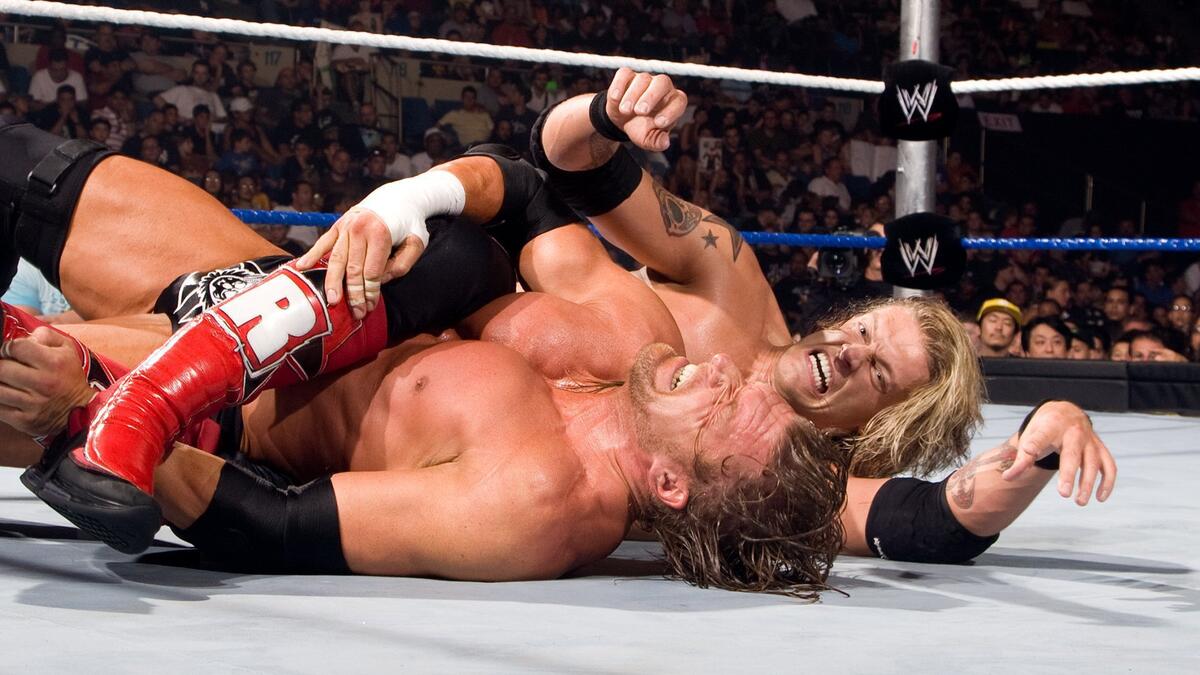
The main event is thoroughly - conspicuously - pointless. It’s Triple H Vs. Edge, and guess who wins?
It is hardly a classic; mirroring Unforgiven ‘04, the main event is a match of two halves. The first is boring; the second is a wildly overbooked extension of the Edge/Alicia Fox/Vickie Guerrero love triangle. Triple H wins after Edge inadvertently spears Vickie, capitalising on Edge’s shock to blast him with the Pedigree. The key thing about this match is that it doesn’t need to happen - certainly not on a B-level pay-per-view. It’s one of the few WrestleMania-sized first time meetings WWE has left. (A singles encounter between the two men had taken place on Raw, but this was before Edge made it as a bonafide main event performer).
You could easily argue that WWE is acting too hastily here. At WrestleMania the following year, Triple H works Randy Orton in the main event in what is a woefully uninspired and overdone pairing, as John Cena takes on the Big Show and Edge in a Triple Threat. These are matches you would not be remotely surprised to see on a No Mercy-style event.
So why does Edge Vs. Triple H happen at the Bash?
The generous take is that WWE feels they need a big match, and believes there is plenty of time to build something even bigger for WrestleMania 25. The cynical take is that Triple H sees Edge as a political threat. The fans love to hate this version of Edge, who is an entertainment machine in the top heel role. This has to be at least big enough for SummerSlam, which is scheduled for the very next month. Is it too conspiratorial to suggest that Triple H, using his creative leverage, wants to position Edge as a mere B+ player?
You could say, yes, that is the ranting of a “smark” - but then, Triple H himself will later state on TV that Edge (and Chris Jericho and Rob Van Dam) was never a top guy. This is in character, but Authority-era Triple H is basically a barely fictionalised extension of Paul Levesque.
John Cena is still, unmistakably, the biggest star in WWE. By 2008, the Reign of Terror has long subsided. Triple H is actually significantly better in the ring during the latter half of the decade than he was in the early 2000s. Still, this idea of a new era is not the reality. It’s not complete fantasy, either, but the years between 2002 and 2008 are as much a Triple H vanity project as a youth movement. Who is the top heel in 2002, and who is the top babyface in 2008?
The King of Kings. The Game. The Cerebral Assassin.
Ruthless Aggression was something Vince McMahon said for a few weeks. It’s the strangest name for an ‘era’ imaginable - or is it? Are most of these designations flawed?
‘PG’ makes sense, to a degree. The feel of the product changes, at least - but what really is the ‘Reality Era’, which supposedly runs between 2014 and 2016? Is the Authority so different from the other McMahon-led alliances? This stuff was premised all along on the idea that they were playing themselves and interfering with your favourite wrestlers. There is nothing realistic about WWE between 2014 and 2016, either. The same invisible camera-driven idiot plots are still in play. Is 2014-2016 classified as ‘Reality’ - a consensus that has made it to Wikipedia - because fans recognised improvements in the product and wished to make it clear that it was better than the dreaded PG Era?
WWE itself billed 2016 as a ‘New Era’, which stuck. Wikipedia also reflects this “change”, but again: what did change? Shane has not been around for a while, but a McMahon acting as an authority figure is, definitionally, not remotely new. SmackDown resembles its own show with a different, almost remarkably feel-good identity for much of 2016, but it doesn’t last.
The Pandemic Era is its own thing, but not through some carefully considered strategy. It was obviously thrust upon WWE.
Ruthless Aggression did not really happen because WWE didn’t change during or since, to a truly significant extent, until Paul Levesque grabbed the pen. Today’s WWE is still distinctly WWE, but there’s a less asinine and more sophisticated quality to it. The brand of melodrama; the vastly improved production; the dignity afforded to wrestlers jumping from other promotions; the genuine attempt at fan-friendly, long-term storytelling: it is a new era. It just took a long time following the days of Attitude to arrive at it. It is more accurate to describe 1999-2008 as the TV-14 era. Everything between 2008 and 2022?
Vince’s Egotistical, Counterproductive Brain-Rot is not snappy, but very accurate.