10 Strangest Justice League Villains Of All Time
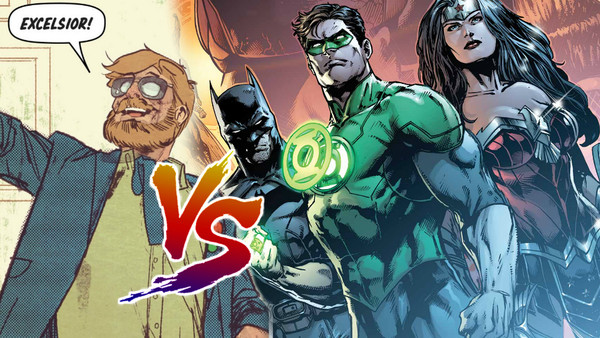
Stan Lee... vs the Justice League?!
Being one of the oldest superhero teams since comics began, the Justice League have had their fair share of beloved and fantastic villains.
They've also had their fair share of absolute weirdos, and the latter team really deserve more focus than they get - in no small part because some of the weirdest and wildest villains are also the most diverse, which is something comics could often do with an extra heaping dose of.
While not every villain can be a God-like woman who only hypothetically exists, or a man who can summon tiny panthers, having these completely surreal characters pop up every now and then works as a kind of comics palette cleanser, as the overload of conventional bad guys is balanced out by the blaring weirdness of these unorthodox lawbreakers.
They're unlikely to feature in any film adaptation, and there's little to zero chance of them featuring in newer comics aside from as a complete joke character. But, in this way, weird Justice League villains are a bizarre little treat for the comics community, where a man with a lock for a head is just another unsurprising dude.
10. Toyman

While the Toyman isn't the worst idea for a villain ever, there's something more than slightly uncanny about the kind of bad guy that belongs more in a kid's cartoon than any kind of legitimate supervillain. The fact that writers seem split between making the Toyman a well-meaning man made villain out of unfortunate circumstances, or the single most sinister figure in the entire of DC's lineup, only makes everything all the more confusing.
For example, initially you learn that one of the definitive events of the Toymaker's life was the death of his wife, Mary, in a tragic car accident. After making you develop a genuine level of sympathy for the odd man, it is then summarily revealed that said 'wife' was in fact an android that the Toymaker had designed and created to behave like he had a wife, and who had had then convinced himself was totally real.
With events like these being a dime a dozen around the Toyman, you'd be forgiven for tensing ever so slightly every time he appears on page.
9. SuperMan
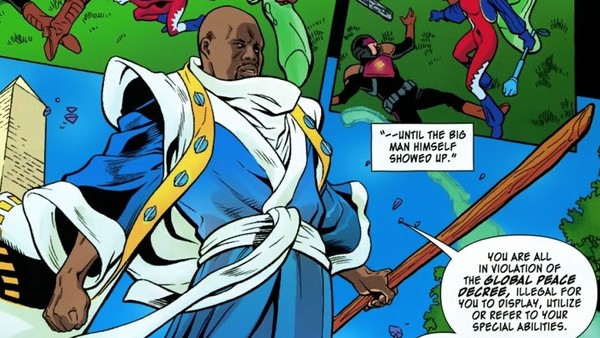
So, bear with us on this one. Harvey Dent - as in, not the Harvey Dent that is Two-Face, but a different universe's that looks nothing like him - is, in said universe, a villain known as SuperMan - but, no, not Superman as we know him, as this one is a powerful psychic who wears a Jedi-style robe.
The decision to use these names has two explanations, ranging between weird, and weird and immoral. Either the people designing the character felt that familiar names would make readers warm to the character, which doesn't quite make sense, or otherwise they thought they could sell a couple extra issues through innocent family members trying to buy 'a Superman comic' for their beloved comic nerd.
Either way, it totally ruins what could have been a decent villain, as the whole thing is so confusing it totally takes you out of the flow of the comic. Which is a waste of sweet robes, if nothing else.
8. The Hypothetical Woman
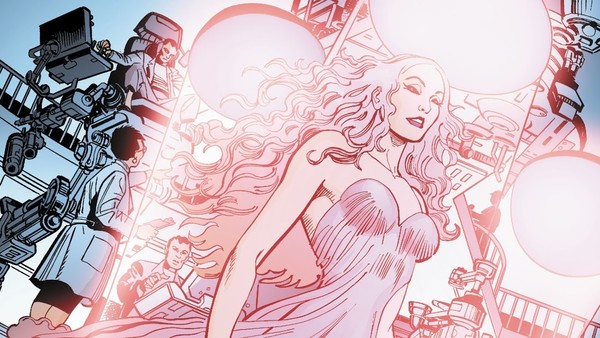
Leader of the Hypothetical Army, and Captain of the world's dumbest names to ever feature in a comic, The Hypothetical Woman is proof that sometimes people do just use a random word generator to create some of their character names.
The Hypothetical Woman exists in maybe the single weirdest comic of the entire JLA: Classified series, which goes through miniature Starros, murderous dictators, and just a healthy dose of human experimentation. Of this, The Hypothetical Woman is the most interesting aspect - hence why the storyline is named after her - as she is essentially able to create superhero by bestowing them with powers.
For the majority of her time in the comic, Sybil is held in stasis, only appearing to the unconscious soldiers she gives powers to in their dreams. In fact, the same issue that The Hypothetical Woman is freed from her prison, she is also killed by the aforementioned dictator, proving that sometimes napping is better for you than confronting the world.
7. Menagerie Man

Take a man in a skintight purple leotard, paint an M on his chest, and add a leopard print toga. Seem ridiculous? Then you've successfully imagined the Menagerie Man's outfit.
Because this clearly didn't make him silly enough, the Menagerie Man's powers involve using a dwarfstar to shrink animals, and then train the tiny beasts to serve him. Does this plan make any sense? No! Does it seem like the single most ineffective use of being able to control a dwarfstar? Entirely.
But that doesn't stop the Menagerie Man from trying his best at that whole 'evil scheme' thing. For a man with a completely nonsensical power and plan, the villain is actually beat up far less than a lot of conventional supervillains - largely due to his ability to teleport, which is never given a solid contextual reason aside from its convenience.
If anyone ever tells you that comics nowadays are in a downward spiral, it might be worth showing them the Menagerie Man - just to remind them of what they have clearly repressed.
6. David Graves

David Graves is an unusual figure because, as much as you feel for him and the unknown sickness that claims his family, him blaming the Justice League for not saving them seems pretty harsh - because there are some things that superheroes really should be leaving to trained medical professionals.
It's also super weird to have his backstory, as we are left with the knowledge that one of the Justice League's more imposing villains is a fringe historian and writer, which doesn't quite strike fear into your heart the same.
This is made doubly true by the fact that Grave's most successful books actually cover the history of the Justice League themselves, such as his most famous work, the vaguely familiar sounding 'Justice League: Gods Among Men'.
As much as it's clear that people would be interested in the superheroes, it's totally surreal to find out that one of their enemies used to spend his nine to five shift writing every detail about them he could find. Is David Graves essentially a fanboy gone wrong? For now, there's no definitive answer - only a lot of questionable details.
5. Funky Flashman

If the fact that the Funky Flashman has existed since 1972 without anyone ever seemingly even considering renaming him, you are either in a very dark place, or his creator, Jack Kirby - or possibly both.
Flashman is supposedly Kirby's satirical representation of Stan Lee after the pair's bitter split, which may serve to explain the sheer effort that appears to have gone into making the Funky Flashman as cowardly and unlikable as he is. Flashman carries out a series of weird and questionable schemes to get cash - such as when he becomes the public relations officer for the Secret Society of Supervillains - and pretty much spends his every waking moment scheming, plotting, and otherwise being a seedy character.
Given the price of therapy, the creation of the Funky Flashman may have been the easiest way for Jack Kirby to get out all of that inner rage, even if it accidentally resulted in the world's weirdest and most unnecessary character.
4. Lord Manga
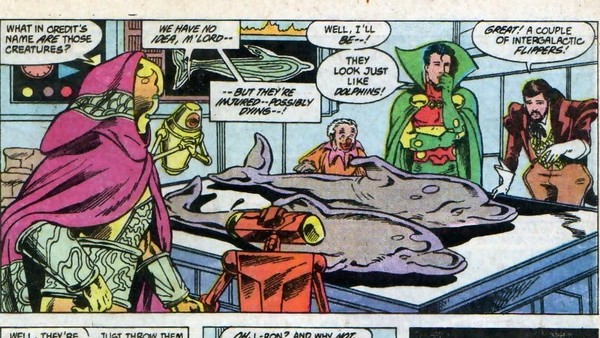
Lord Manga could be the single most dynamic, empathetic villain, featured in exclusively only the best comics, and it'd still be absolutely impossible to overlook the fact that his name is Lord Manga.
It's not even because of the often super sketchy details of many manga to date, but rather that the name makes literally zero sense. The actual translation of the word manga in Japanese means comic, so - all context towards anything else people associate the word manga with - the villain's name literally means 'Lord Comic', which is weird and confusing on an entire staircase of different levels.
Going stranger still, the only details we ever really learn about him are in regards to his weird romance with his robot workers, named L-Ron and J-Lo - robots named after the male science fiction writer L. Ron Hubbard, and famous actress Jennifer Lopez, respectively.
As progressive as it was to have Manga have romantic sub-plots with male and female figures, it doesn't seem insane of think that maybe this kind of progression could have been saved for literally anyone but the weird guy who wants to sleep with his robots.
3. The Key

The Key is a villain who started life out with a lock for a head and a giant key for a weapon, and against all the odds, managed to get only weirder from there.
The issue with The Key for DC was that, despite the fact he was a completely weird villain who exclusively used key-based objects as weapons, he was actually pretty popular with readers, and was one of the older long-term enemies of the Justice League. As such, in 1997 DC tried to 'fix' the character, by changing him from a human-esque figure with a lock for a face, to a straight up ghoulish looking person taken exclusively from your nightmares.
At what point exactly DC decided that the key-based villain clearly deserved a horror reboot is unknown, but at least they kept his character in tact - as seen when one of his most detailed plans involves him trying to get Batman to kill him.
2. The Aryan Brigade
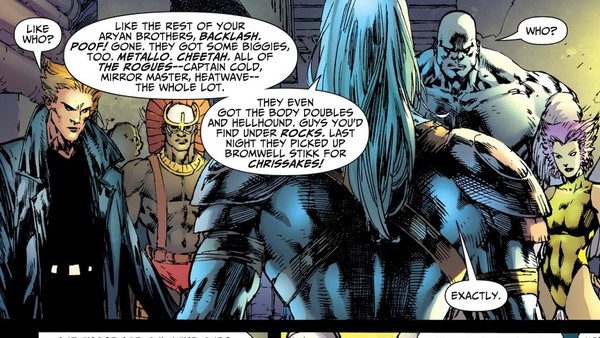
Exactly why DC felt the need to have a superpowered bunch of white nationalists feature in their comic is anyone's guess, but it likely has the same vague reasoning as why Nazis show up so commonly as comic villains - in that it's really, really easy to make a character the audience will hate if they're allied with real evil organisations.
That said, some of the Aryan Brigade's members are likely to raise more than a few eyebrows. Take, for example, Blind Faith, whose details go as far as the fact she is blind, is a telepath, and is also a monumental racist, which makes for an incredibly vague description that also feels like it tells us way too much.
In brighter news though, any Key fans will be thrilled to hear that he serves as the leader of this faction, significantly increasing the number of comics featuring him - but then also making him a huge racist, which is likely to break the heart of the roughly three people who know who he even is.
1. Tattooed Man
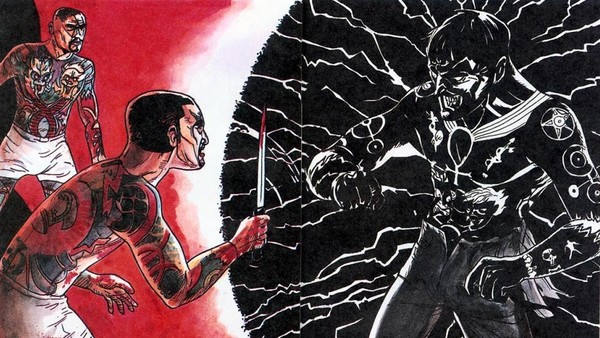
By all means, the Tattooed Man should in no way be as weird - and as terrifying- as he manages to be in his various features in comics.
While the power of having tattoos doesn't initially sound all that impressive, Richards' skin is actually tattooed via a process he calls 'sin-grafting', where he takes the sins of someone he has just killed, and makes them into a mark upon his skin, which supposedly both serves to redeem his victim, and give him powers based on the image. It manages to creep out even the Justice League, which is a pretty good indicator of just how spooky Richards can be.
And all this doesn't even touch upon his own comic, as 'Skin Graft: The Tattooed Man' manages to be worlds of weirdness all on its own. The comic not only develops Tattooed Man's time after being caught by the Justice League, wherein he descends into outright madness.
For such a deceptively simple supervillain name, the Tattooed Man's history is endless and unnerving - which may explain why his Prime Earth version has seen minimal use.
DC Quiz: How Well Do You REALLY Know The Justice League?
