WWE Trades Ruthless Aggression For PG | Wrestling Timelines
January 8, 2013 | Fruity Pebbles
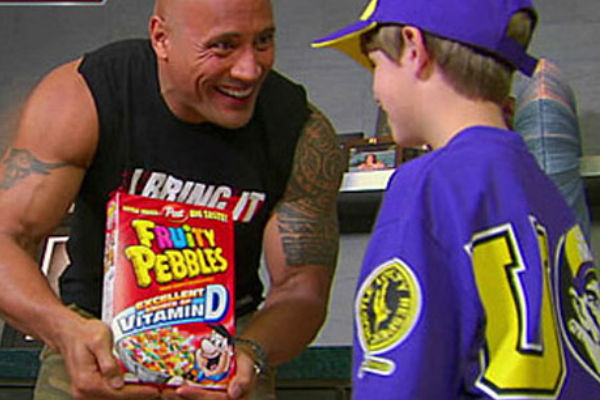
A line in a 2011 promo cut by the Rock, designed to mock John Cena’s garish array of merchandise, becomes a financially lucrative reality.
WWE initially struck a deal with Post Consumer Brands in 2012 for John Cena to appear at the top of Fruity Pebbles boxes. This is facilitated by WWE’s decades-long partnership with the Make A Wish Foundation, a non-profit organisation that helps make the dreams of terminally ill children come true. The charity’s branding also appears on the boxes.
Stephanie McMahon in her role as Chief Brand Officer will in 2015 infamously tweet “philanthropy is the future of marketing, it’s the way brands r going 2 win”. Obviously, WWE’s relationship with Make A Wish does WWE’s public image no harm whatsoever - but it should be stressed here that Cena holds the Guinness World Record for most wishes granted. He has gone above and beyond, not stopping at a far smaller number that would more than adequately position him as a good guy in the eyes of the public.
On January 8, 2013, WWE announces that, for a limited time, John Cena will replace Fred Flintstone on Fruity Pebbles boxes. This is not only a huge coup in and of itself. WWE is not merely attracting sponsors; the company’s marketing department is being very clever with it.
Cena’s name continues to penetrate the mainstream consciousness.
April 7, 2013 | John Cena Beats The Rock
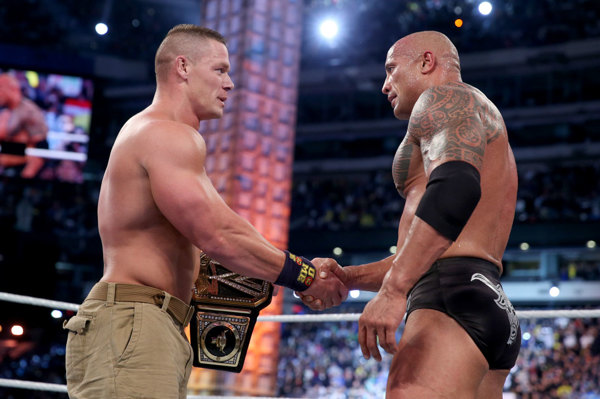
In the main event of WrestleMania 29, John Cena defeats the Rock.
The match doesn’t feel as big as the original, which headlined WrestleMania 28 on April 1, 2012, but the result is symbolic. John Cena is the face of WWE, and, in defeating the Rock, is ostensibly presented as the greatest WWE Superstar of all-time. WWE will not explicitly market Cena under that nickname for several more years, but that is the overarching idea. The match is leaner than the first, and the result feels like a political foregone conclusion.
Fans are irked that ‘Once In A Lifetime’ means nothing, a feeling pronounced on a night where WWE promotes another 2012 rematch in Triple H Vs. Brock Lesnar. WrestleMania 29 is familiar and uninspiring, premised on stars getting their wins back. While it feels like nothing changes on the show that is often sold on the idea of an era-defining title switch, Cena winning is big. He has defeated the Rock, but of more significance is the idea that PG has defeated the Attitude Era, that the old WWE no longer exists.
John Cena is known to wrestling fans as ‘Super Cena’. You can’t escape him. He beats everybody. He is the face of the company, and acts on television like their biggest fan. He is, by careful design and a relentless mega-push, synonymous with WWE. This is pivotal to WWE’s public image because he is squeaky-clean, adored by children, and a genuine hero in regards to his relationship with the Make A Wish Foundation.
WWE is now stigmatised as a lame show for kiddies. This is fine by them.
October 13, 2013 | The Payday
The initiative set out in May 2008 has worked, as evidenced by comments made by Michelle Wilson, WWE’s Chief Marketing Officer. Wilson points out that, in 2008, the year in which the move to PG and attendant strategy was launched, sponsorship revenue was $7.4 million. Now, in 2013, the number has almost tripled to $20 million annually. Wilson mentions that the Attitude Era “sold well” at the time, but there was a need to “get back to the multigenerational nature of our brand” in order to “bring on corporate partners” and “attract blue-chip partners”.
Nestlé, General Mills, Frito-Lay, and Kraft are cited as amongst the 20 blue-chip sponsors that WWE has attracted since 2008 and the last days of TV-14.
Many adults believe that John Cena is a hokey goofball who can’t sell and whose STF submission hold is a farce with no visible pressure applied. They hate him. Sponsors love him. Sponsors love him so much that Kraft puts his face on 72 million Capri Sun drinks cartons.
If you ever wondered why John Cena does not put over the likes of Dolph Ziggler, there’s your answer.
February 24, 2014 | The Network
WWE wants a massive TV rights fee, and while the company is bullish about that prospect, Vince McMahon does not want to rely on it. He hates the media, and always has. As he set out in 2008, he likes reaching his audience directly. His audience won’t attack him. He likes the echo chamber. He likes feeling like a massive genius. There’s also a significant monetary benefit of launching the WWE Network, a long-held dream with which he hopes to abandon the pay-per-view industry and their cut of the money forever.
The Network launches on February 24, 2014, to the delight of fans. Yes, the constant shilling is too much (the service cost just $9.99!). Yes, the original comedy and reality-based programming is not good. But fans get every pay-per-view, every episode of Raw and SmackDown in the archives, every historical pay-per-view. They can watch the near-definitive history of WCW chronologically. The more curious fans can even go further back in time and watch a generous if incomplete serving of some of the best and most influential wrestling TV ever booked in prime Mid-South Wrestling and Jim Crockett Promotions. There’s just one problem: there aren’t actually enough WWE fans globally to satisfy shareholder expectations. In January 2014, WWE stated its goal of drawing between 2-3 million domestic subscribers. That number was not reached even by the total combined global customers at any point.
WWE tried to tout its success to shareholders by disclosing the minutes-watched metric, but to reach that, by the late 2010s, even B-level pay-per-views often reach four hours and change. This dreary filler content deepens WWE’s woeful creative malaise.
By the time WWE shuttered the service, around 1,320,000 people had subscribed to it. Annually, this earned the company approximately $132 million per year. While this is not unimpressive, Brandon Thurston of Wrestlenomics evaluates in 2021 that “the Network…has not produced an obvious return on the investment”. Thurston cites astronomical start-up costs of $66 million, the overly generous $9.99 price point, and the cannibalisation of existing revenue streams as key to why the Network fell “well short” of expectations bandied to shareholders. Co-Presidents George Barrios and Michelle Wilson were terminated in January 2020 in a move widely thought to be scapegoating exercise.
The Network was not a disaster, but it was a failure, in that it was more prudent of WWE to migrate less of the content over to Peacock - thus saving themselves the operating costs - for which NBC paid WWE around $180 million per year in January 2021.
May 15, 2014 | Rights Fee Disappointment
The ultimate goal, of rebranding WWE as a sponsor-friendly operation ripe for lavish TV contracts, is not quite reached.
WWE reaches a deal with NBC Universal for its television rights fees. USA Network will carry Raw, while SyFy will screen SmackDown and Total Divas will be renewed on E!. WWE had hoped to double or even triple the fees paid under the terms of the existing deal. This does not happen, although the 2014 fee increase is at least considered “substantial”, per the May 26, 2014 issue of the Wrestling Observer Newsletter.
This is a poor deal. As Meltzer points out, a bullish WWE had internally discussed the fact that NASCAR - another franchise whose audience is stereotyped as low-income and poorly educated - bagged a mammoth fee of $820 million per year despite scoring slightly lower aggregate TV ratings than WWE. Major League Soccer, meanwhile, did not double nor even triple its fee; in going from $18 million to $90 million, the league quintupled it - despite a year-on-year ratings decline of 29%.
The stock market reacts as such; the WWE share price almost halves from $19.93 to $10.92 over the following days. This is a temporary blip that Vince, in an emergency public conference call, blames on the timing of the Network’s launch potentially diluting and undermining TV viewership.
As embarrassing as this is - so much so that WWE does not even publicise the final number, which Dave Meltzer estimates is in the region of $142.5 million per year - WWE is very much on track to achieve its stated 2008 goals. Perspective is not what WWE shareholders want in 2014, but as awful as the deal is in the context of the wider TV landscape, it’s impressive in the context of where WWE was in 2008. The company is now a sponsor-friendly enterprise almost totally devoid of controversy and the attendant stigma. The clean-up operation is complete. Outsiders no longer look at WWE and cover their nose at the stench of death; when they look at WWE, John Cena’s gurning face is beamed back at them.
In time, WWE will get there…
January 9, 2015 | Sufferin’ Succotash
At various points post-2008, the online wrestling fandom enters a process of bargaining.
They don’t like PG, they don’t like WWE, and will cling desperately onto every false dawn and give it a name. Even on Wikipedia, “new” phases of programming are listed under the ‘Reality Era’ and ‘New Era’ subsections of the ‘Company History’ section. The Authority faction’s 2014 run and the 2016 return of Shane McMahon are praised, and evidently considered the start of a new direction. This simply is not true.
The Reality Era is an almost ironic be-careful-what-you-wish-for designation, in that fans are crushed by the reality that lauded new workrate heroes Daniel Bryan and Cesaro are not going to become the next John Cena figures following WrestleMania 30. WWE’s new meta era of 2014, in which wrestling prevails over the heel sports entertainment empire, factually does not happen. The supposed ‘New’ era of 2016 is even more baffling, even more desperate. Shane McMahon returns and presides over SmackDown as a babyface authority figure. SmackDown, for a few critically acclaimed months, has a different production look and feel-good storytelling vibe. This, too, is crushed.
By May 2017, Jinder Mahal, presented as a jobber losing in three minutes three weeks beforehand, is the WWE Champion. That is because Vince wants to monetise the Indian market and does not even bother trying to make the fictional pretence remotely credible. Shane inevitably becomes a heel authority figure in early 2019.
Beyond that, the format of the shows does not change like it did in 1997. The show-opening promos; the authority figure-driven narrative; the constant trilogies that chomp through familiar pay-per-view cycles: there is no meaningful change at any point.
Nothing will change until Paul ‘Triple H’ Levesque takes over the creative process, in the wake of a disgraced Vince McMahon’s resignation, in the summer of 2022. This is underscored by the monster promotional push of Roman Reigns.
Cena is breaking down and Hollywood beckons. The very handsome Reigns is selected by Vince McMahon as his replacement. Reigns displayed much promise as the powerhouse of the Shield - a rare, awesome stable that is pushed huge by WWE and connects with the audience - but he is nowhere near ready, and a very jaded audience senses and dreads it.
He’s cocky and aloof, a natural heat magnet despite his explosive offence. He’s actually great in the ring, but his presentation outside of it is atrocious. Reigns struggles badly to bottle Cena’s goofy charisma in an infamously bad segment on the January 9, 2015 episode of SmackDown. In a promo battle with Seth Rollins, Roman says “You are a snivelling little suck-up sell-out full of sufferin’ succotash, son!”
Inordinately proud of the worst promo line ever, Roman turns to the hard camera and in a “I’m cool as hell, no big deal” moment borrowed from the Rock, says “Yeah yeah, I know, that was not easy to say!”
He then does a sort-of people’s eyebrow. In one run-killing moment, Roman becomes a John Cena clone trying to be the Rock. He is a lame industry plant. The fans despise him.
January 25, 2015 | #CancelWWENetwork
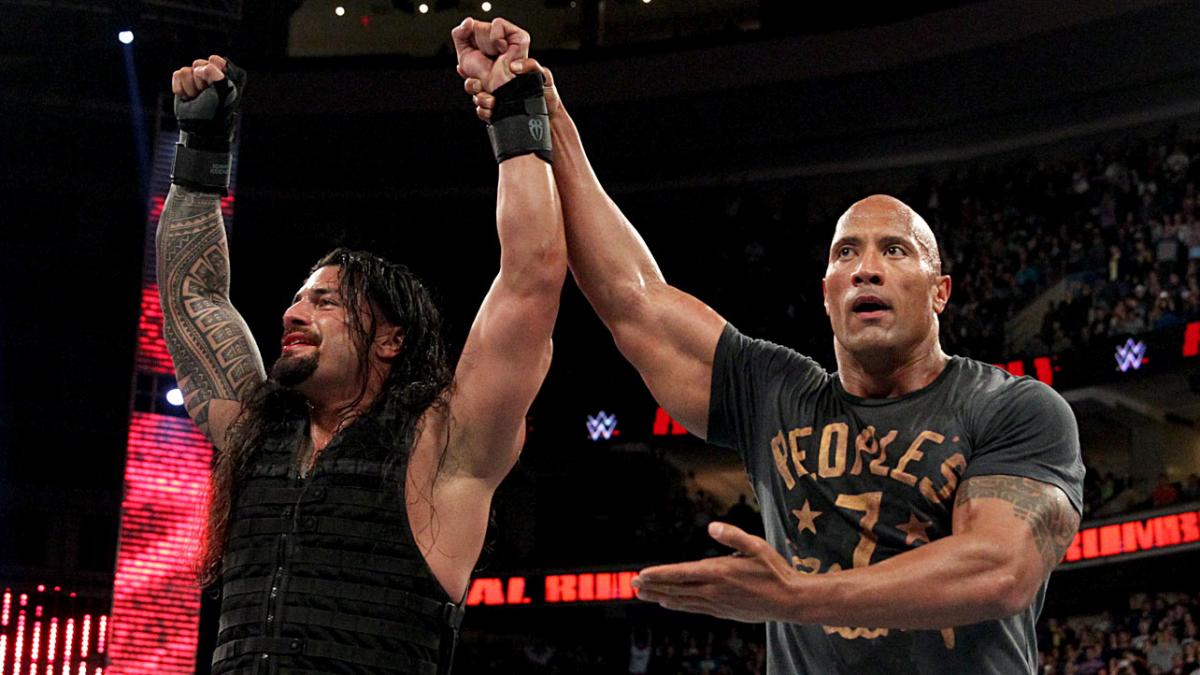
The lame industry plant that everybody despises wins the 2015 Royal Rumble match. This is one of the least well-received creative decisions ever, perhaps the least popular booking decision ever. Of all-time. In history.
Roman wins a match that is cynical in its layout to a darkly hilarious extent. He is portrayed as the best of the worst outcomes. A returning Daniel Bryan is eliminated within 10 minutes. The crowd turns, but they aren’t furious; the scene is too pathetic and expected for outrage. WWE fans have been here before. They vocally react with a collective and sustained groan that sounds like a chorus of vuvuzelas.
Kane and the Big Show dump out multiple cult favourites, among them Dolph Ziggler and Dean Ambrose, like they are rolled-up rugs thought too old and ragged for the house move. They are physically depicted as useless inanimate objects. The idea is that these fossils are so old and over-pushed that it will come as a relief when Roman dumps them out. WWE is aware that Roman is unpopular, but still promotes him to the main event of WrestleMania with a “Well, he’s better than Kane and the Big Show, isn’t he?” masterplan. In the aftermath, the hashtag #CancelWWENetwork trends worldwide to such an extent that Vince is questioned about it by a shareholder. He dismisses it, saying that a small vocal minority weren’t happy because “Santa Claus didn’t come on that pay-per-view” - even though he sort of did, since the next big babyface hero was primed to win the big one at WrestleMania.
Brandon Thurston of Wrestlenomics reckons this did in fact lower viewership. The fans aren’t just ranting online. The TV ratings on the road to WrestleMania 31 are in the worst pattern since 1996.
This sort of thing - i.e., a moment so awful that fans rage-quit in response - becomes a less-than-ideal theme of WWE’s late 2010s. Triple H winning Sting’s first-ever WWE match in 2015; Jinder’s WWE title win; a man winning the first-ever women’s Money In The Bank ladder match in 2017; a 2019 Hell In A Cell match ending via referee stoppage…
The product in the late 2010s is at its lowest creative ebb. WWE prevails regardless - but not necessarily as a result of the switch to PG…
February 23, 2015 | Give Divas a Chance

On the February 23, 2015 edition of WWE Raw, the Bella Twins defeat Paige and Emma in 30 seconds. Even by WWE’s increasingly hideous creative standards, this is an appalling finish; Emma goes to check on a blindsided Paige before Brie hits her with her finish. It barely qualifies as a distraction because the set-up for the Bella Buster takes several seconds, accounting for about 50% of the entire match. AJ Lee has seen enough.
AJ is one of the better women’s wrestlers. She has gained fan support even throughout short matches deliberately promoted as an afterthought. AJ, who was once told by high-ranking executive John Laurinaitis that nobody wants to have sex with her, has nothing to lose. She has one foot out of the door, and uses the other to give WWE a well overdue kicking.
In response to a tweet posted by Stephanie McMahon praising Patricia Arquette’s women’s rights-themed Oscar acceptance speech, AJ points out that female WWE independent contractors receive “a fraction of the wages & screen time of the majority of the male roster” despite selling record levels of merchandise and popping ratings. Twitter has seen enough, too; in the wake of this news story, the hashtag #GiveDivasAChance trends on Twitter.
It is a source of immense embarrassment that the so-called dumb hicks that make up the WWE audience are actually begging the company to be more progressive. Or at least, it should be.
It isn’t; the subsequent ‘Women’s Revolution’ - which basically entails WWE treating women like athletes, as opposed to a prompt to urinate before the main event - is reframed as an act of Stephanie McMahon’s benevolence.
WWE promoting the bare minimum equality as an ultra-progressive and kind act is almost beyond belief, but this is the bubble in which the promotion is permanently encased. As with much of the PG Era, it is humiliating but somehow, far more fruitful. WWE creates a foundation from which to sign former UFC megastar Ronda Rousey in a couple of years - a signing that many fans do not grasp the importance of.
September 1, 2017 | WWE’s Time Is Now
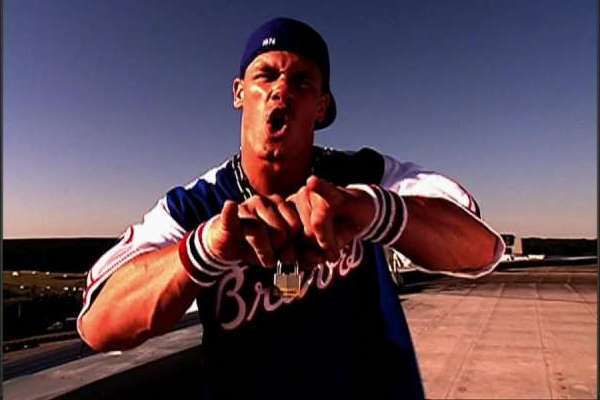
At this point, WWE’s public image is in a healthy enough position that a subversion has taken place: Toyota’s new ad for its 2018 Camry model features John Cena’s ‘My Time Is Now’ theme as its soundtrack. Later, Roman Reigns will appear in Toyota ads that air during SmackDown. Vince gets what he complained about in the media in 2005.
June 26, 2018 | The Worst Era Ever Works

At long last, the goal is reached. WWE secures an enormous rights fee, announced on June 26, 2018.
The beleaguered, desperate USA Network matches the highest offer made for WWE Raw in what, contrary to 2015, is an intense bidding war. USA will pay WWE a mammoth $265m per year for Raw. In a move that shocked even USA, FOX buys the rights for SmackDown, paying WWE $200m across a five-year deal for its stigmatised B-show. That is a billion dollar deal. In total, between Raw and SmackDown, WWE will earn $475 million per year. Dave Meltzer writes in the June 4, 2018 Observer that new signing Ronda Rousey is key to FOX’s faith in WWE. Is this really the successful result of a calculated, years-long marketing campaign? Or has WWE benefitted from the wider television landscape in such a way that the preceding decade might not have mattered all that much?
Of course, WWE is not getting this deal if it’s a toxic mess perceived to be responsible for brutal waves of non-stop death - but the move to PG (and the subsequent piles of cash earned by WWE) is not necessarily the result of causation.
The trend of cord-cutting - i.e., American homes dropping cable packages and opting instead for cheaper, ad-free streaming platforms like Netflix - terrifies the TV industry, which is facing a genuine existential threat. In April 2019, PCMag publishes a graph of net subscriber losses faced by the largest cable service providers that simplifies the alarming decline. In 2014, 125,000 people dropped cable. This number ballooned to 2,875,000 in 2018. Cable is too expensive, people watch stuff on their laptops and phones now, and there are no pesky ads on Netflix. The TV industry doesn't view ads as pesky, quite the opposite. Ads are the lifeblood of a dying medium. In response, the TV industry pays monstrous sums of money to the sports franchises that are a single shield against the encroaching enemy. Sports are “DVR-proof” because a game isn’t worth watching when it’s over. The thrill, the draw, is in the hope of a result turning your way in real time.
In 2018, streaming is the great unknown for sports. No established league has the appetite for risk, and this is quenched altogether by a frantic TV industry begging its last remaining draws to stay put.
This trend compounds a decline first initiated by the rise of the digital video recorder (DVR): a device that allows viewers to record their preferred content, watch it at a more convenient time, and skip the commercial break with the fast-forward function. Moreover, by the mid-to-late 2010s, Netflix is not merely the new, vastly more affordable outlet for licensed reruns, nor the video store replacement. Its critically acclaimed original programming is solidifying the platform as a sensation.
In years past, WWE needed television more than television needed WWE - which is why rights fees were so paltry, or why none were awarded at all under the ad revenue split model. Wrestling was a cheap product with no offseason. It wasn’t a huge asset; it’s more the case that it would be silly not to host WWE from time to time. The advantages just about outweighed the negatives.
Now, TV needs wrestling. True or not, and Dave Meltzer reckons that it is not, FOX is operating under the belief that, as a pseudo-sport, pro wrestling is “DVR-proof”. FOX - and later Warner, which backs the hot new upstart AEW - are now in a desperate enough position to resort to pro wrestling.
This is broadly how we’ve arrived at the insane paradox whereby WWE scores record, eye-watering profits at a time, 2019, where its product is so awful that it is ritually compared to WCW’s annus mirabilis of 2000. WWE is fundamentally broken, but prosperous to an unprecedented extent.