6 Backstage Wrestling Politicians Who Never Drew A Dime
Stars that literally weren’t worth the hassle: featuring Shawn Michaels and more…
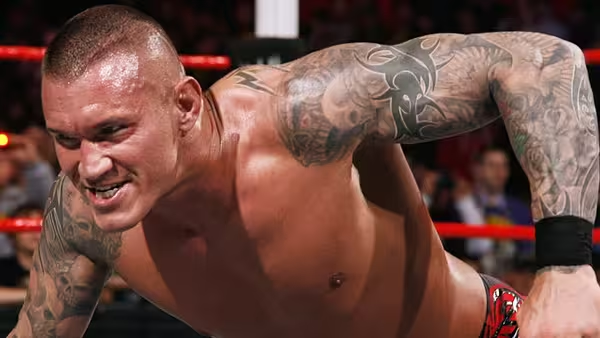
In the dark world of professional wrestling, and this is the case in the wider entertainment industry, there is a rule that is as unfair as it is cast-iron: if you are great, you can get away with virtually anything. Even former WWE owner Vince McMahon would surrender his self-appointed alpha status, if losing a power play meant making money.
You can be a difficult perfectionist. You can be an egomaniac. You can be unreliable. Sadly, in too many cases, you can be abusive. Provided you are a special talent capable of generating revenue and interest, you will still get pushed, even into the role of top star. In fact - mainly in years gone by, since there’s too much corporate money flooding into WWE and AEW for one pivotal star to act the big shot - the top star was always a politician. You had to be. If you weren’t good enough at acting in your best interests, you got screwed. Look at Bret Hart.
Hulk Hogan was a politician. He was smart enough to know that he could not outright bury everybody he perceived to be a threat, but he found many clever, insidious ways, like the time he treated the Ultimate Warrior’s win over him as a cruel act of God. Hogan was blunt with it on occasion, too. He once no-sold Vader’s finish and cast Ric Flair as one eighth of the Dungeon of Doom, just to let everybody know who was running wild in WCW, Jack.
Steve Austin spared some of his peers the embarrassment, mainly because he was too smart and or paranoid to work with Marc Mero and Jeff Jarrett in the first place. Austin did think better of passing the title directly to Triple H at SummerSlam 1999. Triple H spent every subsequent second of his career playing the kicked cat.
Chris Jericho was clever in AEW. When he reached a point at which a second World title reign was never going to go down well, he repackaged himself as a main event gatekeeper. He legitimised AEW - genuinely - so it was up to him to do the same for the talent. Jericho was the guy a wrestler had to beat to prove themselves worthy of the breakthrough. If they weren’t, Jericho could point to the fact that he wasn’t the booker, and when they didn’t, it was time to try again - ensuring that Jericho, not the opponents he “put over”, made it to the next pay-per-view cycle. Chris Jericho’s old ‘Demo God’ nickname wasn’t based on nothing, and his segments even performed well on TV when the go-away heat was at its most intense in the arena.
But which wrestlers had no claim whatsoever…?
6. Randy Orton

Randy Orton looked so much like a star, in Vince McMahon’s eyes, that he was going to be presented and coddled like one, even if the metrics didn’t indicate that he was much of a star at all.
WWE’s monopoly distorted the idea of draws and stars forever. In effect, provided they didn’t pull alarmingly low numbers or destroy the baseline, a wrestler could be marketed as a star, and most fans would simply accept it. How could Randy Orton not be a star? He has headlined countless Premium Live Events and won 14 World titles.
Randy Orton wasn’t much of a politician, granted. His bad reputation in wrestling mostly derives from his history of obnoxious, disrespectful behaviour and angry, abusive outbursts. He was a vandal, an unprofessional nightmare, an impulsive liability in front of fans.
He’s always held a degree of influence, though, and has seemingly wielded it on occasion. Allegedly instrumental in the immediate firing of Mr. Kennedy - Orton was the recipient of a scary, botched backdrop suplex on the May 25, 2009 Raw - Kofi Kingston might not have been demoted to the midcard had Orton not screamed that he was “stupid” over and over again in a match held a year later.
Orton, as one of the most decorated World champions in history, was pushed heavily by WWE for longer than most wrestlers ever. In 2026, he is more over than ever - without really being involved in the main event picture - but this wasn’t always the case. WWE’s version of events clashed with reality. As part of this relentless initiative, Orton was cast as the top babyface on SmackDown throughout 2011. He dropped the World Heavyweight title to Mark Henry at Night of Champions on September 18. The week prior to the switch, WWE recorded its worst weekend house show business of the year; attendance rebounded slightly with Henry on top.
The September 23 SmackDown drew the highest rating (3.26 million) in months. This was no anomaly; Henry was a consistent TV draw; SmackDown frequently exceeded 2 million viewers during his reign, where that had only happened twice between WrestleMania and Night of Champions.
As of early September 2024, a WWE NXT show for which Randy Orton was advertised, set to emanate from the Enterprise Center in his hometown of St. Louis, Missouri, had sold just 2,104 tickets before it was hastily moved to the far smaller The Factory at the District in Chesterfield. As difficult a challenge as it was for Orton to draw a big crowd under the NXT branding, he failed.
Randy Orton is what happens when you are able to control the narrative.