As many jaded commentators like to remind us before any game involving two teams with even the slightest difference in quality, football is not won on paper. Most of the time this is an empty phrase disguised as wisdom in an attempt to hide the fact that the speaker knows nothing about the smaller side. Moreover, there is a reason teams are rated more highly than others, and more often than not the more highly rated side wins big. All the TV promo packages in the world can't make up for sporting dominance. Occasionally though, magic happens. Every so often a team dismissed as certain losers defy all logic. For one reason or another the underdog wins, embarrassing one team, giving the other memories that will last forever, entertaining neutrals and ruining countless accumulators. Such results are the reason people watch excitedly whenever a top division team draws a lower league side in the cup, or when a side full of players nobody has heard of is drawn against one of the greatest sides in the world. It may be true that the higher rated ream usually wins, but on the day, any team can beat any opposition. The following games are the the perfect example of this, ten surprising victories which prove you should never dismiss the underdog.
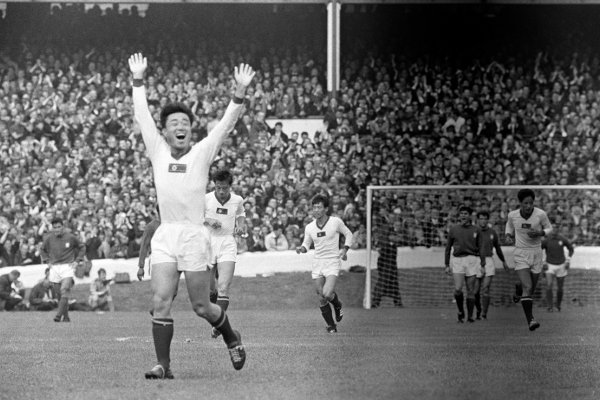
10. North Korea 1-0 Italy
https://www.youtube.com/watch?v=yhiYjKWsMq4 19/7/1966FIFA World Cup Group Stage, Ayresome Park. 1966 was North Korea's first World Cup. Drawn in a group with two time World Cup winners Italy, a Soviet Union side which had won the 1960 European Champions and 1962 World Cup bronze medalists Chile, the Koreans were not expected to pull up trees during the tournament. A 3-0 loss to the Soviet Union in the opening game shocked nobody, but a last minute goal against Chile gave them a 1-1 draw in the second. If they beat Italy they would be through to the quarter finals. Spearheaded by Sandro Salvadore and featuring Gianni Rivera, who would later be voted the 19th greatest player of the 20th century, the Italians had won one of their two games before facing North Korea. A 2-0 victory over Chile was followed by a 1-0 loss against the Soviet Union. A draw was all the Italians needed heading into the final group game in Middlesbrough to advance. Confounding expectations, the North Koreans dominated play throughout. Playing quick, attacking football they were able to match the two-time World Cup winners, quickly winning the regard of the local fans. Just before half time a Pak Doo-ik goal put North Korea one ahead. After the break it was much of the same and to the shock of the world, when the referee blew the final whistle, the first time entrants from North Korea had beaten Italy, sending themselves through to the quarter finals. The attractive nature of the Korean play endeared them to the locals so much that 3,000 Middlesbrough fans followed them to Goodison Park for the quarter final tie, where Eusebio scored four as they lost 5-3 to Portugal, despite taking a 3-0 lead. North Korea would not qualify for another World Cup until 2010. 36 years later, Italy would lose 2-1 to South Korea in the 2002 World Cup.
9. Portugal 0-1 Greece
https://www.youtube.com/watch?v=eGnf4hGmcVo 4/7/2004UEFA Euro Final, Estádio da Luz. If you placed a bet on Greece to win Euro 2004 before the tournament, you would be able to find odds of 150/1. To put that into context, that is three times higher than what some bookies are offering on debutantes Iceland to win this years tournament. Before 2004, Greece had qualified for two major tournaments, Euro 1980, where they managed a solitary draw against West Germany and the 1994 World Cup, where they lost every game, did not score and ended up with a goal difference of -10. Almost immediately, they defied the pre-tournament odds. In the first game of the tournament, Greece beat the hosts Portugal 2-1. A 1-1 draw with Spain was followed by a 2-1 loss against Russia. Despite ending the group stage with the same points and goal difference as Spain, Greece went through to the quarter finals having scored more goals. In the quarter finals Greece's miracle tournament went one further, using strong defensive tactics to beat incumbent champions France 1-0. After an extra time victory over the Czech Republic in the semis, the Greeks had qualified for the final in their second ever European Championship. Their opponents were hosts Portugal, who they had beaten 2-1 in the opening game. Despite the previous result Portugal were heavily favoured against the Greece side, who had been seen as lucky finalists. Portugal's squad featured Luis Figo, Cristiano Ronaldo, Rui Costa and Fernando Couto and backed by a passionate home crowd they were looking comfortable favourites. Whilst not possessing as many superstars as their rivals, the disciplined play of the Greek side had led to them not letting in a goal in the knockout rounds, and this continued into the final. Portugal dominated play, enjoying 58% possession and taking 17 shots to Greece's 4. It was Greece who would take their chances though, in the second half Angelos Charisteas rose from a corner and took what would be Greece's only shot on target. Charisteas's shot found the back of the net and put Greece into the record books. Neither side has been in a major final since 2004, and although Portugal look forward to the 2016 tournament in France, Greece came bottom of a qualifying group, losing twice to the Faroe Islands in the process.
8. Tavriya Simferopol 1-0 Dynamo Kiev
https://www.youtube.com/watch?v=yQCJUt7vEoo 21/6/1992Ukrainian League Championship Playoff, Ukraina Stadium. Three teams have won the Ukrainian League since the nation declared independence from the Soviet Union. Dynamo Kiev and Shakhtar Donetsk have combined for a total of 23 titles since 1992, leaving one solitary season where a team outside of the big two won the Ukrainian title. In its first ever season, the Ukrainian FA created a short championship, taking the 20 teams from Ukraine who had ranked highest in the Soviet Leagues, separating them into two groups of 10 and pitting the winners of each group against each other in a playoff. The second group was won by Dynamo Kiev, Ukraine's biggest team. Dynamo had won more Soviet Top League's than any other club (13) and had finished 5th in the final season of Soviet football. In the first group, former Top League sides Shakhtar Donestk, Metalurh Zaporishya and Chernomorets Odessa failed to finish on pole position, losing out to Tavryia Simferopol, a team which had played the previous season in the Soviet second tier and who other than occasional Ukrainian SSR Championships (which did not contain Top League teams) had not seen much success during the Soviet years. One thing was for sure, the title game was a mismatch. Dynamo did not play like a team which had dominated Soviet football and in the 75th minute, Sergiy Shevchenko headed home a corner. On a mid summers day in Lviv, Tavriya had performed an astounding giant killing, becoming the first ever Ukrainian champions in the process. It would not take long for Dynamo to win their first Ukrainian title, winning the league in the 1992-1993 season, the first full season since independence. Tavriya's fortunes have decreased unbelievably since 1992, until 2014 they had played in every season of the Ukrainian Premier League, however the Crimea based side was forced to disband after the Russian annexation in 2014.
7. Alcorcón 4-0 Real Madrid
https://www.youtube.com/watch?v=q7b97sO-hGU 27/10/2009Copa del Rey Round of 32, First Leg, Estadio Santo Domingo. You know Real Madrid, right? The most successful team in European football. Winners of 10 Champions League/European Cup, 32 La Liga, 19 Copa del Rey and 2 UEFA Cup titles. Do you know Alcorcón? When AD Alcorcón (a team from a town within the Madrid Metropolitan Area) was founded in 1971, Real Madrid had already won six European Cup titles. By 2009, when the two teams were drawn against each other in the Round of 32 of the Copa Del Rey, Real Madrid had won three more. By this time, Alcorcón had spent the previous nine seasons in the Segunda B2, a regionalised league which constituted part of the third tier of Spanish football and included Real Madrid's reserve team, 'Real Madrid Castilla'. The chance to play their more illustrious neighbours was huge for the club. Los Alfareros had never played a team from La Liga before, even in cup competition and just being on the same field as Real Madrid would be the greatest moment in the club's history. By the time the teamsheets were given out the gulf in class was obvious. Madrid did not have their first XI on the field (one notable absentee being the injured Cristiano Ronaldo), but taking the field at Estadio Santo Domingo that day was a side which included Raúl, Karim Benzema, Guti and lvaro Arbeloa. Alcorcón on the other hand had a forward line led by future Kilmarnock striker Borja Pérez, who was joined up front by Diego Cascón, a new signing who had scored 5 goals in 29 games in Segunda B for now defunct Polideportivo Ejido the previous season. This game was a mismatch by anyones estimations and as the teams came out in front of a full crowd of 3,000 at the Estadio Santo Domingo, few would have expected what followed. It was not that Real Madrid lost that was the real surprise, it was how they lost. In a match which Alcorcón dominated, some would be surprised they did not win by more. In the 16th minute Borja Pérez curled a shot from the edge of the area which beat Jerzy Dudek's outstretched arm. Six minutes later a pass across the goal was turned in by Spain international Arbeloa as an own goal. By the 39th minute Alcorcón were 3-0 up against the mighty Real Madrid after Ernesto's well placed finish. After half time another Borja Pérez goal put the result beyond doubt. In their first ever Round of 32 game, Alcornón had beaten Real Madrid 4-0. In the second leg, Real Madrid managed a 1-0 victory which put Alcornón through 4-1 on aggregate. The defeat of Madrid, dubbed 'Alcorconazo' by the press landed the Segunda B side a Round of 16 tie against Racing Santander, which they lost 3-2. At the end of a season in which Real Madrid would score 102 league goals and finish second, AD Alcorcón won the Segunda B2, beating Ontinyent in a playoff which brought them to the second tier of Spanish football for the first time in their history.
6. Steaua Bucharest 0(2)-(0)0 Barcelona
https://www.youtube.com/watch?v=q7b97sO-hGU 7/6/1986European Cup Final, Estadio Ramón Sánchez Pizjuán. Before 1986 Barcelona had not won a European Cup, their previous trip to the final in 1961 resulting in a 3-2 loss to Benfica. Despite this, they were still seen as one of the giants of European football. Ten times La Liga champions, three times winners of the Inter-City Fairs Cup (a precursor to the UEFA Cup), two times winners of the Cup Winners Cup and twenty times winners of the Copa Del Rey prior to the 1985-86 season, Barcelona saw the competition as a chance to finally take the biggest trophy of them all. Featuring an all star team which included Bernd Schuster, Francisco Carrasco and Scotland international Steve Archibald, Barcelona qualified for the final in an impressive run which included victory over Porto and Juventus. You could excuse Barcelona for expecting victory before the final. Their opponents, Romanian champions Steaua had qualified for the final in less impressive style. Victories over Velje of Denmark, Budapest Honved, Finnish champions Lahti and Anderlecht ensured the Bucharest side would face Barcelona in Sevilla. No Romanian side had played in a European Cup Final before and Barcelona were heavily favoured prior to the game. Steaua's tactic was simple, do not allow Barcelona to play, and this they did excellently. In arguably the least interesting European Cup Final in history, Steaua fought Barcelona to a bore draw, bringing the game to a penalty shootout. It was here that the Romanians felt comfortable, and the heroics of goalkeeper Helmuth Duckadam meant that not a single Barcelona penalty was scored during the shootout. Despite missing their first two penalties, successive Lacatus and Balint penalties won the game, the first time the European Cup was won by an Eastern European time and ensuring Barcelona would have to wait for their first European Cup triumph, which they achieved in 1992 with a 1-0 victory over Sampdoria. Steaua would again reach the European Cup Final in 1988, losing 4-0 to AC Milan.
5. Iraq 1-0 Saudi Arabia
https://www.youtube.com/watch?v=G8ncOcyQAyA 29/7/2007AFC Asian Cup Final, Gelora Bung Karno Stadium In 2007, Iraq was a nation at war. Shattered from years at war, it was a miracles the Iraqis were even able to qualify for the 2007 Asian Cup. Hardly known as a powerhouse of Asian football, 2007 would be Iraq's sixth tournament, having achieved a highest finished of 4th in 1976. After a 1-1 draw against co-hosts Thailand in their opening game, Iraq pulled off a 3-1 victory against tournament favourites Australia in the second game of the group stage, earning them a place in the quarter finals. Victory over Vietnam was followed by a surprise penalty shootout win over 2002 World Cup semi finalists South Korea, progressing the Iraqis through to their first continental final. A feat which was overshadowed by a terrorist bombing which killed 30 celebrating Iraqi fans. Their opponents Saudi Arabia would be playing in their sixth Asian Cup Final, having won three, most recently in 1996. Saudi Arabia had been through a golden age in the years before 2007, qualifying for the previous four World Cups and the Saudis were seen as one of the strongest teams on the continent. A 3-2 semi final victory over Japan solidified their status as favourites. The game started slowly and the teams reached half time goalless. Saudi Arabia, who had scored three against Japan and two against Uzbekistan in the knockout round were not able to get through the Iraqi defence. Midway through the second half Iraq countered from a Saudi corner, storming up field to win a corner of their own. A curling corner found the head of Younis Mahmoud, who guided it into the net. After a nervous 20 minutes, the ref blew the final whistle, completing an unbelievable upset and completing a fairytale for the war torn nation. Since 2007, Saudi Arabia have not been the same dominant force they were before, going out in the group stages in 2011 and 2015 and never again qualifying for the World Cup. Iraq have qualified for the quarter finals of both tournaments since. Younis Mahmoud's winning goal created such an impact that he finished 29th in voting for the 2007 Ballon d'Or.
4. Denmark 2-0 Germany
https://www.youtube.com/watch?v=oJ8MefDj5Uo 26/6/1992UEFA Euro Final, Ullevi In a piece of trivia loved by many a pub quiz aficionado, Denmark did not qualify for the 1992 European Championships. Rather, eleven days before the start of the tournament in Sweden, UN sanctions on Yugoslavia, who won Group 4 of the qualifiers banned them from appearing. Their place was taken by the Danish as the runner up, who would play their first game of the tournament just twelve days later. Denmark's chances were not helped when Michael Laudrup, star Barcelona midfielder decided to stay on holiday rather than meet up with the squad. Although they had a few star players, Manchester United goalkeeper Peter Schmeichel and Michael's brother Brian included, Denmark were expected to be cannon fodder during the tournament. A 0-0 draw against England, followed by a 2-1 defeat to hosts Sweden and a surprise 2-1 victory over France gave Denmark a shock berth in the semi-finals, where they faced the Netherlands. The Netherlands had won Euro '88 and had topped a group featuring Germany, Scotland and the Commonwealth of Independent States (the Soviet Union had qualified, but had been dissolved in December 1991 so competed under the CIS name). In the game, Denmark twice took the lead through Henrik Larsen, eventually relying on Schmeichel's heroics as he saved van Basten's penalty in the shootout. Denmark were through to the final. Europe was shocked, a team which did not even qualify on merit had beaten the European Champions. Still, in the final they had to play Germany. Germany had won the European Championship more than any other nation and had a line up which included Effenberg, Brehme and Klinsmann. After a 3-2 victory over Sweden in the semi-final they had been placed as massive favourites over the plucky Danes, who simply could not do it again, right!? In the 18th minute, the ball was passed to John Jensen on the edge of the, who struck a ferocious strike to give Denmark a 1-0 lead. The Germans attacked, with attempt after attempt being saved by Schmeichel. The German pressure was unrelenting until the 78th minute, when Kim Vilfort took a touchpast two German defenders and placed the ball home. In less than a month Denmark went from non-qualifiers to champions of Euro 1992. Four years later the Germans beat the Czech Republic 2-1 at Euro 1996, the Danes were eliminated in the group stage.
3. USA 1-0 England
https://www.youtube.com/watch?v=-vqQWrrzNWU 29/6/1950World Cup Group Match, Estádio Independencia A game so unbelievable, so Hollywood that there is genuinely a movie about it. Before 1950, British teams refused to take part in the World Cup. They were the best teams in the world already, they reasoned, why on earth would they need to travel to Uruguay in 1930, Italy in 1934 or France in 1938 to prove it when the British Home Championship would already prove who was the best in the world? After World War 2, the British federations rejoined FIFA and decided to use to Home Championship as a qualification for the 1950 World Cup, deciding to prove their superiority over the world. As Home Championship champions, the English had proven themselves as Britain's best team and organised the best of the Football League into a team ready to take on the world. Before the tournament England had beaten reigning world champions Italy and Tom Finney, Stanley Matthews, Stan Mortensen and future England manager Alf Ramsey were amongst those selected to go to Brazil to win the World Cup for the English. Goals by Mortensen and Mannion eased England past Chile in the first game of the group stage, putting the English side in a comfortable position before their second game of the tournament, against the United States of America. The United States side were everything the England side was not. Even the greatest players in the American side were semi-pro at best, captain Walter Bahr taught at a local high school whilst playing for the Philadelphia Nationals in 1950. In the opening game of the World Cup, the Americans lost 3-1 to Spain, letting in three goals in the last ten minutes. The semi professional Americans were not given a chance against a side regarded by many as the best in the world. During the game, England dominated play. The patient, passing play of the English gave them the edge in the opening proceedings. In the 38th minute however, Joe Gaetjens, a Haiti born dishwasher got a touch onto a Bahr shot, brushing it into the net. The goal shocked the English, and despite constant pressure they could not get past the American defence, giving the Americans an incredible 1-0 victory. Sixteen years later, England would win their to date only World Cup. The United States did not qualify for another World Cup until 1990.
2. Tottenham Hotspur 3-1 Sheffield United
https://www.youtube.com/watch?v=WrwI1AVrSa4 27/4/1901FA Cup Final Replay, Burnden Park Tottenham Hotspur are today one of the leading clubs in English football. The club has been in the top flight since 1978 and are perennial candidates for European football. In the 1900-01 season the club played non-league football in the Southern League Division One, finishing 5th out of 16 teams. Their FA Cup run, which involved beating holders Bury and First Division sides West Bromwich Albion and Preston North End on route to the final was expected by nobody, despite fellow Southern League side Southampton getting to the final the season before. In 1901 Sheffield United were a First Division team, 1898 winners of the league and 1899 winners of the FA Cup. The 1901 final would be on of 3 in 4 years and the club were heavily favoured as the Football League team going into the game. The first game, played at Crystal Palace resulted in a 2-2 draw in front of 110000 supporters. In the replay, played a week after the original tie a Fred Priest goal gave United the lead going into half time. Seven minutes after the break a John Cameron equaliser squared the game, giving the non-league side hope for an upset. Tom Smith's goal fifteen minutes from the end gave Tottenham a lead which was added to by future Scotland international Sandy Brown. For the first (and probably last time), a non-league side had won the FA Cup. In 1902 Southampton reached the final again, marking the last time a non-league side would reach the final. Seven years later Tottenham joined the Football League.
1. Brazil 1-2 Uruguay
https://www.youtube.com/watch?v=i_pkFXqnpF4 16/7/1950World Cup Final Group, Estádio do Maracana. Picture the scene, a hot Rio de Janiero in July 1950. Brazil, hosting the first World Cup on South American soil for 20 years were fresh from 6-1 and 3-1 wins against Spain and Sweden respectively in the Final Group of the 1950 World Cup, which was held in a round robin format for the only time in history. Their opponents in the final game of the group were Uruguay, a team which had drawn 2-2 with Spain and narrowly defeated Sweden 2-1 thanks to two goals in the last fifteen minutes in the two previous matches. A year earlier, Brazil had hosted the South American Championship, during which they had convincingly beaten Uruguay 5-1 on the road to the trophy. The Brazilian team had scored 21 goals in 5 matches, with players such as Ademir and Jairzinho dazzling the locals crowds. To the Brazilian fans, this was their year. Prior to the final game of the group it was presumed Brazil would win, to the extent that a famous newspaper article from the day of the game showed a picture of the Brazilian team, under the caption 'These are the World Champions.' Not that Uruguay were bad by any means. Just 20 years previously, they had won the 1930 World Cup on home soil and before World War 2 they had won always half of the South American Championships played. However, by 1950 they were no longer the juggernaut they used to be and recent performances gave evidence that they would prove no match for Brazil's incredible attack. If they could not beat Spain, a team Brazil scored six goals against, how would they be expected to get anything at the Maracana in front of a crowd of passionate Brazil fans which numbered almost 200,000? Brazil's arrogance proved their downfall, however. Spurred by captain Varela the Uruguayans players set out to prove that Brazilians were foolish to celebrate before the game started. A solid defensive showing kept Brazil out for 47 minutes, giving Brazil a lead they would only hold for 20 minutes. After Juan Alberto Schiaffino's equalizer Alcides Ghiggia gave Uruguay a 2-1 lead in the 79th minute to give the small nation of a few million a victory over their huge neighbours and their second World Cup title. The shock of what would be dubbed the 'Maracanazo' silenced the huge crowd, causing such humiliation to the Brazilian nation that there were reported suicides, leading playwright Nelson Rodriguez to call the 16th July 1950 'Our Hiroshima'. Brazil have won 5 World Cups since 1950, but have yet to succeed in a home tournament. In 2014, hosting the tournament again they lost 7-1 to Germany in Belo Horizonte.