How Good Was Kurt Angle Actually?
Three I’s, no Five Star Matches: how good WAS Kurt Angle?

You might read the title and question the purpose of the article. It’s Kurt Angle: he was a multiple time WWE World Champion, who might have produced even better work for Total Non-Stop Action. He was a total entertainment machine. He was one of the consensus best professional wrestlers in modern history. Surely, this isn’t up for debate.
It’s Kurt Angle.
And yet, Angle’s name crops up at frequent intervals, and is a reliable staple of the never-ending discourse cycle. You’ll usually see it on X or Reddit or wherever most Fridays, when the most recent edition of the Wrestling Observer Newsletter is published.
At time of writing - August 11, 2025 - Dave Meltzer has awarded 26 matches ***** or above in 2025. 33 weeks have passed this year. That’s not too far away from a five star match a week, which feels definitionally wrong. Aren’t they meant to be special, rare occasions?
The value of the star rating system is probably more debatable than ever before. Even those who hold affection for it, because it guided them on their deep-dive into wrestling history, can agree that the plot has been lost somewhat. Was Kevin Owens Vs. Sami Zayn from Elimination Chamber ‘25 the best match they ever had together? Was Gabe Kidd Vs. Yota Tsuji really better than the best Kurt Angle match?
Because a lot of you believe the the answer to these questions is “no”, Angle - probably the best recognised in-ring wrestler never to earn a fiver from Dave - is cited as evidence of his apparent bias against WWE*.
*The main event of WWE's latest PLE offering, SummerSlam, earned a ***** rating.
The irony, for the older folks here, is that many thought Meltzer overrated Angle - and to an extravagant degree - back in the 2000s, before the star rating system entered a state of irreversible inflation. Contrarian message board posters at the time deemed Angle a wrestler with a poor grasp of psychology who did way too much in his matches.
Dave actually loved Kurt Angle’s work - but not everybody did. How good was the Olympic Hero, actually?
Presence/Look/Presentation

Angle’s look was brilliant. He was ripped and thick and tall. He looked almost literally like a sports entertainer, with an athletic build hulking enough to pass the fabled airport test.
His attire was excellent. He wore the singlet once synonymous with Mr. Perfect, instantly conveying both a technical majesty and his elite-tier amateur legitimacy. The red, white and blue colour palette was inspired on multiple levels. It was authentic, the obvious means by which to present Angle as somebody who had genuinely achieved the highest accolade in the field of athletics. Beyond that, the patriotism element was a deliberate anachronism in 1999, when American family values were something to be attacked by popular artists in the alternative scene. It was an ingenious, zeitgeist-grabbing approach; if Mr. McMahon was the evil boss you hated at your job, the heel Kurt Angle was the disingenuous politician who only pretended to live a clean, wholesome life.
His theme could not have been pitched any more perfectly. It was recycled from the short-lived Patriot babyface character of 1997. Back then, it was shockingly out of date, when the Patriot’s dud run coincided with the rise of anti-hero Stone Cold Steve Austin.
In 1999, it was, again, intentionally out of date. It was the corny, anthemic soundtrack of Angle’s comical internal delusion. It was aural triumph, what he expected to barely hear as his adoring fans, drowning it out, screamed in hysterical admiration for their hero. When they instead started to chant “You suck!” during the conveniently timed pauses, this forced him to lose it - and nobody was funnier when they were pissed off than Kurt Angle.
Angle was packaged so brilliantly that you could argue he was Vince McMahon’s greatest ever creation. Hulkamania ran wild in the early 1980s American Wrestling Association before Hogan headed back to New York. Steve Austin had to pitch the ‘Stone Cold’ character, since Vince had burdened him with the dry ‘Ringmaster’ technician bit. The Rock developed his own egomaniac heel character across 1997 and 1998; it was his ad-libbed decision to refer to himself in the third person. Angle was a perfect character out-of-the-box, but it would not have worked without Angle’s incredible comedic timing. He knew exactly when to explode into fits of rage.
In 2002, Angle, who had already displayed his intense side to startling effect, was forced to shave his hair off after a match against Edge at Judgment Day. After refusing to honour the stipulation by wearing a preposterous wig and amateur headgear combo, Angle eventually debuted a look that accentuated his unreal intensity. Angle remained a laugh riot when the material suited him, but this new look informed his terrifying Wrestling Machine persona. This is when Angle became a goddamn animal between the ropes.
Promos

Kurt Angle was superb on the microphone. He could sell a fight with his famed intensity, and is probably underrated in that regard - but only because he was unforgettably great at making the crowd piss themselves laughing during his promos.
In one of his most famous promos, one that does the rounds on socials every other month, he tried to prove his physical dominance over Rey Mysterio in 2002. You see, Rey was small - just a boy, really, in a man’s world. Kurt Angle meanwhile was a man who could toy with him.
“And I’m a man who loves to play with boys.”
The line was exquisite, Angle’s instant, regretful reaction even better. He gave himself a look as if to say “Was I just stupid enough to compare myself to a child molester?!” before lashing out at the crowd who gave him hell for it. He then repeated the bit and smashed his fist against his own head in fury. A hoarse Tazz, who had evidently just lost it on commentary, implored Angle to put the mic down. He could barely get his words out.
Angle baiting the crowds to mock him was priceless, but he was also great at lording his superiority over them. He was arrogant, but he was also oblivious as to how much of a prick he was, and how much he was offending them, which was a great tweak on heel heat. He wasn’t abrasive, just casually detestable, which is the type of annoying person you’re more likely to encounter in the real world.
In-Ring Ability
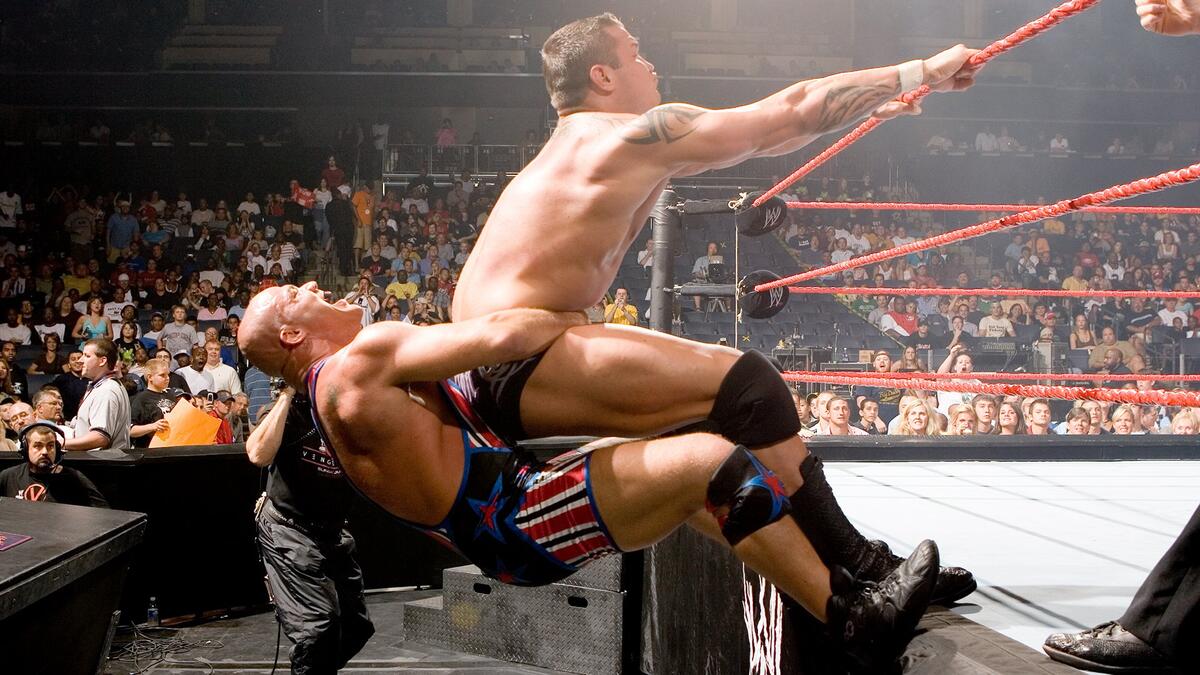
Kurt Angle was evidently a brilliant pro wrestler bell-to-bell. Capable of frenzied big-bumping main event epics and, when matched with the right opponent (e.g. Desmond Wolfe), a more understated chess match, Angle also excelled at the ultra-violent sprint. This is a major strength of his ‘G.O.A.T.’ case. A lot of wrestlers can and have put on lengthy, back-and-forth clinics. Few have convincingly attempted murder in a short, sickening burst like the resourceful Angle did to Roderick Strong on SmackDown in January 2005. Angle combined perfect mechanical form with gruesome violence and intensity. His best matches fuelled fans with pure bloodlust. His facial expressions were so powerful that you genuinely believed he wanted to injure his opponents. Angle was one of the most believable wrestlers ever.
Some of the more suspicious hardcore fans of the day weren’t quite so high on Angle’s work. They reckoned Angle’s matches were poor in psychology, that they lacked cause-and-effect, that he indulged in near-fall spam to a repetitive, numbing extent.
Angle’s work did not always make sense, even in the context of a medium where so little does. Do you fall down and pop right back up after getting punched in the face? Do you refuse to put your hands up so that the fans can enjoy you getting hit?
No - but there’s an internal logic to the illogical, and Angle did not always adhere to it.
The most obvious example here is Angle’s constant, failed attempts to execute a German suplex from the apron to the outside. He never did hit it, but spent years and years trying. The tension and purpose of this spot was nonexistent. Angle looked like a fool and a carny doing (or rather not doing) this signature spot. It was a transparent attempt to generate a few frightened gasps with zero intention of a payoff. It was a deflating experience and nonsensical thing to keep going back to. None of his opponents looked especially spirited for getting out of it, when all of them managed.
Angle’s famous missed moonsault spot was similarly flawed. It generated a reaction, particularly when he was crazed enough to do it off a cage, but he really could have done with landing it more often. That way, the miss might have enhanced the drama of the momentum shift. Instead, for a supposed technical genius, it just scanned as poor decision-making - a painful and dumb way of grabbing a cheap pop.
These criticisms extended to the structure of his matches. Some fans bemoaned that Angle did not build towards his ankle lock in the same manner as Bret Hart would, when weakening his opponent before applying the Sharpshooter. The 2000s message board critics also pointed out that Angle would burst too quickly into life as he sprinted up the turnbuckles to deliver his avalanche belly-to-belly suplex.
The counterargument here is that it was almost in-character for Angle to wrestle the way he did. Angle was both a great wrestler and an utter buffoon. ‘Intelligence’ was one of his three ‘I’s - but he was a blowhard.
He applied his character to the ring. He was prone to wild shifts in mood and embarrassed outbursts. He was never portrayed as a calculated, sly technician - he was just very much capable of executing his stuff flawlessly.
Angle was a deluded, hot-headed maniac. That was the thrust of his comedic approach. Doesn’t it make sense, then, that he would make stupid decisions and insist that he could do things - like the apron German suplex - even though he couldn’t? This is a different way of looking at it - but one that doesn’t explain his TNA run, in which his buffoonery was scaled back. But on the ankle lock: Angle was, in character, a volatile guy. It isn’t too much of a reach to suggest that a sudden attempt to break his opponent’s ankle without first working it over was something he’d logically do. Angle was pure instinct - you can’t plan strategy in your head if you lose it as often as he did.
Angle made poor decisions in the ring, some of which were galling and predictable the more often he did them - but perhaps the idea that he was bad or unintelligent fails to factor in the fictional character he was portraying. Angle very famously won a gold medal with a broken freakin’ neck. He was more fit and athletic than anybody else with an unparalleled tolerance for pain. His character justified those intense bursts of adrenaline.
Circling back to the question mentioned in the intro: does Kurt Angle have a legitimate claim to a “five star match”?
This, obviously, is subjective - but his match against Shawn Michaels at WrestleMania 21 was a bonafide classic.
Angle was incredible on the night, a lunatic in his pursuit to prove himself better than Shawn Michaels. This match best captured the idea of Kurt Angle as a wild animal. In one incredible story beat, Michaels dropped Angle with a desperation Sweet Chin Music. Shawn, who had been utterly annihilated after initially out-wrestling and pissing Angle off, was almost afraid to make the cover in case Angle noticed. Shawn draped his arm gently over Angle’s shoulder as if he were a tiger capable of ripping him to shreds with one last wounded, vulnerable attack.
The wall of noise during the famous climactic stretch, where it felt in the moment like Shawn’s ankle ligaments were about to snap, was deafening. It’s funny: Shawn Michaels spent his entire second chapter trying to convince the fans that his back was about to give out, but he never looked closer to being retired than on April 3, 2005.
Beyond that, Angle has the apparently unfortunate distinction of wrestling countless incredible matches that weren’t quite the very best of all-time.
No Dave fivers, but there aren’t many who have wrestled more fours. Before his system got out of control, Meltzer was just about fair.
Drawing Power

Kurt Angle was a main event star throughout a pro wrestling boom period, but he wasn’t the star. He headlined pay-per-views and eventually racked up six World titles in WWE, if you include the post-buyout version of the WCW title. Clearly, he was treated and depended upon as a fairly major deal. He carried his maiden WWF title for 126 days in 2000 - and this was a time before business cratered, and when the belt was swapped around at a blistering frequency. His was the longest reign that began that year. No small feat at all when the landscape was teeming with star power and competition.
This looks good for his case, but it’s complicated by the number he drew for No Mercy: the site of his first World title win. The number of pay-per-view buys was 550,000 - down from Unforgiven (605,000) the month prior. What’s worse, Unforgiven was headlined by a stopgap Fatal 4-Way match, not the easier sell of a big-time one-on-one meeting with the Rock. But this in itself is complicated by Triple H and Stephanie McMahon. Triple H had pinned Angle at Unforgiven in a sad, flat ending to a well-received storyline. Angle was hardly built as an ultra-credible challenger - and the reign coincided with Stephanie heading up (and failing dismally at) creative.
This isn’t a flattering way to put it, but it’s not inaccurate, either: the absence and abysmal booking of the Rock and Steve Austin respectively destroyed business in the second quarter of 2001. The booking was almost impressively self-destructive throughout this time, but Angle’s big babyface run didn’t reverse the decline.
In essence, having Angle on the Attitude Era roster was a luxury, and he was a big star - but the fate and success of the enterprise was never dependent on him. He was on top a lot throughout the Ruthless Aggression days, and didn’t much move the needle.
His TNA arrival in 2006 was a massive deal for the distant U.S. #2. This might be a more fair measurement of his drawing power than a comparison to the Rock and Steve Austin, who essentially transcended what it meant to be a traditional pro wrestling attraction. They were megastars. Angle’s first PPV match against Samoa Joe, at Genesis, set what remains TNA’s all-time record on pay-per-view with 60,000 buys. Perhaps more impressive is the fact that Angle drew in the region of 55,000 two years later, when the novelty of his shock jump had long faded, for a Steel Cage match against Joe again at Lockdown 2008.
Angle could not boast longevity as a draw otherwise - but that’s on Vince Russo, really. TNA itself was too much of a joke to get people to consistently pay for it.
Time’s Test

You can easily watch a peak Kurt Angle match back now and love it.
It helps that the relentless, lung-bursting pace he set is the norm these days. In that sense, Angle’s work hasn’t drifted out of style - and he was a generational athlete, probably the best to ever compete inside the squared circle. Even if he took the odd shortcut towards it, he almost inevitably arrived at high drama. There’s an emotional component missing from his work, outside of that masterclass opposite Shawn, but Angle made you feel a primal urge to see violence, if not an unbearable sense to see him win or lose in the same way as a Kenta Kobashi or Ric Flair. Angle’s matches were often pure spectacle, not a deeply-felt blow-off to a grudge programme, but it’s really hard to make pure action feel timeless. Angle did it.
Angle’s work withstands the test of time - but did Angle himself?
Increasingly, as modern wrestling often eats itself, slurping down homogenised athletic sludge in a greedy pursuit of critical acclaim, the better “old man” wrestlers stand out. Watching a veteran work around their physical limitations is an impressive and rewarding experience. The wrestlers who can’t do what they used to do must cast true working magic to draw a response from the crowd. This is a deeper, more earnestly felt reaction, the effect of incredible selling and the ability to slowly convince the fans that they are still, somehow, in the fight. Ric Flair - unpleasant as it is to praise him in 2025 - was remarkable at this, on some glorious occasions, in the mid-2000s. Before his knees disintegrated entirely, Hiroshi Tanahashi’s latter role, in which he refused to go gentle into that good night, produced some of the most emotionally intense matches of the New Japan resurgence - a beautiful counterpart to the increasingly formulaic, counter-heavy main event style.
Angle was not a great old man wrestler, truthfully. There was no pathos to his work as he left Impact Wrestling in 2016 and, before rejoining WWE, embarked on an indie run. His matches between 2016 and 2019 ranged from admirable to passable to bleak. He essentially tried to wrestle like the Kurt Angle of old, playing the hits with no lead connected to the amplifier. He didn’t toy with the crowd in the spaces between the moves, and the moves lacked the snap of old.
In some fan circles, his retirement match loss to Baron Corbin at WrestleMania 35 was considered a disgrace - but was there really a better alternative? Angle had already lost to Chad Gable on the March 18, 2019 edition of Monday Night Raw. While many fans might have dreamed about seeing this match against his spiritual successor on the grandest stage, it wasn’t particularly good. Angle was thrashed, unable to use that as an emotional hook nor offer any of his opponents the rub.
This isn’t necessarily a big criticism. Angle went harder than most at his sensational peak; it was little wonder that he had virtually nothing to give by the end. When determining somebody’s case as the greatest of all-time, however, the margins are yarn-thin.
Cultural Significance

Kurt Angle is not a particularly relevant cultural figure.
Successful Olympic athletes become household names, but drop out of the fame cycle as quickly as a sprinter after they’ve appeared in some commercials. The Games are a huge draw, but comparatively very few people are going to retain an interest in the canoe slalom without the five-ring branding and the pull of the wider occasion. Angle’s gold medals in 1996 only mean something in 2025 to dedicated amateur wrestling enthusiasts. There aren’t many of them about.
Older wrestling fans hold a profound sense of respect towards Angle’s accomplishments, but it’s not the same thing. Nostalgia is not cultural significance.
It doesn’t count, exactly, but many people are likely aware of what Kurt Angle looks like without knowing who he is. That’s because Angle is the subject of a very popular meme reaction. The source is Angle announcing his TikTok account with a quick introductory message. When he finishes up, he stares vacantly into the distance, the whites of his eyes completely peeled. It’s a joke - he then asks the person filming if they’re done, so he can take a nap - but for these few awkward seconds, Angle’s facial expression is hilarious. He looks like he’s in trouble, plain awkward, or smiling through disbelief. It’s a funny image to use when trying to no-sell a painful social interaction of any kind.
In a weird way, this is evidence that Angle is still entertaining enough to make people laugh all over the globe. But he isn’t exactly El Santo here.
Rivalries

Angle was an outrageously entertaining comedy character and super-intense wrestling general type with an undying will to win. It was either a bit of a laugh or all business with him - which should mean that he doesn’t score too highly in this category. He’s never been a part of something as intensely personal and layered as CM Punk Vs. MJF, for example.
And yet, his most famous programmes were awesome.
His 2005 feud with Shawn Michaels was a masterpiece of plotting, character work, and action. It was the composite Kurt Angle experience: he was a goofball in the build and a killer at the payoff. His 2002 feud with Rey Mysterio was stellar, too; Angle couldn’t sanction that a smaller guy, a “little boy”, could get the better of him - and when Angle was upset, he was at his best. The sting of humiliation morphing into murderous vengeance: this escalation was Kurt’s specialty.
He was part of one of the Attitude Era’s most beloved storylines, at least until Triple H panicked and grew terrified by the idea that a fictional character might prefer having intercourse with somebody other than him. His series with Brock Lesnar ended up being great (eventually).
In TNA, Angle’s matches with Samoa Joe represented the commercial peak of the entire promotion, and lived up to the most optimistic Dream Match expectations The two hard-as-nails bastards gave each a pounding to get their matches over as sicko-friendly fare. They knew they had to lose brain cells during those matches. They knew they had to be transgressive, and deliver a level of physicality that transcended the mere “stiff”.
Impossible to watch back now, but his stuff with Chris Benoit at the time was staggeringly great. The sports entertainment world of WWE felt like the best and most realistic pure wrestling outfit going when those two shared the same ring.
Moments

In Angle’s best moment, he parodied Shawn Michaels during their legendary 2005 feud.
The conflict was premised on the idea that Angle was intent on proving that he was better than Shawn. It made perfect sense; Angle was one of the most competitive wrestlers ever, and he wanted to put an end to the idea that Shawn was the best in-ring worker in the company. Angle being Angle, an irresistible moron, he took this to the most literal degree possible. Flanked by Shawn’s early 1990s valet Sherri Martell, Angle performed Shawn’s ‘Sexy Boy’ theme song, complete with his own reworked lyrics.
“I think I’m cute / I’ve got gold medals / I got the moves that make ‘em all tap out / The Angle slam / the Angle lock / Marty Jannetty still can’t walk / I’m just a Sexy Kurt (Sexy Kurt!) / I’ll make your ankle hurt (Ankle hurt!)”
This is the sort of seven star pro wrestling magic that you’ll watch at least five times whenever it pops up on your social media platform of choice.
Everything Angle did alongside Edge and Christian in 2000 was tremendous patter. The best angle that exploited his other side - the insane killer - saw him shoot headbutt Samoa Joe square in the nose. Angle celebrated, but in a superb bit of direction - that Paul Levesque has ripped off several hundred times at this point - a bloodied Joe rose up behind him like a movie monster.
Angle is responsible for some of the most genuine laugh out loud and “Hell yeah!” moments in modern pro wrestling history.
Range

This is where Angle isn’t merely “actually great”; it’s the category in which he peaks higher than anybody else - with the exception of Stone Cold Steve Austin.
At Survivor Series 1999, the site of Angle’s first night as full-time member of the WWF roster, there was a glorious, collective epiphany. Oh - you’re meant to hate this guy, and the guy can’t handle it. Angle grabbed the microphone moments into his squash win over trivia question Shawn Stasiak. Kurt lashed out at the crowd for booing an Olympic gold medallist. The jeers then intensified, and a totally magic bit of crowd interaction was born. Angle was absolutely incredible at being pissed off. Booing him was a blast; his Seinfeldian rage at getting booed was even funnier. This deliriously entertaining loop cast him as an instant superstar; he’d win his first WWF title, in the company’s most competitive era ever, in under a year.
This incredible range was best crystallised during his legendary parody segment of Shawn Michaels, but Angle was hysterical in WWE at virtually all times. Kurt Angle once hit octogenarian Mae Young with the Angle Slam and celebrated like he’d just won the belt at WrestleMania. Angle could make you howl with laughter.
In terms of in-ring style, the arc on Angle’s moonsault was more graceful and awe-inspiring than the wrestlers who specialised in aerial moves. He went hold-for-hold with Chris Benoit, mastering the pulsating rhythms of intense grappling. He wasn’t much of a striker, and his punches weren’t amazing, but he’d earn a C from a Memphis expert at least.
Amid the AEW Vs. WWE culture war, the question is (too) often asked. Is it better to be great at wrestling, or to be entertaining?
Angle’s answer to this was “Yes”.
Conclusion

Kurt Angle was incredible - even when he was dumb, it ruled, and actually made a weird sort of sense. He was a dumb maniac of a jock. Progressive limb work was never really meant to be his forte.
Angle was a master of all trades at his very best, and he boasts another incredible attribute not listed above. This is a rare and super-impressive one, too: Angle was unbelievable at elevating inferior opponents to his superb level. It was once said, to put over his brilliance in this regard, that Ric Flair could carry a broomstick to a great match. Angle was right there with him.
Angle gave Mr. Anderson an impossibly great match at Lockdown 2010. It was a legitimate Match of the Year contender, something verging on a miracle, at least 10 times better than anything else the former Mr. Kennedy ever did. At Bound For Glory 2008, Angle might have entered an even better individual performance. If Mr. Anderson was solid-to-unremarkable, even mediocre, Matt Morgan was actively not very good at all - and Angle still dragged him by his neck into a total thriller. Jeff Jarrett was a superb wrestler, so this is nowhere near the same thing, but he had one of the top five matches of his career against Angle at Genesis 2009. Abyss was limited but very effective in the right context; if he didn’t have his best match against AJ Styles at Lockdown 2005, he had it against Angle at Turning Point 2008.
Abyss has something in common with Shane McMahon, weirdly: Shane also had his most well-received bouts against Styles and Angle. Angle is the clear winner here: their legendarily violent King of the Ring 2001 war was the best-ever use of Shane McMahon in the ring. Shane was correctly portrayed as a barely-wrestler who only kept up with Angle in the match because he was too proud to accept the disturbing ass-kicking. Angle was so exceptional that he earned Marty Jannetty a new contract in 2005. 2005!
Angle was so intent on having awe-inspiring pro wrestling matches that he didn’t even care who was in the ring with him. He understood the showbiz aspect. His best work continues to flood social media in ‘Remember When’ posts, and invariably brightens your day for a precious moment.
Angle was phenomenal, actually.