Newcastle: 6 Signs Pardew Actually HAS Changed Philosophy

Hair sticking up like a telephone wire...

According to Alan Pardew's unsurprisingly not exactly revelatory interview with the London Evening Standard - who are card-carrying fans of his work, and have openly asked why Newcastle fans think they're entitled to protest (while saying Spurs fans definitely are) - nothing has changed at Newcastle. The media were already portraying the beleaguered manager as a rock of self-confidence, standing sturdy in the winds of discontent from fans who were hurling personal abuse at him and his family and had no grounds for protest, and now it's getting out of hand. Pardew's arrogance saved him, but only from resignation, it didn't precipitate change, and it didn't inform any of the wins that have come since the winless streak ended. According to that interview, Pardew always had faith in the same philosophy that he brought in at the start of the season, and that nothing has really changed (aside from the formation, but that's apparently not a big deal). But the question is, if nothing has changed, and the wins are coming naturally because of the same old philosophy and the same system, then how come there have been such obvious changes? How would the manager account for these six massive tactical changes that he seems to be suggesting are a figment of everyone's imagination?

6. The Quick Transition Out Of Defence

One of the real keys of the system working at the minute is the speed with which Newcastle break with the ball out of defence. If they weren't turning the ball over and quickly breaking to try and punish the opposition for over-committing, or to punch holes through the unprotected defence, they wouldn't carry any goal threat. With Moussa Sissoko in the middle, Newcastle carry the ball out a lot quicker. Jack Colback becomes the ball-playing midfielder (he's made the most passes of the whole team) and tends to look forward or wide to the wings, rather than going sideways to another defensive midfield. This is a step in the right direction as it brings the more dangerous players onto the ball. At the start of the season, this wasn't the case. Though Emmanuel Riviere and Remy Cabella were held up as scapegoats, it was in fact the presence of Cheick Tiote that made Newcastle's transitions to attack so unsuccessful. Rather than attempting to move forward, the Ivorian's agenda was simply to keep possession, so he'd pick the ball up from the centre-halves from two yards away and either pass it back to them, or pass it to Colback. Two unnecessary steps in the transition. And a change for the better.

5. Shorter Passes Out Of Defence

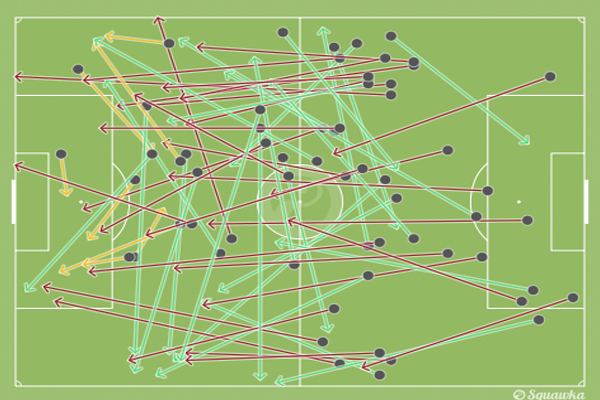
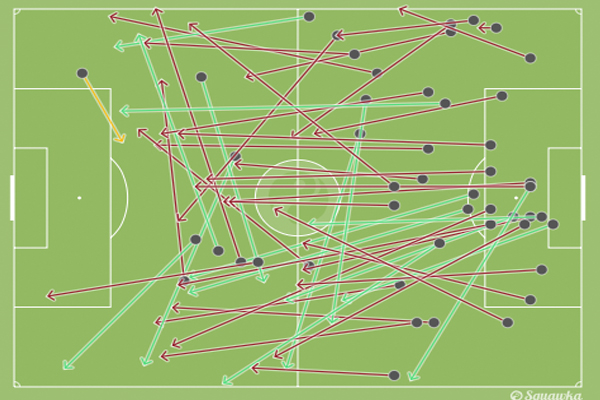
Obviously the Tiote example shows why it's bad to pass it REALLY short out of defence, but for most of the start of the season, and indeed the second half of last season, Newcastle tried to accommodate the loss of Yohan Cabaye by playing long balls out of defence in order to create something directly. Mike Williamson more often than not looks to hit the striker with his long balls - something Coloccini was doing for a while - and the result was simply to make the striker look more isolated. Now though, the centre-halves (minus Williamson, who has been absent) are hitting a similar number of longer balls, but the focus of them has changed from the striker to Moussa Sissoko at the front of the midfield, or out to the wings. Look at the different in the long ball heat-maps from the Villa and West Brom games (red lines are incomplete passes, green completed and yellow key). Here's Villa - with a concentration of balls going into and around the box...
And here's West Brom, with more focus on deeper areas, where Newcastle can actually win the ball...
It's as simple as not kicking it as long, and putting the ball into more useful areas, lessening the chance of interceptions (in theory, but Tim Krul's kicking needs some work) and allowing the wide men - including the full-backs - to run beyond Sissoko, and join the striker higher up the pitch.

4. The Redefinition Of The Number 10

In his interview with the Standard, Pardew admitted that Newcastle were now using Moussa Sissoko as a "battering ram" of an attacking midfielder/number 10, to punch through the opposition defence as he did against Man City. Previously, he used Yohan Cabaye in that position, and at times this season had played Remy Cabella there, but neither would play the same way Sissoko does. By his own admission, Pardew has brought Sissoko into the middle, which has hurt defences in a very specific way, and it's very obvious to anyone watching Newcastle that the Frenchman is not playing the same style number 10 role we've grown accustomed to over the past two years. So that's a definite change in the system and the philosophy, no matter how keen Pardew is to ignore the fact.

3. Natural Width

At the start of the season, Newcastle were playing Yoan Gouffran as a wide forward, despite the fact that he has been nullified as a threat for the past year or so by being asked to track back too much. He is not a winger at the best of times, and unfortunately he has been so badly out of form that his continued selection looked like nothing short of a mistake by Alan Pardew. But since he was dropped from the team, Pardew has used Sammy Ameobi, Rolando Aarons and Gabriel Obertan - albeit until his injury - with Remy Cabella growing more into a wide player. He's also used the full-backs more effectively, by playing Massadio Haidara in place of Paul Dummett - a wide man replacing a centrally trained one. With the pace they have in the team, Newcastle need to be able to break around defences, rather than just relying on Sissoko to punch through them, and having wingers and full-backs who know how to play wide has been a big step forward.

2. Surrendering Possession

For the first six or seven matches of the season, just as Newcastle weren't losing, Pardew came out with his best defence, that the stats were proving that the Magpies were in a false position and that they were not a bad team. In fact, he went as far as to say they'd deserved more from most of the games - aside from Southampton. He said that because Newcastle had had a lot of the ball, they would inevitably come good - the stats were suggesting that good things were on the way and it was only a matter of time before that possession meant prizes. Even after the Spurs and Liverpool victories he said the side needed to win more possession, but it seems the team are consciously allowing their opponents to have the ball. As Pardew has just said, sometimes he thinks the team are more dangerous when they haven't got the ball - which implies a conscious decision to give the ball up. Or in other words, another change of system.

1. 4-3-3, Not 4-2-3-1

Nufc Formation Qpr For the first winless games of the season Newcastle played a 4-2-3-1 system that was widely criticised for alienating the lone striker, dallying on the ball and having no natural width. Pardew stuck with it, but now he seems to suggest we have changed to 4-3-3. Some fans aren't fooled - Pardew is still pretty much playing the 4-2-3-1 when the opposition has the ball, though with the wingers tucked back and the striker patrolling a similar area to the number 10, so it's more like a staggered 4-4-2, absorbing pressure. The difference is in the fluidity of play, and the shape of the team when attacking - which is sort of the same thing really - as Newcastle wouldn't be able to play the 4-3-3 without quickly moving the ball out of defence and allowing the wide men to join in the attack. But if the manager is openly referring to a different formation, then presumably he at least thinks something has changed. Does Pardew deserve credit for making these changes that he definitely seems to think he didn't make?

Contributor
Contributor

WhatCulture's former COO, veteran writer and editor.