15 Greatest Angles In Modern Wrestling History
The angle is the most difficult idea to come up with. Who did it best?
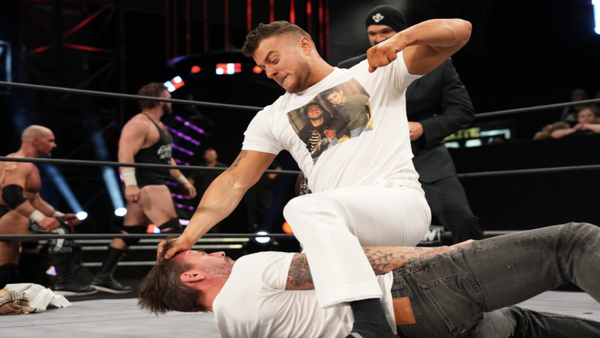
The hot pro wrestling angle is one of the most exhilarating thrills in the sport, and the very hardest thing to pull off - particularly in the modern era.
The last five minutes of a classic match are unbeatable - this, ultimately, is why we watch - but every match is baseline "good" now. It's almost no longer impressive or exciting. There is no formal training in devising a unique, captivating means of selling a match. A booker can study tape, and craft a story, but that one inciting incident, the scene that fizzes up your insides like a Catherine wheel, and makes you desperate to see the match that very second?
That is the pinnacle of the creativity of a wrestling promotion.
The feeling is inimitable, and almost impossible to elicit. On WWE and AEW TV, you'll often see two rival wrestlers talk to one another in lengthy exposition dumps capped off with a carefully prepared soundbite. You'll see a mass brawl so often that you barely register the punches, much less the emotion. Worse yet, on particularly bad weeks, you'll see an example of U.S. TV wrestling's obsession with terrible stunts, which often include the use of vehicles or suspiciously-erected plasterboard.
A few years back, a fan of Jack Evans bemoaned his lack of TV time in AEW on X. Evans was candid in his response, expressing his wish that wrestling schools taught students how to book angles.
Anybody can talk sh*t over an invisible wall; very few people make you want to run through a brick wall just to see them fight...
15. The Ending Of AEW Dynamite Episode #1

The premiere of AEW Dynamite was very important. Tony Khan had to achieve a great deal in a short timeframe with no scope for error. He had to set the tone and encourage return watchers.
Most of the show was probably "very good" and "promising" more than electrifying. The backdrop was amazing. Cody Rhodes looked like the next big thing in the sport in beating Sammy Guevara in a cracking opener. But then, MJF was hardly given much time to impress, and PAC Vs. Hangman Page while solid had the deeply unfortunate quality of dragging. The shocking over-delivery that was Riho Vs. Nyla Rose steered the show away from a somewhat worrying direction. Then the incredible main event angle happened.
It was one plot hole away from perfection, in that Jon Moxley dragged Kenny Omega away from the trios main event between the Elite and Chris Jericho, Santana and Ortiz without incurring a disqualification. But the resulting angle was an overlapping, world-building masterclass - and since Khan wanted you to return to that world, it was vitally necessary. Tony Khan, across one angle, detonated a narrative big bang.
Khan heated up Mox Vs. Omega, through an awesomely vile spot in which the former blasted the latter through a glass table, and formed a stable in the same segment. Sammy Guevara joined this new faction, the Inner Circle, after a thoughtful moment of foreshadowing when denying Cody's handshake earlier - with the exact same shrug Chris Jericho performed after winning the World title at All Out.
Making his debut, Jake Hager joined him in their beat-down of the babyface squad, setting up dozens and dozens of potential singles, tags and trios matches, in a scene so hot that it was easy to forget that he was Jake Hager.
14. Hangman Page: Burning Down The House

Across its early messaging, AEW promised a sports-oriented presentation.
Rather quickly, this was betrayed, until eventually, Dynamite resembled every other 21st century TV product, with its overproduced run-ins and vehicular stunts. AEW's world wasn't as heightened as WWE's, nor anywhere close to the murder-infested Lucha Underground, but this descent into hokey terrain still bothered a lot of viewers desperate for a legitimate, different alternative. Why, then, was the angle in which Hangman Page committed a felony, without going to prison, so well-received?
Because it was awesome.
Hangman Page committed arson by burning down the childhood home of Swerve Strickland, which had been foreshadowed twice; Page had promised to burn Swerve's life to the ground, and Swerve had happily announced the purchase of the property in the days prior to the segment. On the strictest of levels, this was a dumb, hokey angle, the likes of which defined WWE, WCW, and TNA at their dirt-worst. The difference here was twofold.
Firstly, they earned it: Hangman's descent into fury and mania was exceptionally well-performed. Without even grading it against the curve of dismal wrestling acting, Page seemed genuinely unhinged but he also seemed more lost than pure evil. There was still a babyface, the main character, lurking under the husk.
Also, the actual scene was wild. They burned the hell out of that house. No expense was spared. AEW usually has awful form when it explores this sort of big, headline-grabbing stunt - Chris Jericho's Blood & Guts roof bump, Chris Jericho's car getting wrecked, Chris Jericho spraying the Pinnacle with a champagne hose - but the visual was wild, and Page literally drinking it in was the hardest visual in company history.
The ends justified the means here.
13. The New Day Betray Big E
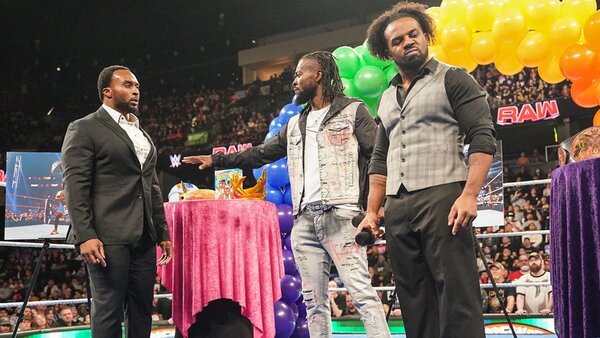
Yes, it all ended up with the New Day whinging to Adam Pearce and wearing (admittedly funny) oversized hats. In the defining thread of WWE's 2025, the follow-up to a hot angle was inexcusably bad.
But the angle itself was too incredible to omit here.
The drama was informed by the rarest of things under latter-day Vince McMahon: disciplined long-term storytelling. The New Day were a force for so long that it felt like they'd never split. Even when they weren't a proper stable, they remained an aligned collective. WWE never opted to break them up for the sole purpose of eating away at a few bothersome PLE cycles. The merchandise sales over the years likely helped a great deal, but there was no pressing need. People didn't want to see it. This was especially true after Big E suffered what sadly appears to be a career-ending neck injury in March 2022.
This is what made the December 2, 2024 heel turn so impactful: it was an unnecessary, unconscionable act. In storylines, it was not Big E's fault that Kofi Kingston and Xavier Woods were so aimless - but they projected and blamed him for their loss of form and relevance in an excruciating, masterfully paced segment. Against an ironic and bleak backdrop of celebration, Big E's heart gradually disintegrated. His facial expressions were powerful throughout; able to plead with his eyes, using his good nature to reason with his old friends, it was hopeless: the New Day was over, and the betrayal of Big E was handled so callously that no physicality was needed. Big E's acted heartbreak was more painful.
Triple H received loads of flak for botching this, and it still wasn't enough.
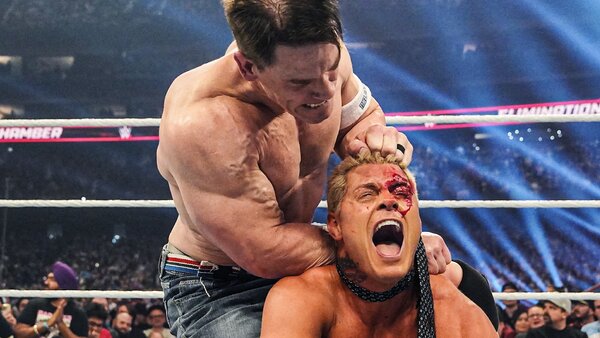
12. The John Cena Heel Turn
Yes, it all ended up with John Cena basically apologising to the fans and sneakily turning face on the eve of SummerSlam. In the defining thread of WWE's 2025, the follow-up to a hot angle was inexcusably bad.
But the angle itself was too incredible to omit here.
It was rushed and didn't make a great deal of sense. Why would The Rock, a member of the TKO board, want to orchestrate a scenario that would result in Cody Rhodes, top draw, losing his spot?
The moment was so powerful that the fans and even the promoters didn't want to think beyond it. It had to be done, somehow, just once before Cena hung them up. The allure of the idea, viable in a post-Vince WWE, cast a spell over everybody. The actual scene itself was probably worth it. Cena is definitionally uneven; the fate of his final year was sealed regardless.
The Rock sent the signal after Cena lured Cody into an embrace, getting off on his evildoing so much that he effectively penetrated himself when performing the "throat slit" gesture - a weirdly good choice for an angle designed to unsettle. Cena went a lot more broad with it, but when his face dropped from a smile to a frown, that second was worth it.
The resulting beat-down was awesome. The rare use of blood enhanced the drama, the violence, the sense that this shouldn't be happening and something must have gone wrong for it to be happening. The use of Dusty Rhodes' watch was a vile personal touch. Travis Scott f*cked up his role and hurt Cody because he was incapable of pulling his stuff, but it worked to deepen a tone struck beautifully across every department. Michael Cole dropped an expletive, which worked to great effect because it's a no-no in WWE. A transgression put over the transgression.
The single most unexpected thing left in wrestling happened, and the execution was great.
11. The Formation Of The Death Riders
Wrestling's relationship with plunder needs a thorough rethink, beyond merely the excess of it all.
It is bad enough that an assortment of objects are hidden underneath the ring, which is a dumb quirk that people have come to accept. This new trend of colour-coded Kendo sticks, tables daubed with a wrestler's name or slogan, or even worse, Slim Jim, is lame in addition to being woefully contrived. This stuff works best, and always worked best, when a wrestler grabbed an everyday item that would feasibly exist in that environment and used it for violent means. It felt more improvised and thus more realistic. A Molotov cocktail is a stupid wrestling weapon. Before they popped up everywhere, the sturdy ringside table was a fantastic weapon. A mundane object used for a violent purpose is the best way of approaching plunder because it captures the slanted, vile enterprise of a wrestler's mind.
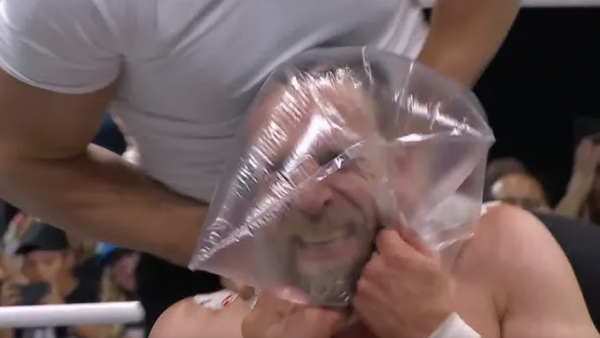
Jon Moxley using a plastic bag to suffocate Bryan Danielson at All Out was a superb idea. It wasn't AEW's idea, rather Terry Funk's, but Bryan and Mox's repurposing of it was inspired. You see a plastic carrier bag every day of your life. You never feel the urge to tighten it around somebody's throat. Only a sick bastard would do that. Thus, Mox was put over as a sick bastard, not some loser who had spent his day spray-painting a table so that his wrestling spot looked even cooler in his mind.
After defeating Jack Perry, Bryan Danielson was joined in the ring by his Blackpool Combat Club mates at All Out '24. There would be no celebrations; Claudio rocked Danielson with an uppercut before the suffocation.
Danielson's performance throughout was magnificent. Without drawing too much influence from his trainer Shawn Michaels, Bryan expressed shock. It was an earned take on an overdone facial expression because he wasn't in disbelief that somebody had kicked out of a signature move; he was shocked to an extent that bypassed his pain receptors because he had just been betrayed.
10. Cody Gets Lashed

The MJF Vs. Cody Rhodes feud was expertly plotted. It would be remembered as a classic bit of business, if the blow-off wasn't a mild disappointment. Ultimately, both wrestlers are guilty of overthinking it. The Revolution match was a messy collision of their sensibilities.
It remains the most anticipated match in AEW history. The level of hype orchestrated was phenomenal. Drawing inspiration from the great Taz Vs.Sabu feud in ECW - which was also never likely to live up to the theatre of the mind - MJF committed the ultimate transgression, and tortured the fans into waiting for his comeuppance.
MJF betrayed Cody at Full Gear '19, costing the man whose friendship never meant anything to him the chance to ever compete for the AEW World title. While this was later exposed as a senseless business decision, long-term, in the moment, it heated up the MJF build to an incandescent level rarely felt in the 21st century. MJF then set out three stipulations. Cody could only wrestle MJF if the following conditions were met:
1. Cody was unable to lay his hands on MJF until the bell rang;
2. Cody would have to endure 10 lashes at MJF's hands;
3. Cody would have to defeat Wardlow in a Steel Cage match
Stipulation #3 generated a lot of discussion. Some pundits did not believe it was possible for Cody to emerge from it with his dignity and credibility intact. He did; in a perfectly measured performance, Cody took it. He sold it, but he took it, and he didn't use it as a platform to put over how tough he is; he grimaced and agonised through the ordeal.
The little things elevated the scene - MJF targeting Cody's 'Dream' chest tattoo after initially firing at his back, the dread summoned by Wardlow's subtle "Give me a turn" gesture - which effectively portrayed MJF as a sadistic little bastard.
9. The Trial Of Sami Zayn

If there was one flaw to the Bloodline saga - and it's both massive and irrelevant, since the story is stupidly convenient but everybody loved it regardless - it's that every misunderstanding that drove the plot could have been resolved, easily, had the characters watched the television show. WWE acts are simultaneously aware and unaware that they are being filmed. It's stupid.
Or at least it was, until the Trial of Sami Zayn.
In the best case of better late than never, both Paul Heyman and Jey Uso watched hours of footage back to determine whose side Sami was really on. Heyman's prosecution was a hit piece, hilariously circumstantial, while Jey's was conclusive. That Jey, once Sami's biggest detractor, would literally leap to Sami's defence was genuinely heartwarming. He rescued Sami from Solo Sikoa's finisher, jumping into frame from out of nowhere at the last possible moment. This generated an eruption of a pop. The shot composition was superb. The "cinema" talk was always very dumb, but this angle was somewhat close. Between the creative and the production, this all felt like a deliriously joyful walk in a post Vince McMahon and Kevin Dunn utopia.
And then, with rare, creative forethought - after Adam Pearce had already instituted a reactionary Freebird rule in favour of the Judgment Day a few weeks prior - Sami deputised for an "injured" Jimmy Uso mid-match. Successfully defending the Unified Tag titles with Jey, in a match against the Judgment Day loaded with several unbearable near-falls, this was Sami's big moment before the turn, before he finally rediscovered his agency.
More on this later...
8. The Elite Sit Down

AEW hasn't exploited the Jim Ross sit-down interview anywhere near enough.
Renee Paquette is great in the role, but those segments are rushed. The graduating level of tension that drives these candid, heated conversations is edited to death. The impact is often lost.
They perfected it when the Elite sat down to promote their classic Tag Team title match at Revolution 2020 on the go-home Dynamite.
Not always the most subtle nor natural actors, these were exceptional, muted performances. Nick Jackson, conveying the awkwardness, didn't want to be there. Matt Jackson wondered aloud why he wasn't an AEW World Tag Team champion. He was in disbelief that two "great singles wrestlers" were sat in front of them with the belts laid across their lap. He couldn't understand it. "Oh God, you wouldn't" Hangman Page said, so softly that you could barely hear it.
Omega explained - to Page's dismay - that their success was "situational". Page argued that it wasn't some accident. Omega, deftly building the layers of melodrama that sparked the seminal match on February 29, claimed he was inspired by the Young Bucks to be better (where Page was motivated by his need to defy them and prove himself Elite). Omega and Page, on a different conversational wavelength, were telling you all along that they were two singles wrestlers who weren't an actual team built to last.
Ross was magnificent. The tension wasn't chopped to death. It hung in the air, and Ross probed it, asking Page why he was uncomfortable.
The conversation deteriorated not with a threat, nor an insult. Matt Jackson referring to Page, with awful condescension, as "Adam" was it: the catalyst for Page to walk. The "ROH jobber" was a young boy in their minds, and he knew it. Omega sat there with his head in his hands. The feeling, allowed to linger, was palpable. Every character in that promo had a relatable and just motive. Those motives simply couldn't co-exist. AEW has had fun, possibly too much, burying WWE.
This however was the best flex yet of its superiority.
7. The Debut Presentation Of Kevin Owens

Triple H's NXT was incredible at its feel-good best, but go back and watch the week-to-week episodic TV. The wrestling was great (mostly). The character arcs in totality were very effective. The spark, the energy, the promos and angles weren't really there. It was a basic, functional show that reached - eventually - euphoric crescendos. The exception was the stunning introduction of the Kevin Owens character.
His debut was built ahead of time as a massive deal. Owens had finally made it. A buzz-worthy name from the indie circuit, he was always going to be received as a babyface by the ultra hardcore fans who both respected him and enjoyed flexing their knowledge. WWE baited the Full Sail fans by presenting him as such. Owens was the killer with purpose; he needed to secure his young family's future. After defeating Juice Robinson at NXT TakeOver: R Evolution, Owens celebrated Sami Zayn's NXT title win over Adrian Neville later that night. The hug, the tears, the very real emotion siphoned into the work: this was amazing, and not just because WWE had acknowledged a story that unfolded beyond its canon. It's tempting to put this over as merely "refreshing", but the level of performance was world-class.
Owens didn't just turn by smashing Zayn against the apron with a power bomb; by ruining his closest friend's career triumph, he revealed himself to be the worst person in the industry. Just a remorseless, ugly, self-obsessed piece of total sh*t.
Or, a fantastic heel.
6. Eddie Kingston And CM Punk Build Their Fight

An acrimonious divorce, a secret workplace rivalry, a moment of madness when two strangers in bad places are on the drink: conflict in real-life either lasts a lifetime or is over in one pissy flash. Nothing lasts or is concluded after three neat months, but that doesn't suit wrestling and its storytelling cycles, so the medium rarely reflects the reality of conflict. AEW did with the CM Punk Vs. Eddie Kingston programme.
Eminently relatable - again, who hasn't thought a co-worker was a sanctimonious pr*ck from afar? - Kingston never forgot how much of an ar*ehole Punk was to him early in his career. They were drawn together when an irate Kingston (inadvertently) ate up Punk's interview time on Rampage. When they convened a week later, Punk remarked that this was typical, unprofessional Eddie.
Kingston's performance was a masterclass. The rising anger was as organic as it was incredible. He sold a big fight in a way everybody could understand using only his face - and he also happened to cut an outstanding promo, too.
A genius pro wrestling storyteller, Kingston knows from his lived experience of mental health issues that sarcasm is the precursor to an outburst. His eyes bulged as Punk patronised him. He was seething. Then, the sarcasm. The fake, mugging smile.
He was angry, but he attempted to obscure it - before, after Punk took his piss-taking too far, he wondered why he was bothering. He told Punk he was a tw*t, got in his face, ate a headbutt, and then tried to bite the flesh off his face.
Look at the expression on Kingston's face. It was unbridled fury, it all started with a simmer, and everybody has felt that internally in everyday life.
5. The Full Gear '19 Go-Home Brawl

If the closing scene of the Dynamite premiere was evidence that AEW could create excitement ahead of a PPV cycle, the Full Gear go-home brawl was proof that they could sell a major show. This was the moment AEW Dynamite felt truly special, where the show established its identity as a high-energy overlap of interconnected characters with layered motivations.
AEW perfected this resourceful exhilaration on the Full Gear '19 go-home show when, following Chris Jericho and Sammy Guevara's tainted win over Kenny Omega and Hangman Page, Cody Rhodes ran into equalise the Inner Circle beat-down. MJF, in one last red herring before the turn, sent the retreating Jericho back into the ring for the Cross Rhodes that teased a title switch.
Jon Moxley, smelling the blood, came out to get amongst it as the Inner Circle recovered. His upcoming opponent, Kenny Omega, slunk away - but not to help out Cody. He wanted to fight barbed wire with barbed wire with Mox. Their barbaric show-down was teased only briefly - you'd have to pay for that - before Ortiz and Santana attacked Omega. None of this was contrived; every player involved had motive to join the fray.
A mass brawl ensued, in which - after Omega blasted Santana with a V-Trigger disgusting even by his awesome standards - the Bucks condensed their demented PWG work into their part of the brawl by diving off the entrance tunnel. It ended with a stand-off, except it didn't. Matt Jackson broke the invisible wall because it was invisible; like a real-feeling character, he was still hot, and no fake format sheet had to tell him to calm down.
AEW sold every big match on a pay-per-view in five utterly blistering minutes.
4. The Festival Of Friendship

As good as if not better than any angle shot in the heyday of WWE Raw, the Festival of Friendship was a masterpiece.
The non-fan finds pro wrestling not merely "fake" or silly, but utterly inexplicable. They can't fathom that you like it. Show them this segment, and they might begin to understand. The tone was set with Chris Jericho announcing the festivities with the biggest, beaming smile on his face. He wore it to put over the contrast of the moment his heart would be ripped in two. Jericho also wore the expression in order to slowly, torturously, ramp up the gut-punching suspense. How could Owens do what he did to Jericho?
The Festival goes wrong, hilariously so, throughout. It was bad enough, for Owens, that his clown mate was screwing around too much and ruining his aura. Now, Owens was becoming a laughing stock. The genius of the Festival of Friendship is that Jericho was annihilated when this five-star winner of an act was at its most entertaining.
In an ingenious twist, Jericho shattered the facade near the climax and used his real-life feelings about what was a rejuvenating period in his career to tell Owens how much he appreciated him. It felt like (and probably was) a shoot. Then, when Owens was done with Jericho's b*llocks, he gave him a new list.
"How come my name's on this?" Jericho said.
Wrestling is at its very best when it conveys an emotion the audience has felt. The rejection here was soul-destroying.
3. The Sami Zayn Turn

WWE did something phenomenal at the 2023 Royal Rumble. Stadiums are not meant to sound like they did when Sami Zayn cracked Roman Reigns with the steel chair. The sound is not meant to carry that well. The level of emotion no-sold the acoustics. Sami Zayn's face turn was a masterpiece of an angle.
The moment was informed by tremendous, layered storytelling plotted across several months. Zayn's character work was stunning its range, too; endearing and sympathetic, he didn't join the Bloodline because he was a bad person. A man who spent so much of his career being manipulated and battered by his closest friend Kevin Owens longed for acceptance. In yet another facet to a seminal turn, he saved that friend. He wasn't just funny, sympathetic, well-intentioned. He was loyal.
Without the use of blood, WWE effectively orchestrated an effective, brutal scene. Kevin Owens, cuffed and at the total mercy of the Bloodline following his loss to Roman, sold his role brilliantly. Roman Reigns was outstanding too - and again, months' worth of subtle menace informed the power of his furious explosion. Predictable is the wrong word to use here - that would imply the saga wasn't dramatic - the expected turn of events was already great.
Sami turns.
He loses to Roman at Elimination Chamber.
He exacts a measure of revenge alongside Owens against the Usos at WrestleMania 39.
Jey Uso walking out added a superb, intriguing twist to the story that also dovetailed with his own complicated relationship with Roman. WWE took the storyline into an even more fascinating direction than we all thought.
The whole thing was masterful.
2. The Pinnacle Hang CM Punk

Jim Ross has divided the AEW fandom since his first day on a job he never seemed to be into all that much. Moaning about the booking and officiating, he spends more time trying to grasp the action than calling it - but while he may not be as good as he was, on March 2, 2002, he was as good once as he ever was.
The legendary CM Punk Vs. MJF programme had taken an incredible, left-field twist the week prior, when MJF revealed that Punk had acted as his escape from a bullied life of torment in his formative years. Punk could no longer receive MJF as a rival. He was something else, or at least he believed he was somebody else - because he was a good man, or at least he was trying to be.
Punk's goodness was such that it excused him falling for the ruse, but he wasn't such a hand-slapping good guy that it betrayed his edge and his character's evil history, which he openly acknowledged. The whole saga was as nuanced as wrestling gets, and when MJF revealed to the old man that he was a snake, he got even more over as a heel.
He kicked Punk in the balls, punched open a gash in his head, and, using the dog collar, hanged him over the ropes. A gruesome twist of a heat angle, it was phenomenally effective - Revolution '22 drew at least 165,000 buys - and Ross played it to perfection.
He wasn't histrionic. Measuring the subtle complexity of the story brilliantly, he simply said "Too far, fellas. Way too far."
1. The Young Bucks Vs. FTR Non-Match

Fans want to get excited about a match. This is what the AEW of 2025/26 all too often fails to grasp. The graphic alone is not enough. The AEW of 2020 did such an awesome job of this that the promotion made fans relieved that they'd have to pay to watch FTR Vs. The Young Bucks.
FTR could cut a ring in half like no other team, and upon arriving in AEW, they cut the Elite half, enabling Hangman Page's drinking under the pretence of friendship. This disgusted Page's sober stablemates, which FTR exploited. Meanwhile, FTR and the Bucks both aspired to win the Tag Team titles. This dovetailing story reached an incredible inflection point ahead of All Out 2020.
In a brilliant and all too rare use of the old rankings system, the four highest-ranked teams competed in a gauntlet match. The teams ranked #3 and #4, logically, entered first and had to make hard work of it. This drew FTR and the Bucks perilously close to another. On free TV? In a Gauntlet match? With no build?
No: Hangman Page cost the Bucks the win by preventing Nick Jackson from executing the Meltzer Driver. His life, as shown with an effective if on-the-nose visual, had been shattered.
This was a superb display of booking; this one angle advanced Hangman's character arc, ripped the Elite apart to initiate the long build towards Full Gear 2021, and reminded fans of the enormity of the FTR Vs. The Young Bucks I. Threatening to give it away acted as a reminder that it was a premium dream match worth shelling out $50 for.