One MIND-BLOWING Secret From Every WWE Royal Rumble
Your jaw must touch the floor: a huge deep-dive featuring Sabu, Abyss, and MORE.

The WWE Royal Rumble endures as the best gimmick match ever.
This isn’t an objective statement, but that is the consensus - and it is an inarguable fact, from a purely commercial perspective. If you stacked everything up, there’s a strong chance you’d list just as many disasters as epics. The PLE, historically, is wildly uneven. It is meant to be the catalyst for the most important wrestling event of the year - nay, all-time - and it often was.
Steve Austin winning in 1998 to formalise his ascent as the main man in all of wrestling; Chris Jericho and Shawn Michaels interacting in 2003, teasing the promise of an inter-generational dream match once thought lost to time; WWE improving on that premise by booking SmackDown’s Kurt Angle to eliminate Raw’s Shawn in 2005, leading to the one time WWE grasped the surreal brilliance of inter-promotional conflict; John Cena's shocking return from the WWE injury list in 2008: all were incredible moments informed by the Rumble and its in-built mechanisms to initiate and progress multiple storylines.
Then there was the backlash that greeted Batista’s win in 2014; the infamous Roman Reigns business a year later, when an entire arena rejected WWE en masse; the utterly, laughably idealess decision to go with Brock Lesnar in 2022.
Other times, it was simply uninspiring (Randy Orton as the safe choice in 2017, Seth Rollins emerging triumphant in 2019.)
But it’s the promise, the mystery, that never dies. Who’s going to win? Which two upper midcarders will set-up their breakthrough match at WrestleMania? Which much-missed star from yesteryear will make a cameo appearance? Who will make their grand full-time return? Who might debut?!
It’s the secretive element to the Royal Rumble that generates an enduring, fervent interest - and, since you’re into that sort of thing…
1988 - The Real Inspiration Behind The Match
The Hell In A Cell match was heavily inspired by the ‘Last Battle of Atlanta’, promoted in 1983 by Georgia Championship Wrestling. The Ladder match originated in the Stampede territory. The Royal Rumble was also a twist on another territory’s match: San Francisco’s Cow Palace Battle Royal.
The Cow Palace Battle Royal was the biggest match on the Big Time Wrestling calendar.
In the ‘70s, the match was built by Roy Shire as a huge attraction to which the biggest territory stars across the land were invited - i.e., the match didn’t just utilise the existing roster. It was promoted in January in order to initiate the key storylines that would play out over the remainder of the year. Most of the time, the winner would receive a United States title shot at the next major Cow Palace show. The match was held under traditional battle royal rules - Pat Patterson’s interval format was his own, genius idea - but the WWF lifted or tweaked almost everything else.
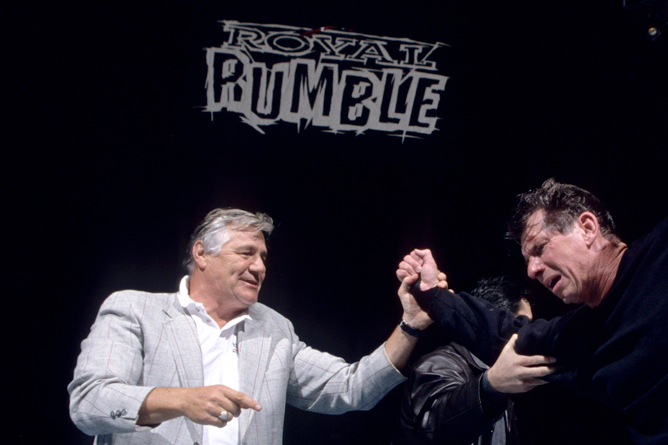
In 1988, the WWF promoted the first canon Royal Rumble event: a 20-man TV special pitched by Pat Patterson at the urging of NBC executive Dick Ebersol, who wanted a brand new attraction. Vince infamously hated the idea. The match was shunted onto PPV the very next year, since the ‘88 demo, won by Hacksaw Jim Duggan, was the third highest-rated wrestling event in the history of cable television.
This was not however the first Rumble match - and the first experimental version was such a failure that the fabled Road to WrestleMania almost looked very different. Vince was actually justified in doubting the Rumble as a spectacle; the non-televised October 1987 experiment was an artistic and commercial failure. The match was said to be rubbish, and incredibly, the best gimmick match format ever alienated a traditionally-minded St. Louis audience.
In an interesting trivia note, history would repeat itself: St. Louis was cursed to endure one of the worst Royal Rumble events ever in 2022.
1989 - The Iconic Opening Sequence Was Kept Secret

The 1987 Royal Rumble match was said to be so awful that Vince McMahon nearly trashed the concept forever. The 1988 Royal Rumble was a smash hit, but in retrospect, the novelty of the gimmick carried the action. The speed with which McMahon and Patterson realised the layered storytelling potential of the Rumble was still astonishing.
In 1989, famously, Ax and Smash, teammates in Demolition, drew #1 and #2 respectively. This was and remains an incredible sight. For context, Vince McMahon had not even promoted a major babyface versus babyface match on pay-per-view; that would follow a year later, when Hulk Hogan and the Ultimate Warrior faced off at WrestleMania 6. Watching these badass heroes and teammates was a eureka moment on top of a shocking double innovation. The WWF had innovated the hot start, creating a pathway for some of the most exciting opening pairings in Rumble history. Weirdly, it took a while longer for Vince to recreate and tweak the magic - but when he did, a string of mark-out moments unfurled. Even Bret Hart professed to feeling like a giddy fan in his autobiography when watching Ric Flair and Bob Backlund get things going in 1993.
Chris Jericho Vs. Shawn Michaels, and how it didn’t happen, was a sensational twist on the concept in 2003 - an awesome means of building anticipation ahead of their WrestleMania 19 match. In a way, the 1989 masterstroke was almost too good an idea, in that certain nothing-happening wrestlers were resented for having the temerity to come out at #2.
As revealed in a 2023 interview with ‘Wrestling Then And Now’, Ax and Smash had no idea that this was going to happen - and naturally, they had no idea what to do. So they just whaled on each other and sent the crowd into a frenzy.
1990 - Busting A Myth

False narratives prevail for countless reasons.
Memories are faulty generally, compounding the fact that people tend to believe what they’d like to believe. Certain things feel like they must be true, or very feasibly could be true, so we tend to run away with something when the dots are there to connect.
A combination of all of this has informed the enduring idea that Curt ‘Mr. Perfect’ Hennig was slated to win the 1990 Royal Rumble match.
Mr. Perfect was a beloved character, admired in particular by the wrestling fan who gravitated towards the technical artform beyond the fad. To this day, he regularly tops polls and lists asking “Who should have been WWE Champion, but never got the chance?”
Hulk Hogan, conversely, was the contrarian’s enemy. He was over-pushed (despite earning every bit of it as a result of his immense box office muscle). He was on top too long (despite doing the big job just as his powers were fading, and the fact that the business model in place at the time meant he wasn’t overexposed through 52 weeks of live primetime episodic TV). He was one of wrestling’s most ruthless and influential politicians, thinking nothing of ruining entire companies if it meant his ego was satisfied. What’s one wrestler’s career?
While this last part is true, he didn’t snatch Perfect’s win away from him on the day of the show. As brilliant and as entertaining as Perfect was, he was not a draw. His match against Hogan at Madison Square Garden on January 15, 1990 drew 11,5000: the worst crowd at that building ever for a Hogan title defence.
This was just days away from Rumble ‘90, too: if there was a plan to have Perfect win, and there’s no evidence of that, Hulk Hogan wouldn’t have been the one to scrap it.
1991 - Mutiny Was Afoot

WrestleMania 6, an excellent show by the standards of the time, watched live by 64,287 people, was nonetheless the beginning of the end of the WWF boom. The show was outperformed by WrestleMania 5 the year prior (560,000 versus 767,000), and worse, the Ultimate Warrior failed as a draw.
A lot of factors converged here - Hogan played the magnanimous real hero in the post-match, no wrestling boom lasts forever regardless of who’s on top, Warrior had already worked his major heel opponent, Rick Rude - but Warrior was a novelty act, albeit a very popular one. Business softened with Warrior on top, and so the decision was made to go back to Hogan - even though 1990 was the right time for him to lose.
Vince McMahon was stuck, and whenever he got stuck, he got desperate. His grand plan for WrestleMania was to exploit ongoing tensions in the Gulf - and he was undeterred, emboldened even, when war broke out. Sgt. Slaughter, repackaged as an Iraqi sympathiser, was used to transition the belt between Warrior and Hogan. The public was aghast at this storyline development; WrestleMania 7 was a disaster.
The lens through which to view all of this is important. Nowadays, relative to WWE’s history of controversy bait, the events of 1991 feel almost quaint - but in 1991, the promotion still presented itself as the most family-friendly interpretation of pro wrestling ever or imaginable.
Days before the Rumble, the conflict in the Gulf was initiated. According to the January 28, 1990 Wrestling Observer Newsletter - written at a time when Dave Meltzer was arguably at his most thorough and impassioned - “many within the front office feared a media backlash against such an obvious attempt to heavily exploit the war”.
Meltzer even reported that “a few heavy hitters in the front office were privately considering quitting the company”, and that others pleaded with Vince, until the very last minutes before the PPV aired, to abandon the title switch and resulting storyline plans.
1992 - No, This Wasn’t The Most Star-Studded Rumble Ever

The 1992 Royal Rumble is remembered in shorthand for two reasons.
Firstly, it is considered one of if not the very best Rumble matches ever, acclaimed in the extreme for Ric Flair’s iron man stint and Bobby Heenan’s breathless, panicked tour de force of a commentary performance. Secondly, it is known as the most “star-studded” field in the history of the match.
Only one of these things is arguably true.
The field looks star-studded, but only through the faulty lens of nostalgia. On paper, yes, the field is an amazing list of names - but consider the status of many of those stars in 1992, which was a rotten year for business. Ted DiBiase was one of the most entertaining big heel stars ever in the 1980s; by January ‘92, he had peaked as a featured singles act. Roddy Piper, Randy Savage and Jake Roberts had all done or were very close to doing career-best work, artistically, but their star power was on the wane. Greg Valentine was done with the company less than a week later, to underscore the extent to which he had outlived his usefulness. Conversely, Shawn Michaels was only just getting over, and wouldn’t become the Showstopper until 1994. The Undertaker while magnetic was closer to being a failed main event experiment than a top star. It’s a better poster than a roster, a collage of names that were past their prime or nowhere close to it yet.
If the ‘92 Rumble was as star-studded as we all remember it, how do you explain its performance?
The show drew 260,000 buys - the worst-performing PPV in company history, if you don’t take the experimental This Tuesday In Texas into account.
While this isn’t a secret - the information has been known to the public for decades - it might as well be, since it clashes so spectacularly with the prevailing consensus narrative.
1993 - Why The WWF Title Match Was So Quiet

Jim Cornette supposedly pitched, repeatedly, that some wrestler or other should hide in a box by the stage for weeks on end in 1997. Meanwhile, in a “be careful what you wish for” moment, Cornette campaigned for the return of Terry Funk.
Vince, with his love of props n’ gimmicks, connected these dots and repackaged Funk as ‘Chainsaw Charlie’. It was Funk, using the cutting tool, who emerged from the box.
“Anyone who comes out of a box is instantly over” is a quote often used to ridicule Cornette, but he had something of a point - and this was proved correct back at Royal Rumble 1993.
People are obsessed with mystery and secrets; the object hidden in a box is the most rudimentary example of this phenomenon. It’s ridiculous, but no less true; in October 2025, WWE ran teaser footage of shoes worn by unknown figures on their social media channels, and before it was revealed to be a WrestleMania commercial, the fandom had convinced themselves that a new faction was set to take over WWE. This stuff, naff as it is, fuels the imagination.
At the ‘93 Rumble, WWF Champion Bret Hart defeated Razor Ramon. It was a solid match, well-wrestled, a bit too long, not one of Bret’s best. It was also bereft of crowd heat to a very noticeable degree in the first half, and that’s because the crowd was distracted by a mystery: the production crew was busy setting up the curtains hiding the wall of mirrors set in front of which Lex ‘The Narcissist’ Luger was set to debut.
It's official: DIY is more over than logical limb work.
1994 - Sabu Rejected A Cameo Spot

The prevailing narrative is that Vince McMahon was a puerile, size-obsessed enemy of the wrestling art form, a despot who spat in the face of workrate. He only booked good matches when he had no other choice. Elements of this are true, but Vince loved a rollicking midcard match at almost every turn in his career as a promoter. He seemed to love that more than his successor, strangely enough.
In 1993, he was sufficiently taken with Sabu, or at least saw enough of him in a mixed October 1993 series of tryout matches, to offer him a spot in the ‘94 Rumble match. (According to Joe Lanza of Voices of Wrestling, Vince selected Owen Hart as a Sabu dark opponent purely because he thought it would rule).
Sabu was free to do it, as a true independent contractor, but was also so over as a lucrative touring sensation that he could literally afford to be discerning. If he didn’t like the idea, he didn’t have to do it, and he was always mindful of the unique, underground aura. Going to “the Fed” might have diminished that; he could always cash in later. (Also, despite its exceptionalist marketing, there wasn’t that much money to be made up north in 1995).
Sabu turned down the cameo because, almost two full years before Survivor Series 1995, Vince wanted Sabu to break a table - a table that Sabu would bring to the ring himself. Sabu thought the idea was contrived; in those earlier years, he liked to “find” a table that would ordinarily be placed near ringside.
1995 - Dick Murdoch’s Age

The early-to-mid 1990s was a cold and barren time for the WWF.
The promotion’s national expansion had destroyed the territory system and its mechanisms of building new talent. The emerging indie landscape was yet not an adequate replacement for it. The roster depth was shocking for years, which was less than ideal, since Vince McMahon needed 30 guys for one annual match. He had to get creative. The architect of the New Generation had to go old school.
Older fans will remember how this informed a certain phenomenon: dusty unknown guys entering the Rumble match. Many of these wrestlers were of course stars or legends in their own right, but to the young kids who didn’t know any better, they were weird and off-putting. They might as well have been 100 years old. Did you beg your parents to get you the Carlos Colon Hasbro?
But mom, he’s an upcoming youngster! He might win the belt!
Dick Murdoch was 48 years old when he entered the 1995 Royal Rumble match at #27 for a brief five minute stint. Through the lens of a child, he looked, at best, like an uncle. You had never seen something so ancient as this olden days wrestler.
Murdoch was 48 in 1995: the same age as AJ Styles, John Cena, and Brock Lesnar in 2025. Murdoch was just one year older than CM Punk and Sheamus are now, and two years older than Samoa Joe and Johnny TV.
Murdoch was actually younger in 1995 than Adam Copeland, MVP, Bobby Lashley, Nigel McGuinness, and Shelton Benjamin.
1996 - A Boxer Was (Supposedly) Considered As A Mystery Celebrity Entrant

Who was the first “mystery” entrant in the Royal Rumble?
As mentioned, there were several “surprises” before the trope was woven into the tradition, but that’s only because you had no idea who these people were. You weren’t meant to pop for them; they were there to shamble their way to the ring, hoping to go unnoticed before they were eliminated within minutes, because they were there to make up the numbers.
The first actual surprise entrant - i.e., someone you knew of, and whose appearance was portrayed as a surprise - was Jerry ‘The King’ Lawler in 1997, whose sh*t-eating grin was wiped off his face when Bret Hart eliminated him in five seconds. The spot was so incredible that it birthed the ensuing novelty wave. The first celebrity entrant was Drew Carey in 2001. Oddly, considering he was a professional comedian, this was infinitely less funny.
Both Lawler and Carey were almost beaten to the punch - that is if you take the word of boxer Peter McNeeley.
McNeeley was known only for being the first guy to take on Mike Tyson after he was released from prison. The fight was always going to receive a massive amount of publicity; Tyson was a monster draw even before he became notorious. Fittingly, there was a pro wrestling flavour to the “finish”; McNeeley’s manager theatrically entered the ring to save his man after the second knockdown, causing a disqualification.
According to the Boston Herald, McNeeley reckoned that the WWF wanted to reenact the Tyson fight finish by throwing him out on 89 seconds after his manager, Vinnie Verrione, interfered. This all seems very plausible, a thing the mainstream-chasing WWF would do, but what ultimately felt like a publicity stunt was revealed when the Undertaker was named as the guy who was planned to eliminate him.
‘Taker was not in nor planned to be in the Rumble match that year.