One MIND-BLOWING Secret From Every WWE Royal Rumble
1997 - Vince Russo Was Responsible For A Swerve BEFORE He Became Head Writer
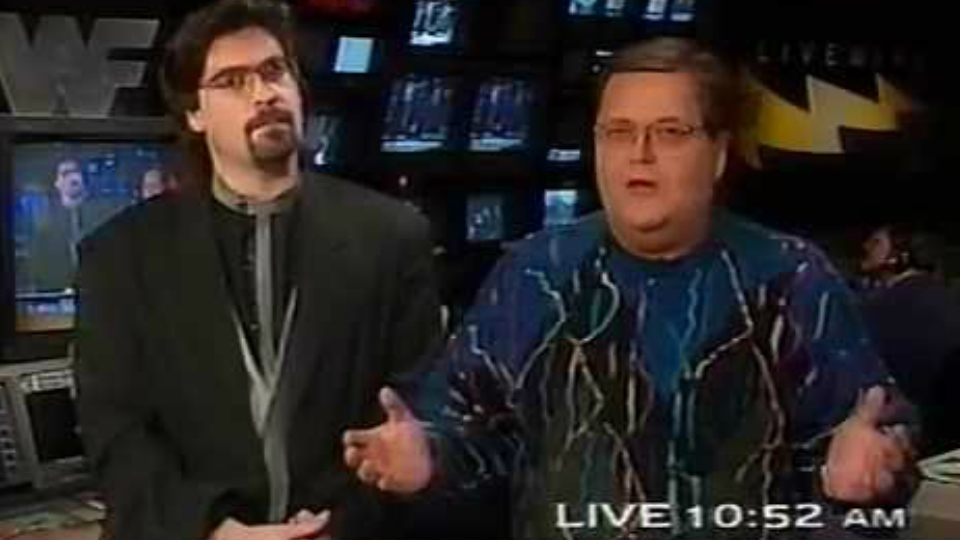
Former WWE head writer Vince Russo was obsessed with swerves. He is defined by swerves. He made his career by hatching swerves. He loved nothing more than fooling the audience, but his one-dimensional approach reached such levels of parody that the swerve developed an inescapable irony. After Survivor Series 1998, his daft but equally incredible opus, the swerve became the expectation. In an indictment of the industry, after assisting WCW’s death, he was employed for years and years afterwards.
Jim Cornette can get hysterical about Vince Russo, but when Jim said Russo hated wrestling and wrestling fans, you can readily believe it. Russo once introduced a star wrestler to TNA audiences by saying “You pieces of sh*t, give it up for AJ Styles!”
Russo always seemed to want to portray himself as smarter than the smart marks, who were there to be manipulated, and he started early. Before he seized power in WWE creative, as ‘Vic Venom’, he progressed from magazine writer to co-host of LiveWire: a phone-in programme that sought to “lift the lid” on all WWF happenings.
Russo loved that he knew something that you didn’t, and, when asked for his “prediction” on the winner of the 1997 Royal Rumble match, he “predicted” Bret Hart with near-certainty. That’s because he knew the plan was for Bret Hart to win, and wished to appear very clever and prescient. People took it seriously, too, since Venom leaned on his persona as an insider.
In the January 6 Observer, Meltzer reported that Russo took heat for it, which is why he seemed to backtrack. In the January 27 Observer, Dave Meltzer reported that the finish to the match was actually changed because too many people believed Bret was winning because Russo had given it away. Meltzer did write that the WWF was “perhaps overly” concerned about this.
1998 - Hulk Hogan Was Teased To Appear…
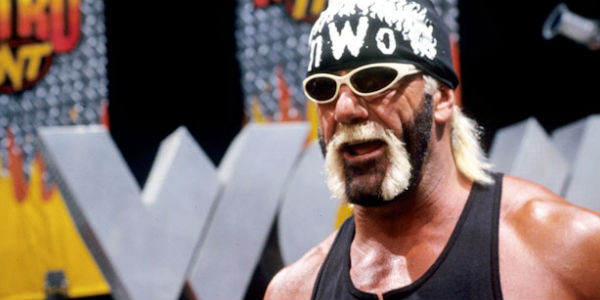
…sort of.
A carny business like pro wrestling was always going to gravitate to the hotline racket, because it - a pre-mainstream internet means of spreading gossip - was a flagrant work. If you’re a younger fan who knows nothing about it, here’s a rundown:
It would cost a small fortune to make the phone call; if your parents were wise to the scheme, they’d never let you ring the number. If you somehow successfully pestered them into a state of “whatever, just leave me alone for five goddamn minutes” fatigue, you will recall how it worked.
The host service would keep you on the line forever, would first reel off short summaries of the promised scoops, promote some other stuff for an eternity, and then in excruciating detail and at a slow pace run through said scoops in the order of least to most interesting. By the time you got to the information you very clearly specifically utilised the service to learn, it was revealed not to be major breaking news at all.
Ahead of Royal Rumble 1998, the WWF Hotline promised the scoop on those red-hot rumours about Hulk Hogan’s shocking, epic World Wrestling Federation comeback. Was he jumping from WCW (or the New World Order) to the WWF and returning at the Royal Rumble?! Which, conveniently, is just days away?!
Customers were told that, in no uncertain terms, no: Hogan is not returning. They need not have bothered clarifying what wasn’t exactly the talking point on everybody’s lips - but, by teasing that this was something of a possibility, enough to shoot down anyway, they made a few quid.
1999 - The Infamous I Quit Match Almost Looked Very Different
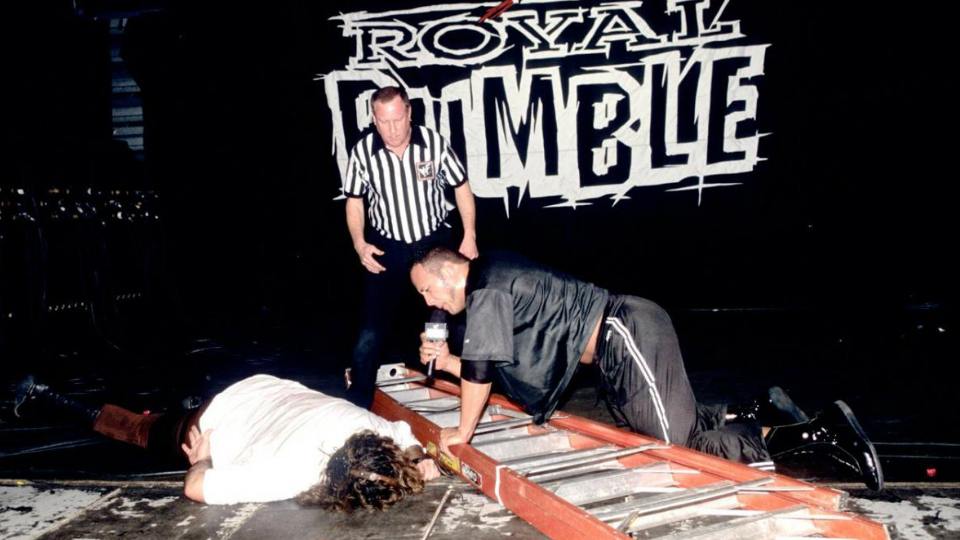
One of the most infamous and harrowing moments in WWE history unfolded at Royal Rumble 1999; the Rock took a steel chair and drilled a handcuffed Mick Foley several times with it, full-force, in the back of the head. It was a transgressive attempt at building drama, since Mankind had been built as a man with a supernatural pain tolerance, but it was taken much too far - particularly since Foley’s children were present at ringside, visibly devastated. Even traumatised. It is Foley’s biggest career regret.
The scene was bleak enough, but it gets worse: according to a report in the Observer, in the weeks leading up to the event, Foley requested tapes of two famous, incredible ‘I Quit’ matches: Tully Blanchard Vs. Magnum TA (NWA Starrcade 1985) and Terry Funk Vs. Ric Flair (NWA Clash of the Champions 1989).
While both are forever classics, the first in particular is a masterpiece. In the climactic scene, Magnum threatens to puncture Tully’s eyeball with a wooden chair leg. This is the moment that forced Tully to give. There is no dangerous, real violence here; only the threat, sold to perfection. They were working. Perhaps Foley held naive thoughts of sparing his body this time.
Foley need not have bothered wasting his time; the implied violence was never going to be enough for a now insatiable Attitude Era fandom.
Foley did agree to the sequence, but not to its revolting, senseless extent. He has claimed more than once that the Rock took liberties and exceeded the agreed-upon number of chair shots.
2000 - Insane Lore Behind The Rock’s New Catchphrase
The Rock cut a promo ahead of the Royal Rumble match. This when he was on the cusp of taking over the world - and taking Steve Austin’s spot.
He felt invincible, irresistible, but even a charismatic demigod is not infallible. It was here that he said “You should be concerned with fixing yourself a nice, tall glass of shut up juice!”
This attempted catchphrase did not get printed on too many t-shirts, and did not make it into his repertoire. That might be because it was dire, and was actually meant to be eye-rolling on purpose when originally used by, of all people, the writer responsible for the best episodes in the history of ‘The Simpsons’. Conan O’Brien used it to gently remonstrate with his writers on ‘Late Night’ when they weren’t focused. One such writer jumped to WWE, suggested the line to the Rock, and that explains that. A neat bit of trivia.
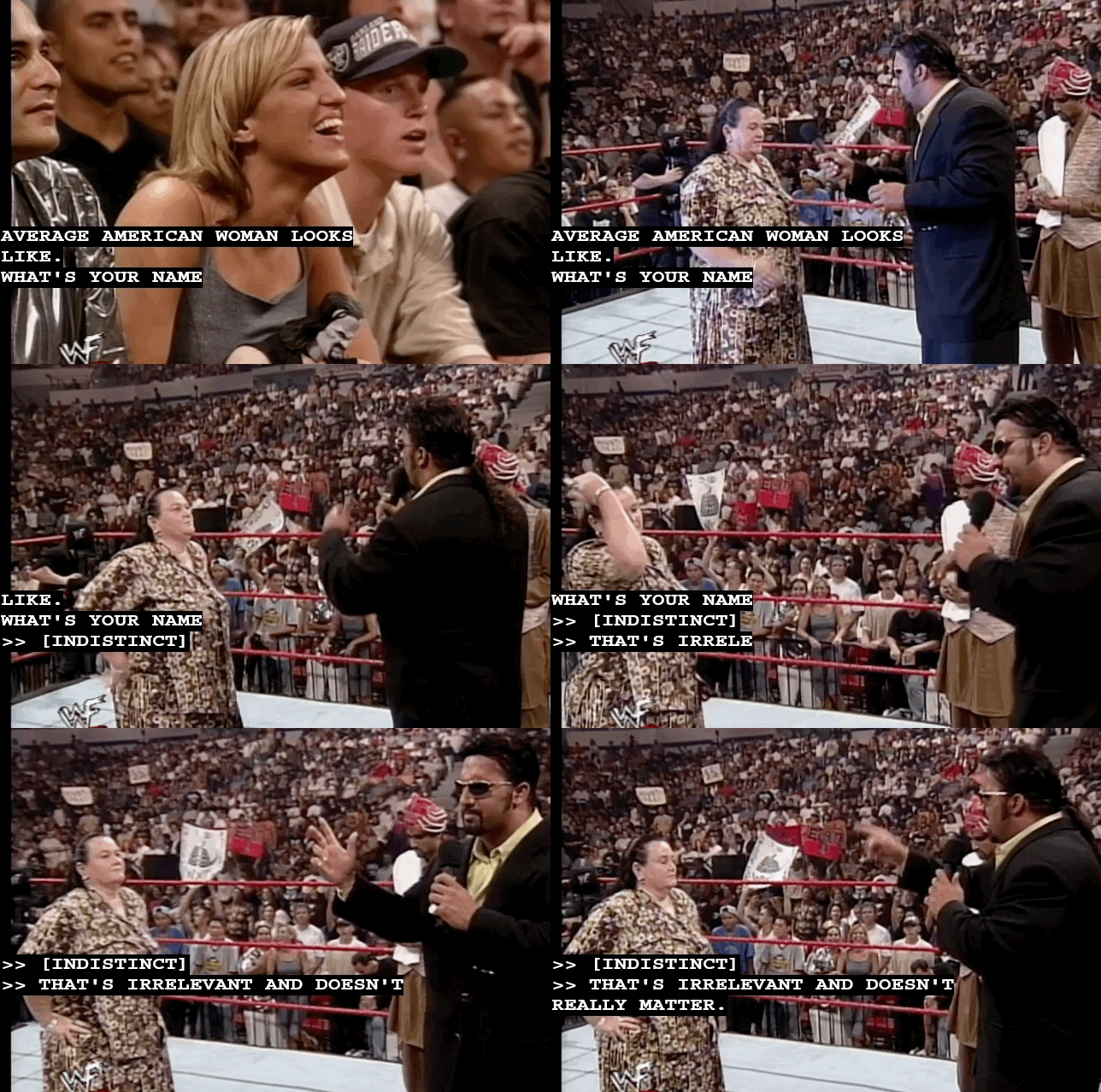
This trivia becomes ironic when you compare it to the Rock’s immortal “It doesn’t matter!” schtick. This was actually first used by infamous dud Tiger Ali Singh, in 1998, when he cut off an audience plant after asking what her name was. It’s hard to tell who came up with that, but it’s either Singh himself, Vince Russo, or somebody who was less qualified than the then-lead writer.
So one of the funniest people ever came up with one of the Rock’s worst bits, and one of the least talented people alive came up with the best.
2001 - An Ironic Note On The Prior Year’s Controversy
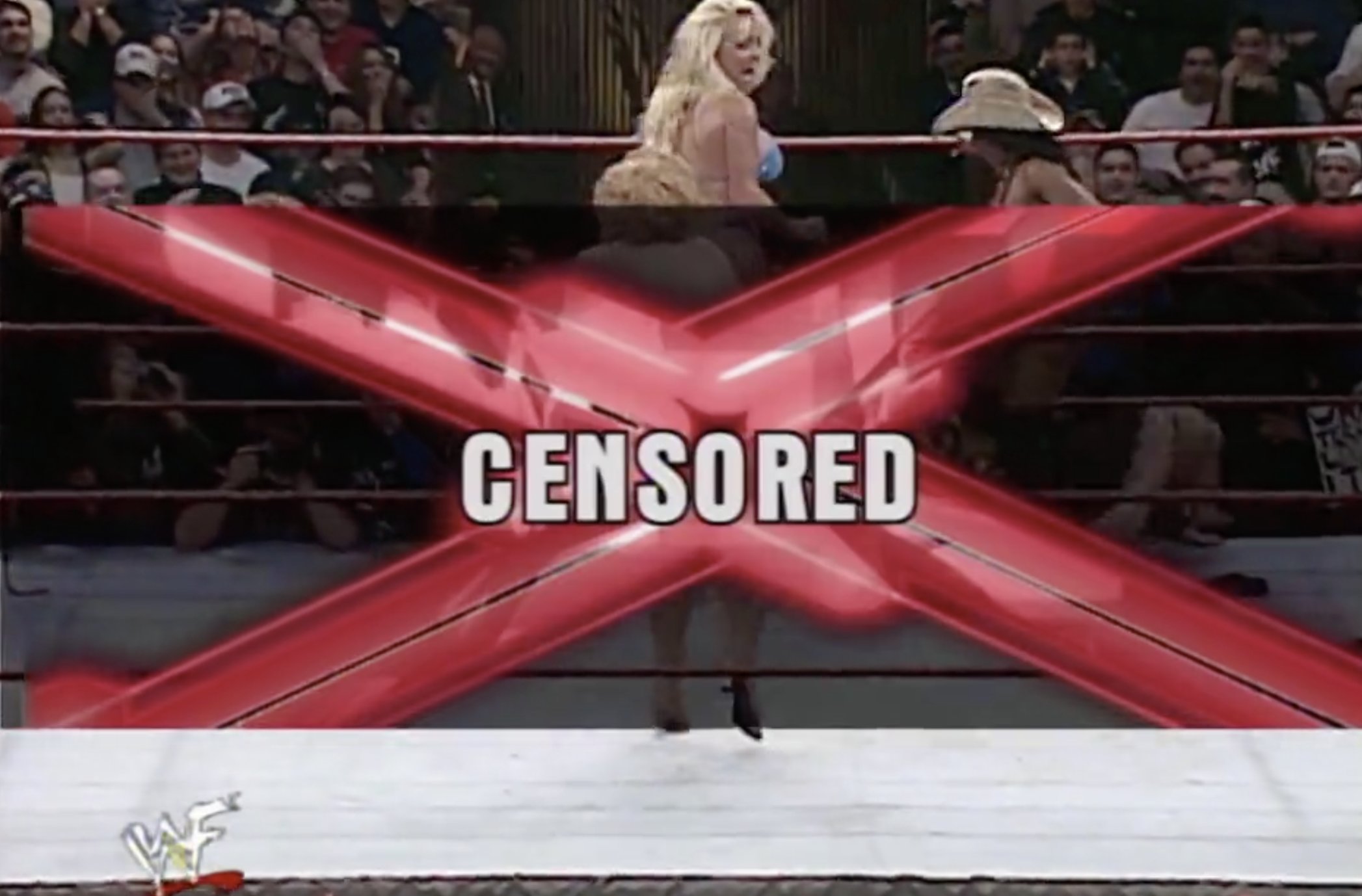
Going back in time a year, Royal Rumble 2000 was a fairly insane show even by Attitude Era standards. Tables were destroyed. Blood was spilled. Octogenarian women pretended to get their knockers out.
This was par for the course stateside, but this stuff incensed higher-ups at Channel 4 - a British station carrying a pay-per-view for the very first time. Given that they really should have expected this, since they ordered it, it must be inferred that someone of influence had heard wrestling was popular again, thought “The fake stuff with Hulk Hogan?”, and commissioned it - only to be confronted by Mae Young’s prosthetic hip-ticklers.
For the remainder of the deal, which as you can imagine was not very long, Channel 4 aired every subsequent PPV event on 50 minute tape delay, allowing editors to digitise blood and cut out any offending material. This was the case when the station broadcast Royal Rumble 2001 - with quite incredible hypocrisy.
UK fans thought this entire thing was odd, since Channel 4 was practically defined by its risque late-night fare, which was swarming with breasts. Even the signature breakfast show was rimming - sorry, brimming - with innuendo. And it was odd, because the show aired before Royal Rumble was a documentary premised on the dangers of binge drinking (or rather, a thinly-veiled excuse to screen fights and young people in states of undress). You could see bare breasts and everything.
So Mae Young’s fake nipples = bad, real nipples = spiffing.
Channel 4 explained the decision by claiming younger fans were more likely to tape the Royal Rumble.
2002 - The Real Reason WWE Re-Signed Mr. Perfect
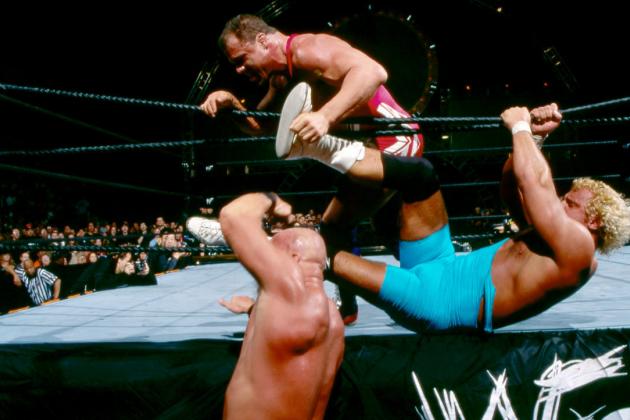
It was magic when Mr. Perfect returned at Royal Rumble 2002, wasn’t it?
All those years of thrashed WCW-era Curt Hennig were erased. The cameo was helped, massively, by nostalgia - at the ideal time, too, since what was old felt new again. The fans were tired of the current product, since 2001 was such a disaster of a year.
Perfect still looked the part; it was almost as if he had been catapulted forward through time, and of all the characters to bring back, the technical genius was the best choice. In 2002, the desire to see great in-ring wrestlers in the main event scene was at its most intense among the hardcores. It was this exact sentiment that saw Chris Benoit get the push ahead of WrestleMania 20.
But it felt like more than a sweet mystery cameo. Perfect was in there for 15 minutes, part-eliminated Steve Austin alongside Kurt Angle, made the final three, and the nature of the match meant he could play the hits and play them well. The run wouldn’t last, but the moment is remembered fondly all these years later. Why did it happen?
The reason is less fuzzy than the occasion was: the WWF wanted to thwart a potential competitor.
X Wrestling Federation (XWF) was pitched by Kevin Harrington and ran by Jimmy Hart between 2001-2002. The basic thrust of it was to plug the market gap by using a readily available pool of talent - an unofficial WCW reboot deal. It was opportunistic and unlikely to succeed, but Vince didn’t want the XWF to stand even a miniscule chance, so he poached Hennig, who had earned praise for his work. This XWF business also hastened the inevitable return of Jerry Lawler.
Pushing Hennig so hard might have dissuaded other past names from joining up with the various post-buyout offshoot groups.
2003 - The Best Royal Rumble Storyline Wasn’t Even Booked By WWE
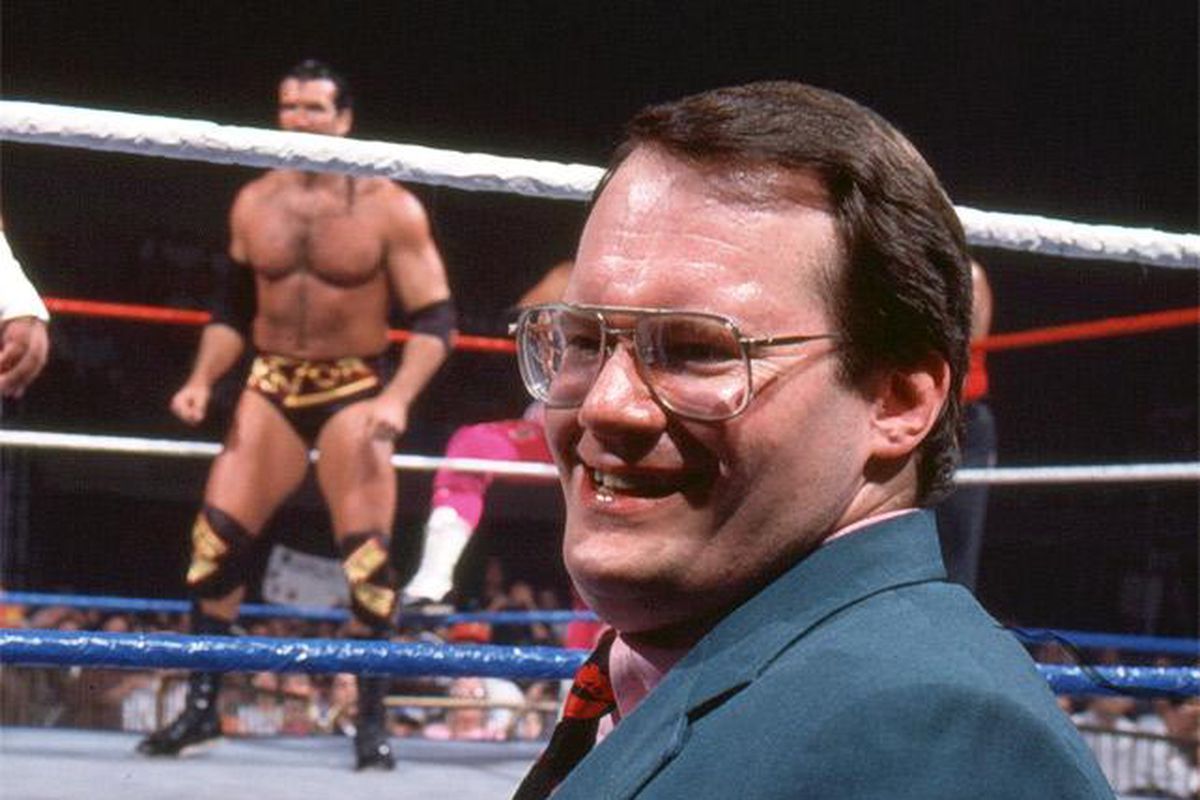
In 2003, Jim Cornette presided over Ohio Valley Wrestling: WWE’s then in-house developmental programme.
OVW was both a feeder system and a promotion, reliant on ticket sales, in its own right. For a few years, the project was wildly successful - OVW spawned the careers of Brock Lesnar, John Cena, Randy Orton, and Batista - but it was also flawed and doomed. Cornette reported to John Laurinaitis, who he despised. Cornette felt that his regulars should compete for spots with the WWE signees; the rookies needed the competition, and Cornette needed talent who could attract crowds when WWE called their guys up. Cornette had a TV show to produce, he was proud of it, and he felt that everybody should take it as seriously as he did. WWE, meanwhile, did not care about OVW as anything other than a training school. They didn’t care about destroying OVW continuity. This would often create friction, and indeed would result in the demise of Cornette’s WWE career.
Before his meltdown, in which he was fired for slapping Santino Marella, a passionate Cornette would expertly navigate WWE’s thoughtless meddling.
Danny ‘Damaja’ Basham was meant to debut in the 2003 Royal Rumble match. This was a coordinated plan between WWE and OVW; Damaja won the ‘Run For The Rumble’ tournament final on OVW TV as early as November 2002.
Plans changed.
WWE did not care about the dropped storyline, but Cornette did. He booked an angle in which Damaja attacked Rocky Johnson, Dr. Tom Prichard, and Cornette. Jim Ross helped; representing WWE, he told Cornette that Damaja had disqualified himself from the Royal Rumble as a result of his actions. (In a great attention to detail, Ross chewed Cornette out for the “discipline problems” plaguing OVW).
Damaja threw a tantrum, destroying everything in sight - TV monitors, chairs, a milk crate that smashed into a nearby camera operator. His performance was so incredible that even his own valet, Jackie Gayda, thought he was legitimately out of control; Gayda called the office afterwards to apologise for the extent of the damage.
If you look past the great Shawn Michaels Vs. Chris Jericho bait-and-switch, OVW booker Jim Cornette booked the best Royal Rumble angle of 2003.
2004 - The Rock Was Changing WrestleMania Plans YEARS Ago
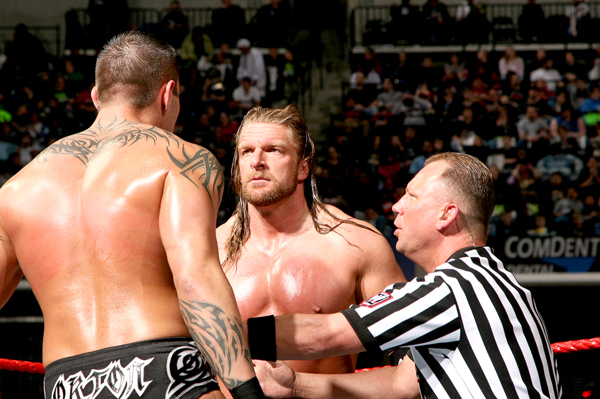
Evolution was a great idea and, ultimately, a massively effective stable.
The idea was to position Ric Flair as the wily genius mentor, Triple H as his modern great best in the world successor, and Batista and Randy Orton as their successors. It worked and it didn’t. The actual week-to-week experience was often drab and overlong. Triple H was no Ric Flair, which is an understatement. But Batista did get over to a massive extent, and Randy Orton, even if through longevity alone, joined him eventually.
The big split was mooted to happen at Royal Rumble 2004 - but, in a premonition of 2024, the Rock got in the way of the original plans.
The idea of Triple H and Orton falling out en route to a showdown at WrestleMania 20 was discussed, but the Rock was persuaded to work what would be his last match for seven years. Instead, as a result, Evolution remained intact and defeated the reunited Rock n’ Sock Connection.
In truth, this was probably a combination of the Rock needing a match, and the reality that it was too soon to split up Evolution. Orton was not ready. He needed the Cactus Jack match at Backlash to establish him as a main event-level threat. In the inverse scenario of 2024, though, it wasn’t the Rock who destroyed anything.
Triple H undermined Orton, and badly, throughout their delayed summer series, meaning the Cactus Jack match might as well have not happened. Orton would have been better off selling his soul to the Rock and going 50/50 with R-Truth.
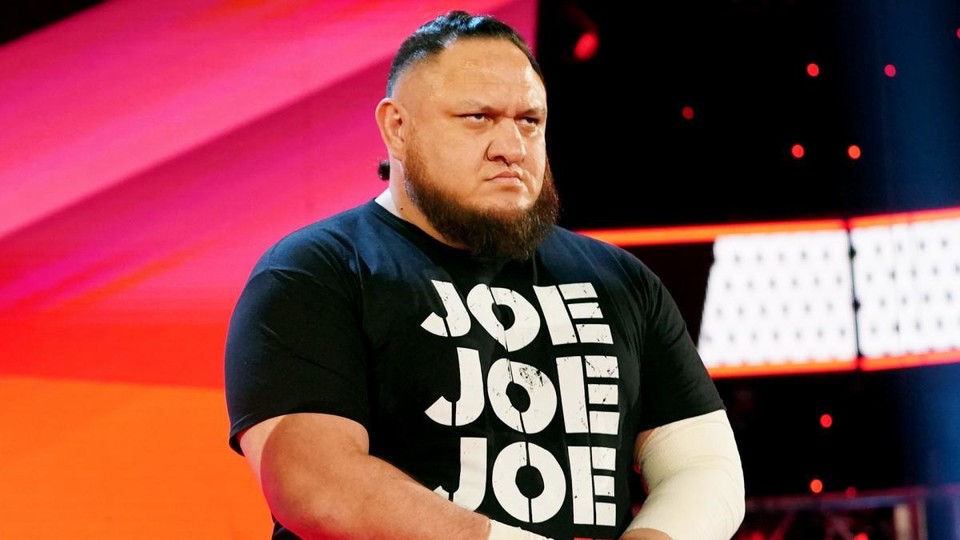
2005 - Samoa Joe Was Offered A Spot In The Royal Rumble…Sort Of
In a strange chapter of his career, Mick Foley turned up in Ring Of Honor in late 2004 as something of a regular.
When he wasn’t using the promotion as a vehicle with which to vent his frustrations over Ric Flair, he built feuds that would never get a payoff. He also turned face after playing a promising heel character with little in the way of explanation.
Riffing on his ECW days, Foley played a guy who put over WWE as the be-all, end-all. This was smart, in that the ROH fans flocked to the promotion precisely because WWE was so wrestling-phobic in their eyes, but it was a diminished return - nowhere near as effective as the Hardcore Legend grabbing headlocks to genuinely infuriate the ECW arena ultras.
In a January angle, one of Foley’s better efforts, he initiated a feud with Samoa Joe. Foley said he’d wrestle Joe - but only in WWE for a six-figure payday. Foley also said that he could hook Joe up with a spot in the Rumble. Foley just needed to make the call to the main man: Brian Gewirtz. That was a funny line. Deeper into the worked shoot promo, Foley said Joe would have to tone his stuff down, eat fish, and perform a Stinkface if he was going to make the jump.
The angle ended with Foley cracking Joe with a mic and a chair before blasting him with the double-arm DDT. He didn’t get much heat; the fans still liked him.
In reality, this was not sanctioned by WWE, nor was the promotion interested in Joe’s services at the time: according to Bruce Prichard, Vince McMahon deemed Joe “a big fat Samoan”.
2006 - Vince McMahon Was As Chaotic And Desperate As He Ever Was
2005 wasn’t a great year for WWE; as incredible and multifariously productive as the record-setting WrestleMania 21 was, the move back to USA Network did not result in a rights fee increase of any significance. New stars were made - John Cena, Edge, Batista - but the other performance indicators weren’t all that impressive, either.
Raw ratings were a marginal improvement over the Spike average - but Dave Meltzer calculated that, if you removed the Homecoming special and Eddie Guerrero tribute shows, the average USA number was lower. House show business was only superior to 1993, ‘94, ‘95, and 2004. 2003 was considered a terrible year for this revenue stream, and WWE failed to match it even with increased overseas touring inflating WWE’s true popularity. International buys again masked poor domestic performance on PPV relative, somehow, to 2004.
Business wasn’t great, and Vince didn’t seem to want to actually put the belt on Rey Mysterio; despite his Rumble triumph, the original plan, which was obviously abandoned, was for Randy Orton to take his shot at No Way Out.
This panic extended further; according to the February 6 Observer, Meltzer reported that Vince, amid his dithering over the Rumble match, reached out to no less than four bonafide legends in a bid to pull a monster number for WrestleMania 22.
Vince called Bret Hart, who didn’t want to work a storyline based on Survivor Series 1997; that would not happen until 2010. The Rock didn’t even want to cut a promo in 2006. Vince wasn’t on good terms with Steve Austin, who was pissed at Vince’s treatment of Jim Ross and the way in which his mooted November ‘04 comeback was handled. Hulk Hogan wasn’t happy with the list of opponents Vince pitched.