7 Exact Times Wrestlers Got Their Spot TAKEN
When the sport of pro wrestling, with relegations and promotions, actually gets real.
In 2026, across both WWE and AEW, the idea of grabbing and controlling the top spot drives the narrative forward more so than betrayals and vengeance and classic tales of bloody hatred.
This was the premise of the CM Punk Vs. Roman Reigns match heading into night two of WrestleMania 42. While the two men did express their contempt for one another at various points, they mainly feuded over their suitability for the top spot. Punk complained that Roman wasn’t around enough to warrant it; Roman countered that Punk is too old and too likely to self-implode. Roman wanted to reclaim his place at the head of the table. Really, Roman has been telling variations of this story for almost six years.
Meanwhile, in AEW, Swerve Strickland outright told Hangman Page that he was coming for “the spot you don’t even want”. This one at least mutated into a proper blood feud, but elsewhere, the “feeling” of AEW and who is best positioned to “restore” it drives storylines as much as intense personal conflict.
Value to the brand and the desire to represent it: this is the new pro wrestling vernacular. We have moved away from the “personal issues draw money” maxim and into the field of business studies. To be the top guy is not to become the World Champion in the company that happens to contract you; it’s to be a mascot for that company. And to get to the top, you must not beat your competition in a fight, but prove more popular and reliable.
While this stuff is often a total eye-roller, it’s believable, at least. This sort of thing is not without real-life precedent…
7. Shawn Michaels > Bret Hart (WWF Raw Is War, August 11, 1997)
SummerSlam 1997 was the peak of Bret Hart’s seminal run in the WWF.
Emanating from the New Jersey Meadowlands on August 3, Bret won his fifth and final Winged Eagle at the expense of the Undertaker. At the finish, he had ducked a wild chair shot launched at him from on and offscreen nemesis Shawn Michaels. ‘Taker absorbed the full, gruesome impact, leading to his defeat. This sparked an incredible feud between Shawn and ‘Taker, and Shawn’s legendary character shift into full degenerate territory. Meanwhile, roster depth was shallow. Bret had to work the Patriot.
The Patriot was an anachronistic, one-dimensional character defined entirely by his love of the U.S.A, and only existed, conveniently, because Bret Hart didn’t like the U.S.A. The Patriot had already defeated Bret on the July 28 Raw as a result of Shawn’s interference as a means of building him up for a pay-per-view loss to Bret Hart, but it was Bret who was defeated in this programme solely by it happening in the first place.
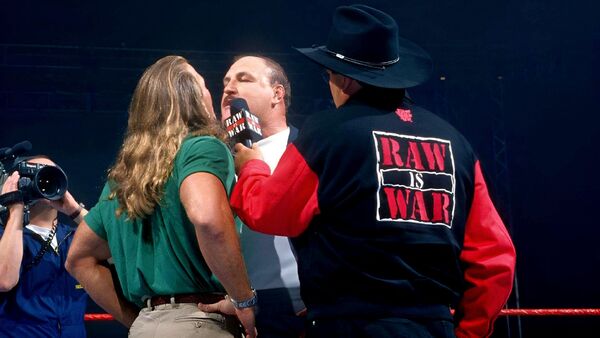
On the August 11 Raw Is War, the build to In Your House: Ground Zero progressed when the Patriot, alongside Ken Shamrock, defeated Hart Foundation members Owen Hart and the British Bulldog. This seemed to rattle Bret, who, fearful of the Patriot’s growing “momentum”, attacked him later in the show. The Patriot wasn’t even a New Generation-coded act; when he was onscreen, with his yokel cornball ranting, 1997 felt like the desperate jingoism of 1991. Shawn, in contrast, was grabbing the zeitgeist.
Fans gravitated towards his new proto-Attitude Era act because he felt like a real human being - and Shawn was in essence playing himself, a troubled, obnoxious, ultra-cocky tyrant. Shawn was mesmerising in his performance on the same edition of Raw. Slowly forming the group that would become known as D-Generation X, by hyping the “insurance policy” that later revealed himself to be Rick Rude, Shawn cut a promo to open the show. Cheered initially, he drew the desired response almost immediately with his smug aura, and when some fans chanted “Shawn is gay”, Michaels responded by saying: “Why don’t you ask your mama how gay Shawn Michaels is?”
Shawn was then interrupted by onscreen authority figure Sgt. Slaughter. Michaels was unbelievable here, laughing in the man’s face and, debuting a classic bit, wiping away what he sold as Vesuvius-levels of spittle firing out of Sarge’s mouth. Shawn was never better when playing off an earnest geek whom he could eat alive.
The problem for Bret is that, starting from this very episode of Raw, he was a geek, too.
6. Daniel Bryan > CM Punk (WWE Raw, July 15, 2013)
This entry isn’t meant to undermine CM Punk’s first WWE run. It was obviously incredible, so studded with iconic moments and ultra-rare actually good storylines for that era of the promotion that fans did in fact chant his name years and years after he left in January 2014. But the thing is, the ‘Summer of Punk’ wasn’t quite as hot as you might recall - certainly nowhere near hot enough to justify altering the philosophy of the company, or even pushing Punk ahead of John Cena.
Money In The Bank 2011 (205,000 buys) was actually outdrawn by Money In The Bank 2012 (206,000) and 2013 (223,000). Unlike the hit Nexus angle, Raw ratings actually fell to the lowest non-holiday numbers in months following the June 27 ‘Pipebomb’ promo. It was the most captivating thing to happen in the eyes of hardcore fans for years and years - but WWE perhaps has a point when they say that they shouldn’t cater to us.
Punk was an amazing heel in WWE, and is worth more to the company in 2026 than Daniel Bryan ever was - but Bryan was the more over babyface (eventually) in the early 2010s. Punk was always a little bit snarky even in the face role, and positioned himself as an outsider in and to the company. Bryan, less driven and spiteful and more relaxed, seemed happy enough to go along with WWE’s brand of daftness - and Bryan’s Team Hell No act with Kane was a high water-mark for that genre. Is this embrace of sports entertainment - Punk would never have done something like the Yes! chant unironically - why WWE fans opted for Bryan in 2013?
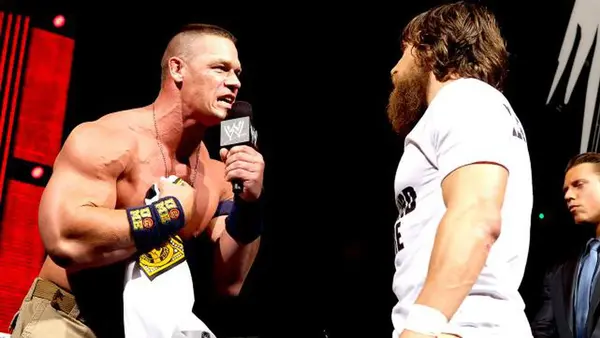
Both Bryan and Punk were babyfaces by that point. What’s interesting is that Bryan turned face in the autumn of 2012; Punk returned as a babyface at Payback in June 2013. Usually, the newest thing is the coolest - but Bryan had caught fire to such an extent that he was significantly more over. This was recognised on the July 15, 2013 episode of Raw, on which John Cena cut a promo. He said he needed help from the crowd selecting his opponent for SummerSlam, in order to make it the biggest show of its kind. Cena had a bit prepared, where he polled the crowd on a number of rubbish choices, like Jinder Mahal and Heath Slater, but he could barely get started. The fans chanted Bryan’s name immediately. When Cena finally issued the challenge to Bryan, the fans exploded. Bryan was the only possible choice.
Punk himself is well aware that Bryan took his spot as the best hardcore fan favourite in the sports entertainment company. On the infamous episode of Colt Cabana’s Art of Wrestling podcast, Punk said it “boggled” his mind that Bryan had not been “figured into [WWE’s] plans for WrestleMania 30 because this is his f*cking year”.
5. Bret Hart > Lex Luger (WWF Superstars Taping, February 22, 1994)
Vince McMahon always reverted to type.
The man actively tried to re-sign the Ultimate Warrior in December 1997. If you look at the leaked contract, it’s sobering. The date on the letterhead is December 17. This was after Vince’s big dawn of the Attitude Era address, in which Vince acknowledged that the fans were tired of “good guys versus bad guys”. Can you imagine Warrior playing with shades of grey, trying to add range to his character, as was the style at the time? That would be like Terrence Malick trying to direct Steven Seagal.
It makes an awful lot of sense, then, that Vince would opt to push Lex Luger over true fan favourite Bret Hart as 1994 began. While this is a gross oversimplification, Vince was mostly gross and simple man: Luger had a more muscular body and better resembled a star superficially.
Vince spent much of the declining 1990s trying to relive the glory days of the 1980s, and Lex Luger, with his action movie physique and newfound patriotism, was a mulletted coping mechanism. While neither man was doing truly impressive numbers, Bret remained very popular with live crowds. McMahon thought Luger had the higher ceiling. Undecided, Vince booked a novel finish to the 1994 Royal Rumble match, in which both Luger and Bret toppled to the floor at the same time and were named as co-winners. This while creative was convoluted, and only served to buy Vince some time to make the choice.
Like the vast majority of his peers, Bret is an unreliable narrator; while his memory is shockingly photographic by the standards of a wrestler, his ego is hilariously large. So when Bret says that this whole deal was a weekly popularity contest, the winner of which would go on to defeat Yokozuna at WrestleMania 10, it makes him look good because he of course won it. Bret’s version of events does not account for the various whispers surrounding Luger at the time. Did Lex have an ego problem? Did he get drunk in a bar and brag that he was about to win the belt, infuriating Vince?
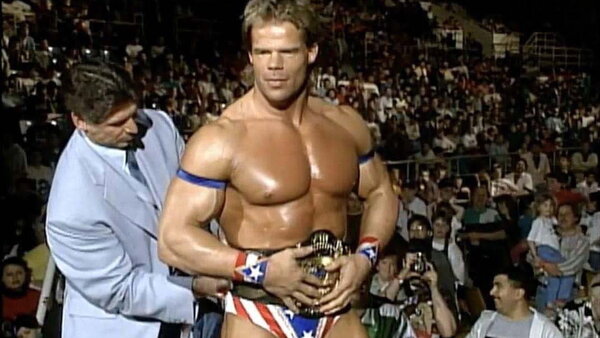
However, Bret has back-up in the form of Sean ‘The 123 Kid’ Waltman, who claimed in an old Kayfabe Commentaries shoot interview that Bret’s story is pretty much accurate. In an unaired segment on the February 22 Superstars taping, footage of which has since been unearthed, Lex Luger said to Yoko’s manager Jim Cornette that he wanted to try the winged eagle belt on, just to see how good he’d look with it wrapped around his waist. Luger even performed his entrance, as if he’d just actually won it. Per Waltman, this strange angle was designed so that Vince could literally visualise what company Ace Lex Luger would look and sound like. While Lex drew mild cheers for wearing the belt, the entrance was embarrassing.
The entitled weirdness of the angle probably explains the flat reaction, but the fans evidently were not clamouring for this vision of the future.
4. Goldberg > Bret Hart (WCW Monday Nitro, April 20, 1998)
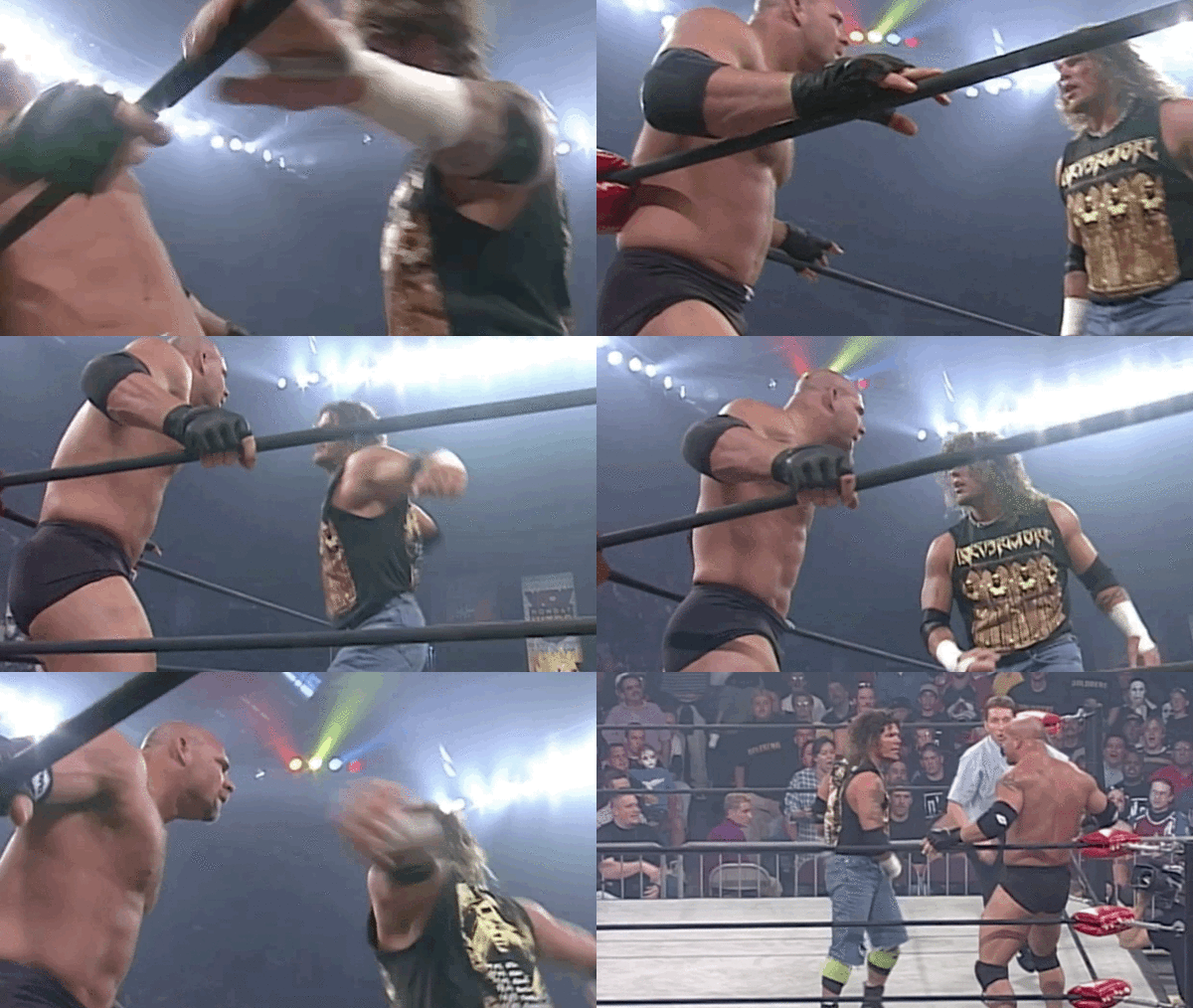
Bret Hart will tell you, and everybody else, over and over and over and over again, that Goldberg robbed him of his pro wrestling career. The conversation turns to this topic constantly. It doesn’t matter what Bret is talking about; he could be chatting about footwear, and then something will light up in his mind, and he’ll say “Yeah, and on the subject of boots, Bill Goldberg ended my career when he booted me in the head”. You could also argue that Goldberg took Bret Hart’s spot, too.
While Eric Bischoff by his own admission did not know what to do with Bret Hart, surely, at some point in 1998, he should have won the WCW World title. Bret was the best wrestler in the world in 1997, and the most coveted free agent ever. In the days leading to Starrcade 1997, it was not unreasonable to expect the short-term lineage to go something like: Hollywood Hogan > Sting > Some Heel Or Other > Bret Hart. This is not how it panned out.
Bret’s WCW run was a total disaster, but after the Starrcade debacle, in which he was cast as the special guest referee for the match between Eric Bischoff and Larry Zbysko, things were somewhat promising for a little while. His win over Ric Flair at Souled Out was a luxurious (and heavily promoted) wrestling match, a neat alternative to the mostly dire action over in the post-Bret WWF. The pay-per-view drew 380,000 buys - at that point, the third-highest number in WCW history. Watching Bret Hart simply be Bret Hart didn’t last as a concept; his match against legendary rival Curt Hennig, at Uncensored, was a bleak and dated diminished return. Bret was damned, twice over, on the April 20, 1998 episode of Monday Nitro.
Bret himself turned heel, gifted Hollywood Hogan the World title in the main event against Randy Savage, and joined the New World Order as an “associate”. He was never going to be the top heel, of course. That was Hogan’s spot. The top babyface spot was also taken that very night.
The total sensation that was Bill Goldberg won the United States title from Raven in an absolutely fantastic TV wrestling match, in which he blasted through every member of the Flock and merely shrugged at several weapon shots. Goldberg was so awesome and so over that he outgrew the title the very second he actually won it: he was booked to defeat Hogan for the World Heavyweight title on the July 6, 1998 Nitro, after which he immediately vacated the secondary prize.
As Goldberg shot up the card, he and Bret Hart switched places; Bret defeated Diamond Dallas Page for the vacated U.S. title a fortnight after Goldberg’s World title win.
3. Hulk Hogan > Triple H (WWF WrestleMania 18)

The best (or at least the most effective) wrestlers are those who are able to make it look simple.
Triple H went down with a torn quadricep muscle on May 21, 2001, in the midst of an all-time great TV match alongside Steve Austin against Chris Jericho and Chris Benoit. Triple H had peaked as a heel, and, having earned the respect of the fans through an extraordinary 18 month run, was positioned to return as the top babyface. The WWF hype machine pushed its processing power to the very limit by documenting Triple H’s long and arduous recovery process in video packages played on Raw. Triple H had winced through an agonising injury to complete the classic tag match. He had worked for months to come back in even better shape for you, the fans. He made his comeback in what was then the most boisterous arena in the world, Madison Square Garden, on January 7, 2002. The ECW/WCW Invasion was dreadful, but fear not: the best wrestler in the land was back, and you were permitted to adore him. Hulk Hogan scooped his heat by flexing his trapezius muscle in a pose that lasted all of a few seconds.
There’s obviously more to it than that - the fans at WrestleMania 18 were high on nostalgia and immortal star power, ecstatic that their childhood hero had returned after a nine year-long lifetime - but March 17, 2002 was still a damning indictment of Triple H, who never became a truly beloved top star babyface even when Hogan was no longer around.
At ‘Mania 18, in the most effective masterclass in wrestling psychology this century, Hogan surfed that wave with his expert body language to become possibly the most over man in any building ever. Triple H, meanwhile, simply did not have the magic or the dynamism or the soul to even approach a comparable level of performance: his Undisputed title win over Chris Jericho was a crushing, flat bore of a main event.
At the very next pay-per-view, Hogan defeated Triple H for the belt. The match was awful and the magic had waned instantly - Hogan lost the title to the Undertaker in less than a month - but Triple H didn’t get the spot back, either. He turned heel ahead of a SummerSlam match against Shawn Michaels, a role he subsequently played for four more years.
2. Toni Storm > Saraya (AEW Dynamite, August 30, 2023)

If you squint, you can half-see what on earth Tony Khan was thinking by pushing Saraya so hard in AEW.
A lot of people wanted the former Paige to make a comeback. She was a popular “better than the Divas” pre-Women’s Revolution wrestler in WWE, and for empathy’s sake, she was forced into retirement in her twenties. Also, from Khan’s perspective, Saraya was the subject of a modest box office and critical hit movie, 2019’s ‘Fighting With My Family’, produced and heavily promoted by Dwayne ‘The Rock’ Johnson. There was potentially some further name value in Saraya there. This all made for a nice story, if not a good run.
Saraya was not good at all in AEW. While her shock debut at Grand Slam 2022 went down well, she almost immediately accidentally said that the division was awful and needed saving, and then, ironically, just as quickly became the worst part of it. The trash-talk was horrendous - “Well, Doctor, your name rhymes with sh*t!” she said to Britt Baker - and her in-ring performances were slack and generic. Khan in his defence quickly turned Saraya heel, but her shrill promo style was quintessential go-away heat. Saraya was awarded with the Women’s World title at the first All In: London, in a four-way match against Toni Storm, Hikatu Shida and Britt Baker, though even her home country fans were hardly gasping for it. This established her as the top star, nominally, in the division. This spot was re-taken in almost record time by former occupant Toni Storm.
Storm had already started to flirt with a golden age of cinema look, wearing a medium-length swirl of curls at All In. The black-and-white tron had also debuted. But on the very next Dynamite, Storm, in the tizz that marked her descent into madness, drew an enormous belly laugh - which sparked her ascent as the top women’s star and the funniest person in all of wrestling. “It’s safe to say that Wembley went tits up!” she said to a corpsing Renee Paquette.
That also rhymed with Britt, but it was infinitely funnier.
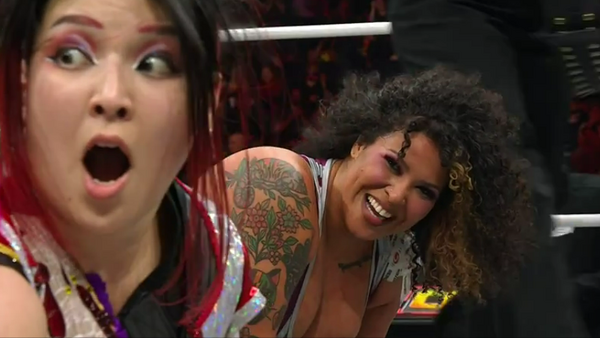
1. Willow Nightingale > Hikaru Shida (AEW Collision, April 2, 2026)
For a long time, Hikaru Shida was the ever-reliable stalwart of the AEW Women’s division.
Shida was prone to entering uneven performances, and her supposed hard-hitting style often looked a bit limp, but she was very expressive and passionate, seemed like the proverbial good egg, and weak strikes aside was still the most consistent full-time member of the division before the likes of Toni Storm and Mercedes Mone raised its ceiling (if sadly not its allotted TV time). Fans appreciated Shida’s efforts in bringing along Dr. Britt Baker - their April 8, 2020 Dynamite ripper was so good and bloody that it set Britt’s slow-burn face turn in motion - and recalled a tremendous over-delivery against Penelope Ford at Fyter Fest that same year. Shida was belatedly rewarded for her efforts in building the division when, as a more sporadic presence on AEW TV, she was able to enter the first All In: London as AEW Women’s World champion by virtue of dethroning Toni Storm on the August 2, 2023 edition of Dynamite.
Shida was, in short, a sentimental fan favourite, infrequently parachuted into the title picture when the World champion needed a credible challenger who guaranteed a baseline of match quality (or when the championship itself required a transitional holder).
This all started to falter at All Out 2024, when Shida returned to do a job for TBS Champion Mercedes Mone. In a sad scene, nobody cared a great deal. This wasn’t Shida’s fault, per se - it’s more that booker Tony Khan was lazy, and expected fans to care about Shida based entirely on her past contributions. This became all the more apparent on the April 2, 2026 Collision, when Khan once again brought Shida back without actually bothering to promote her. Shida’s match mostly just existed. The AEW fanbase weren’t cruel, or anything, and Shida did elicit a polite reception; they’d simply moved on.
Also, it’s exceptionally difficult to be the sentimental favourite when the competition for that spot is the inordinately wholesome Willow Nightingale.